Alaska family has owned a 115-acre farm since 1948; as housing spreads nearby, they make sure the land can never be divided for development
The Grover family has safeguarded their 115-acre farm in Alaska, ensuring it remains protected from housing development through a permanent conservation easement, preserving essential agricultural land for future generations.
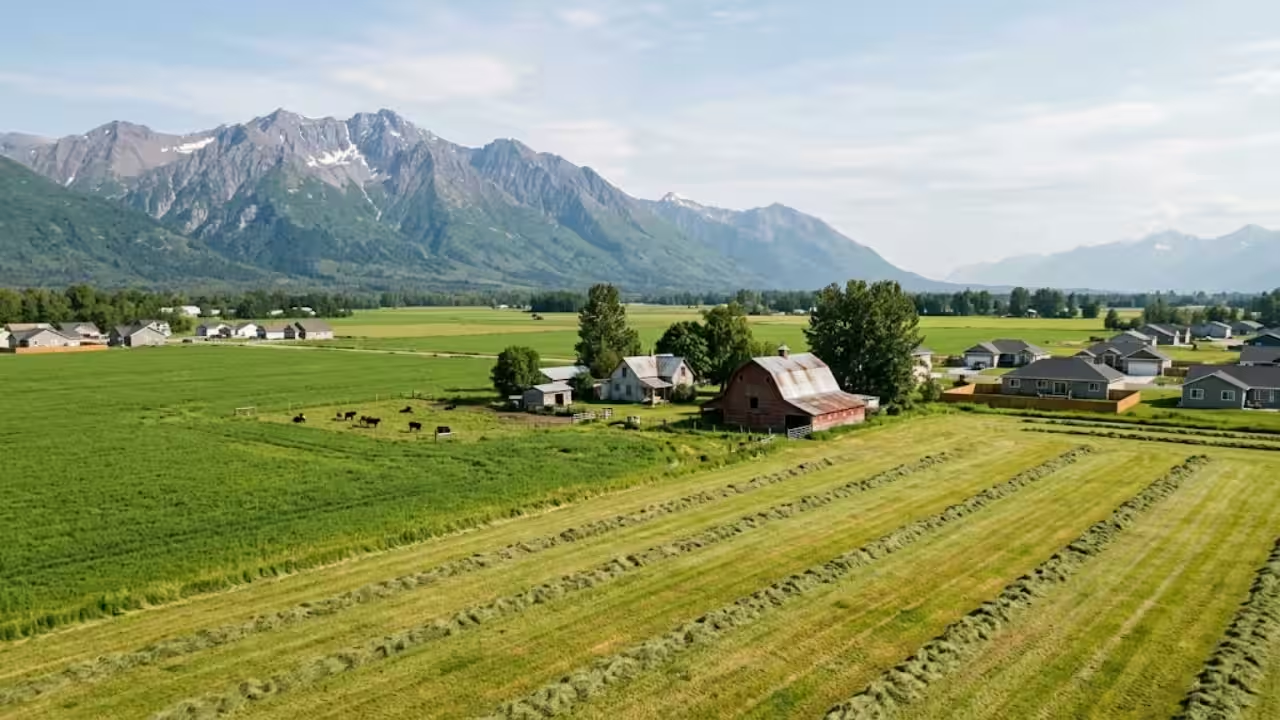
Housing and agriculture compete for productive land throughout southcentral Alaska's Matanuska Valley. As Palmer grows, development increasingly puts pressure on farmland that could otherwise remain in agricultural production. It is extremely rare for a field to resume producing food after it has been paved over and built on. In June 2025, one local family took steps to protect its farm from that possibility.The 115.22 acre Grover Farm in Palmer was permanently protected through an agricultural conservation easement that closed on June 13, 2025. Clifton and Vera Grover established the farm in 1948, and their family still owns the property. Under the agreement, the family received financial compensation for permanently giving up development rights, meaning the land cannot be subdivided or paved over for housing. The project involved the Alaska Farmland Trust and the US Department of Agriculture's Natural Resources Conservation Service (NRCS). Wesley Grover said he had spent about five years working with the trust to secure the agreementA family farm since 1948The Grovers' story began in November 1948, when Clifton and Vera Grover moved to the Matanuska Valley and began farming the property. Wesley Grover recalled that the family initially planted oats, peas and vetch, which they used for hay and silage. He described the soil as excellent and stressed its importance to farming. "You need the land to plant the crops, you can't get that any place, they don't make any more of it," he said.Over the decades, the farm changed with the family's circumstances. It began as a dairy operation and later shifted to cattle production. The family also started leasing portions of the property to other local farmers, allowing the land to remain in agricultural use as the operation evolved.The trust’s board president, Leslie Senden, says the property holds about 15 feet of topsoil and sits close to markets, which makes it well placed for food production. Senden also counts it among the best soils in the state on the Springer system in Palmer. At the signing ceremony, Wesley and his wife Bonnie were joined by four of their grown children. A signature, though, is only the start of the story. What keeps the promise in force is the legal tool behind it.How the easement worksThe Alaska Farmland Trust's voluntary programme allows landowners to retain ownership while permanently giving up specified development rights. The Grover family still owns the farm, but it can no longer be divided into residential lots or paved over for housing. Agricultural activities can continue under the terms of the easement.Federal support for agricultural easements comes through the Agricultural Conservation Easement Program (ACEP). Its Agricultural Land Easement component helps protect working farms by limiting nonagricultural development. For eligible projects, NRCS may contribute up to 50 per cent of the fair market value of the agricultural land easement. The programme works with land trusts and other eligible partners that hold and manage these agreements.The easement remains effective beyond the current owners' lifetimes. Future owners will also have to follow its restrictions if the property changes hands. The Alaska Farmland Trust monitors protected properties at least once a year to check that land use complies with each agreement. If a violation occurs, the organisation can take steps to enforce the restrictions.Why Palmer’s farmland mattersDevelopment pressure continues to affect farmland across the Matanuska Valley. Margaret Adsit, the trust's lands coordinator, said agricultural properties were increasingly being converted into housing and other nonagricultural uses. "The time to act is now. Once it's gone, it's gone for good," she said.When the Grover easement closed in June 2025, the Alaska Farmland Trust had protected 519 acres in total as it marked its 20th anniversary. The 115.22-acre Grover Farm therefore accounted for more than a fifth of the acreage the organisation had conserved at that time. The trust also operates its FarmLink programme, which connects farmland owners with aspiring farmers to help keep protected properties in active agricultural use.The easement also has a food supply dimension. Alaska Farmland Trust board president Leslie Senden said the farm has about 15 feet of topsoil and lies close to markets, making it suitable for continued food production. The trust and NRCS described its protection as part of a broader effort to keep productive agricultural land available to feed future generations of Alaskans. For the Grover family, the agreement protects more than seven decades of agricultural history. The property remains privately owned, but its development rights have been permanently retired, allowing future generations to keep using the land for farming rather than residential construction.You use AI every day. Now get your AI Quotient. Take the AIQ test.
Topics in this story
Gathered from external sources. Rights to this text belong to whoever originally published it.