Why families are being urged to look closer on autumn walks
Experts urge families to spot, photograph and enjoy autumn fungi on their doorstep.
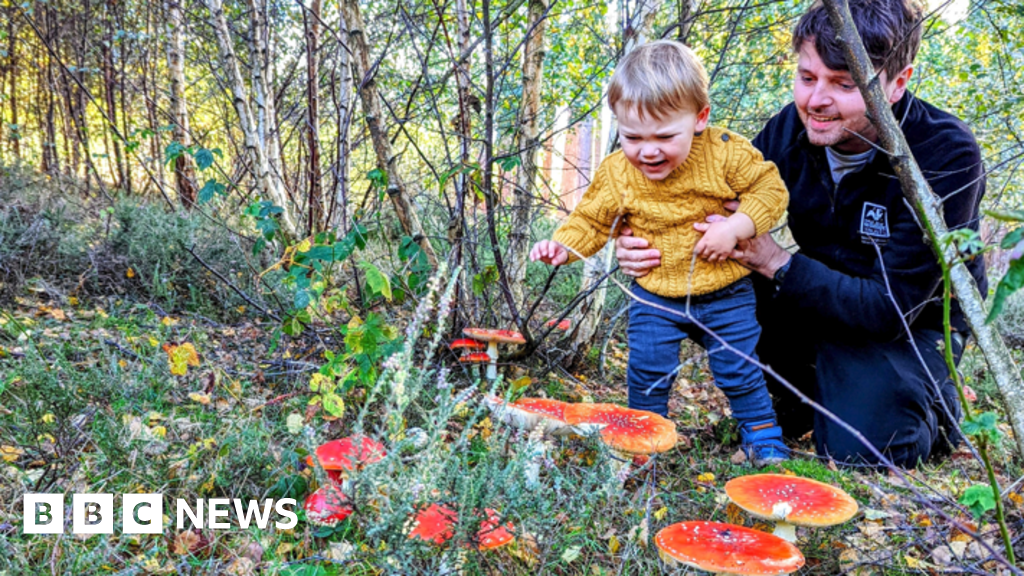
From fairytale toadstools to fungi that look like birds' nests, experts say some of Britain's most unusual mushrooms are beginning to emerge as autumn arrives.
Hidden in parks, woodlands and nature reserves, species ranging from the bright-red fly agaric to the rare red cage fungus can be found by anyone willing to slow down and take a closer look.
For James Benwell, of the Birmingham and Black Country Wildlife Trust, searching for fungi has become a way to explore the outdoors with his young son.
He said mushroom spotting can transform an ordinary walk into an adventure, revealing colourful and unusual species that many people pass by without noticing.
Across the West Midlands, fungi enthusiasts have recorded everything from tiny bird's nest fungi in Birmingham city centre, to fly agaric mushrooms growing beneath woodland birch trees and a rare red cage fungus discovered in Cannon Hill Park.
Many species can go unnoticed among fallen leaves, rotting wood and the bases of trees, but Benwell said taking the time to look more closely opens up a hidden world.
"Every walk becomes interesting and exciting if you're exploring and if you're looking for new things," he said.
With more than 15,000 species of fungi found in the UK, experts are encouraging people to photograph and record what they find, rather than pick them.
Interest in fungi has grown in recent years, according to Lucas Large, chairman of the West Midlands Fungus Group, who said the organisation regularly attracted newcomers to its activities and fungi forays.
Benwell added one of the attractions was the variety of shapes, colours and forms that can be discovered throughout autumn.
"Sometimes you've just got to look through the leaf litter a bit, and you'd be amazed at the colours and different shapes and sizes of mushrooms you can find when you do look," he said.
Among the most recognisable species is the fly agaric, the striking red mushroom covered in white spots that has become closely associated with folklore and popular culture.
Benwell described it as "the mushroom of fairy tales".
"It's in Alice in Wonderland, it's in Super Mario Brothers... It's everywhere as part of fairy tales and folklore," he said.
"But there are still adults who've never seen it."
Other species offer equally unusual sights. Bird's nest fungi resemble miniature nests complete with tiny eggs, while the rare red cage fungus forms a vivid crimson lattice structure.
The latter was spotted in Birmingham's Cannon Hill Park last year, in what Benwell said was only the second recorded sighting of the species in Birmingham and the Black Country.
"UK-wide, you're only talking hundreds of records ever. It's not a common species at all," he said.
Large said the red cage fungus also had another notable characteristic.
"It smells horrible," he said, explaining the fungus attracts flies which help spread its spores.
After more than a decade studying fungi, Large said the rarest species he had seen in the region was the coral tooth fungus.
"It formed this enormous kind of white, coraloid fruiting body," he said.
While the colourful displays may encourage people to learn more about fungi, experts are warning against assuming wild mushrooms are safe to eat.
Several species found in the UK can cause severe illness or death if consumed, including the death cap mushroom, which the Woodland Trust says is responsible for most fungus-related fatalities.
Large said there was no foolproof shortcut to determining whether a mushroom was poisonous.
"The only way to do it is to know which one it is, or be sort of certain that you've got a particular species," he said.
Benwell agreed and said people without specialist knowledge should avoid picking wild mushrooms.
"There are mushrooms that will harm you, that will make you sick or even kill you in this country," he said.
"The best place to get your mushrooms if you want to eat them is the supermarket."
Instead, people are encouraged to enjoy fungi where they are found, whether in Birmingham city parks, the woodlands of Cannock Chase, Sutton Park or the Wyre Forest.
When searching with his son, the pair follow a simple rule.
For Benwell, that approach allows families to enjoy the excitement of discovery while ensuring the region's remarkable fungi can be appreciated by everyone who passes by.
Follow BBC Birmingham on BBC Sounds , Facebook , X and Instagram .
Internet fungi foragers told 'click, don't pick'
Foragers warned not to pick forest's mushrooms
Sign of life as bright orange 'fire fungus' grows at park ravaged by wildfire
Birmingham and Black Country Wildlife Trust
Topics in this story
Gathered from external sources. Rights to this text belong to whoever originally published it.