At 60, French artist Robert Tatin began a 21-year sculptural project around his home, filling the grounds with towering painted-cement figures, gates and gardens
Discover the remarkable journey of French artist Robert Tatin, who at 60 years old, transformed his hamlet in Mayenne into a mesmerizing sculpture garden over 21 years, showcasing towering figures and painted cement works. Learn about Tatin's legacy and the ongoing evolution of the Musée Robert Tatin.
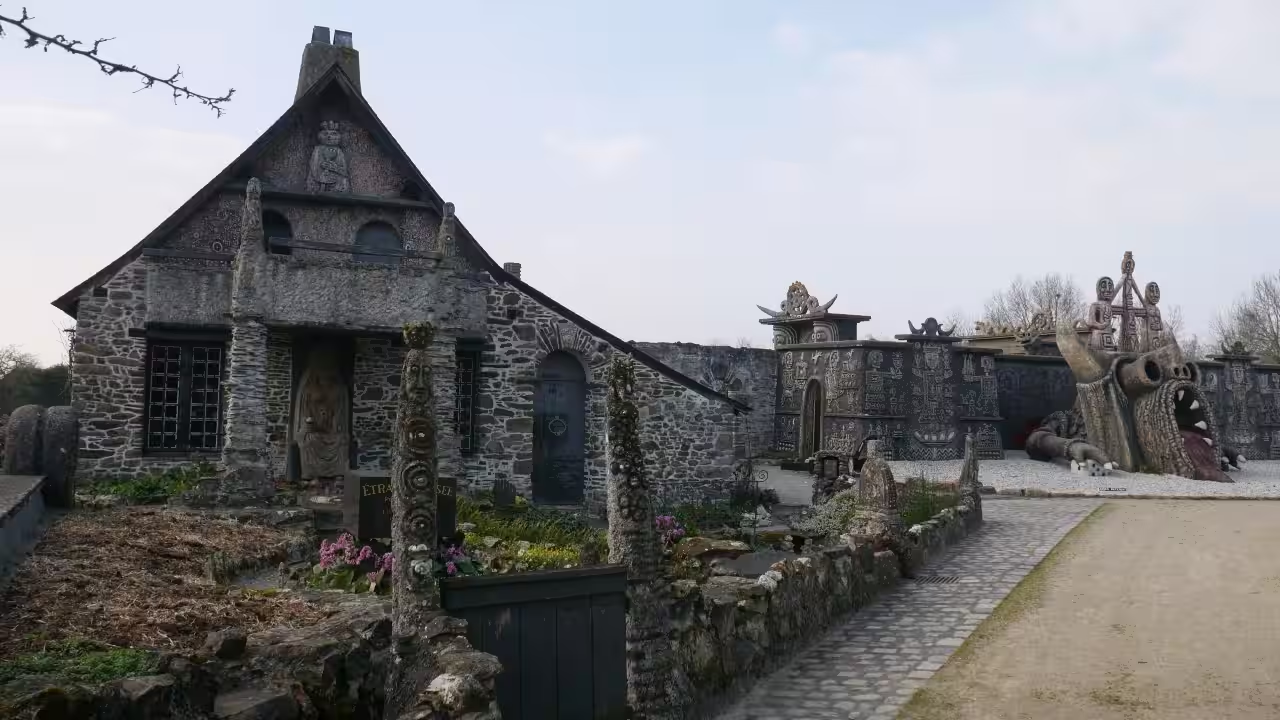
Most artists have a peaceful studio ahead of them and a lifetime of work behind them when they reach 60. French painter and ceramicist Robert Tatin decided to start the largest undertaking of his life at that very moment. He moved to La Frénouse, a small hamlet in the Mayenne area of western France, close to the town of Cossé-le-Vivien in 1962. Over the course of the following 21 years, he covered the grounds surrounding his home with imposing painted cement figures, gates, and gardens. The outcome is what tourists today refer to as the Musée Robert Tatin, one of France's most peculiar art places.The Musée Robert Tatin itself informs us that at the age of 60, Tatin conceived and launched a gigantic sculptural project surrounding his dwelling. He drew on his experience with the builders of Brasília and technical developments in reinforced cement mortar to produce what the museum calls an arch sculpture, built over 21 years from several ideas and drawings.A life before the gardenTatin was born in 1902 and originally became renowned as a ceramist; it was modelling clay that gained him his early recognition. He had come to art via painting and had travelled much. The museum’s biography says Tatin left France for South America in 1950 and returned in 1955. He spent several years on the French Riviera before settling permanently in Mayenne in 1962, where he began developing the monumental sculpture garden. In France he perceived the landscape in front of his villa at Mayenne as a sort of promised land.He wasn’t a lone wolf. His wife Lise was heavily involved in the building, and the museum says that the couple had a sewing workshop on the first floor of the house from 1968 until 1976. Tatin aspired to build a global language, a bridge between East and West, and soon the first painted cement sculptures appeared in what he dubbed the Garden of Meditations.Giants, gates and a gardenTatin created the Allée des Géants as the approach to the site, lining an avenue almost 80 metres long with 19 monumental painted-cement statues. The figures represent people from his artistic and historical imagination, from Joan of Arc to Alfred Jarry. On the museum’s façade, the Gate of the Giants displays large high-relief portraits of artists he admired, including Rembrandt, Van Gogh, Leonardo da Vinci, Goya and Delacroix. Raw Vision and SPACES document these features as part of the site’s design.Beyond the avenue is the Garden of Meditations, some 500 square metres in area. It goes from the Sun Gate (representing the sunrise) to the Moon Gate (representing the sunset). In the centre is a 6.5 metre statue of the Lady of All the World, and structures representing the twelve months around a small pond. Rooms off the garden show Tatin’s paintings, ceramics and lithographs.The complete site has often been compared with the Ideal Palace erected by postman Ferdinand Cheval in the Drôme, and the resemblance is appropriate. Both were the work of one determined man, built over many years out of whatever materials and with whatever techniques were at hand. By the time Tatin died in 1983, he had spent more than two decades shaping the site into a distinctive art environment.A museum that keeps growingThe museum’s history records that after Tatin’s death in 1983, the property passed into public hands. It became an official Musée de France in 2002, and in 2012 the house where Robert and Lise lived received the Maison des Illustres label from France’s Ministry of Culture. The original sculptural ensemble is considered complete, while the wider museum experience continues to develop through temporary exhibitions in La Grange and contemporary sculptures displayed across its five hectares of gardens.The residential and sculptural elements reflect Tatin’s vision of a village of living, moving artisans. His legacy is a reminder that ambition need not end at 60 years of age. Tatin started late, laboured for more than twenty years and developed a destination that still draws visitors in a secluded part of Mayenne.You use AI every day. Now get your AI Quotient. Take the AIQ test.
Topics in this story
Gathered from external sources. Rights to this text belong to whoever originally published it.