In 1994, Yellowstone began removing invasive lake trout; by 2024 crews had taken out over 4.9 million as native cutthroat trout showed signs of recovery
Yellowstone Lake and the Yellowstone River support the largest remaining inland population of Yellowstone cutthroat trout.
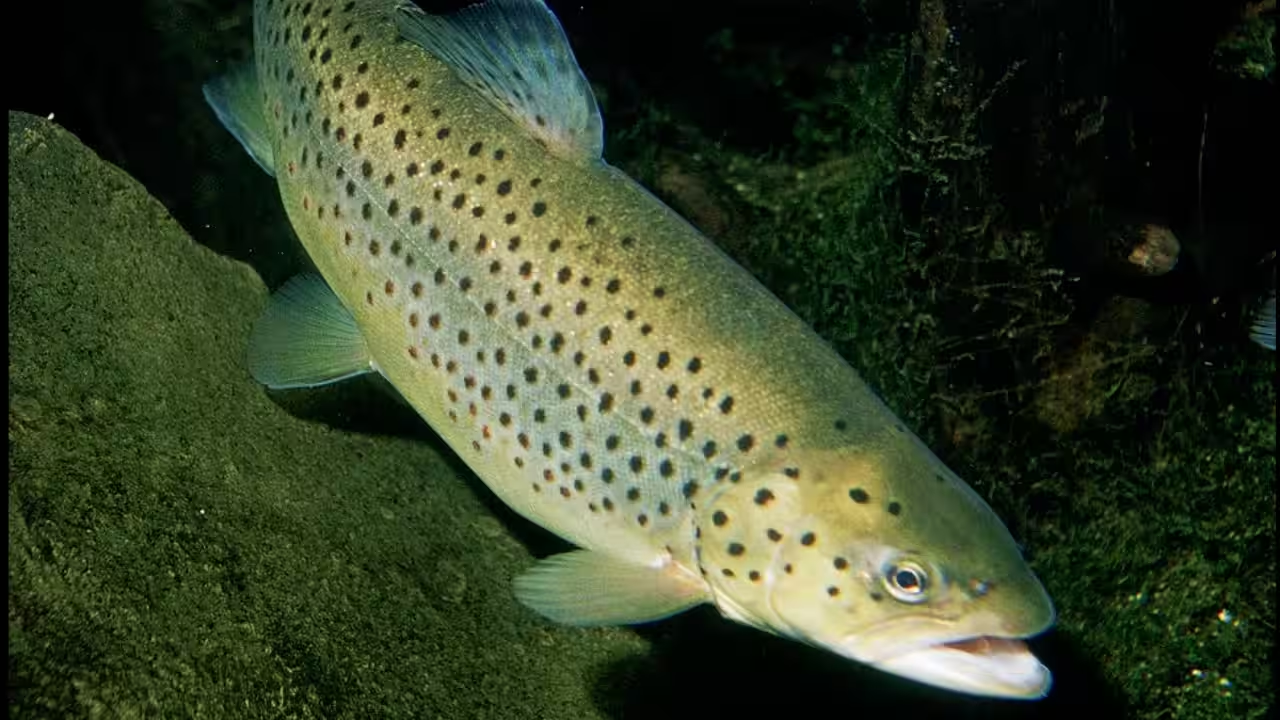
Yellowstone Lake and the Yellowstone River support the largest remaining inland population of Yellowstone cutthroat trout. The National Park Service has been protecting this population from the predatory threat for three decades now. Gillnetting to suppress non‑native lake trout began in 1994, the same year they were first discovered in Yellowstone Lake, with early removal efforts expanded in 2001. Based on the data provided by Yellowstone Forever, the official fundraising partner for the park, it was noted that over 4.9 million lake trout have been harvested from Yellowstone Lake up until 2024, with 264,650 in 2024 only. This article outlines the history of the invasion, its progression and outcomes, and presents findings from a recent 2024 study that identify additional obstacles in the process.Lake trout were stocked elsewhere in the park in 1890 and first detected in Yellowstone Lake in 1994As per the records of the U.S. Fish Commission, lake trout were intentionally introduced in Lewis and Shoshone lakes in 1890. At that time, the lakes had no fish. In the following 100 years, lake trout became established in Yellowstone Lake, where the fish were initially found in 1994. Following verification that lake trout were breeding, an expert group was convened by the park. It was determined that suppression measures were required to conserve the native cutthroat trout, but that this would be a never-ending task. Direct removal methods, like gill netting, were recommended. According to the article, part of the problem may be the lake's deep water. Lake trout inhabit deep waters in which few predators can venture, so eagles, osprey, pelicans, otters, and grizzly bears have no alternative but the cutthroat trout.Gillnetting has been used since 1995 and expanded more than 10-fold in 2001 with a Great Lakes-style boatAccording to a Yellowstone Science article on the suppression program, early removal efforts were expanded in 2001. The lake added a gillnetting boat of the Great Lakes variety, numerous nets, and staff members to net all summer. As noted by the U.S. Geological Survey, the suppression measures on Yellowstone Lake have led to a tenfold increase in gillnetting since 2010, resulting in a doubling of lake trout caught yearly.However, increasing catches with increasing efforts indicated that the fish population continued to increase. Managers requested an intensive investigation and set the objective of restoring the lake trout population to its mid-1990s level. Modeling done by fisheries scientists showed that there was an abundance of lake trout in Yellowstone Lake during 2012.More than 4.9 million were removed by the end of 2024, including 264,650 that yearHowever, it has gone down from its height. According to Yellowstone Forever, crews harvested 396,950 lake trout from Yellowstone Lake in 2017 as part of the Native Fish Conservation Program. Yellowstone National Park itself has estimated the figure at 282,892 in 2019 and 236,853 in 2023, with the total caught over 30 years of netting efforts (1994 to 2023) exceeding 4.5 million. The National Park Service's fish-management website lists a total of more than 5.1 million lake trout removed since 1994, while Yellowstone Forever's estimate, including 2024, is lower at more than 4.9 million. The scale of the fishing effort is immense. According to the 2022 Native Fish Conservation Program Report of Yellowstone National Park, suppression crews deployed 89,320 gillnet units (net‑nights) to target invasive lake trout. Forty miles of net were fished in the lake daily, and more than 5,500 miles of net were used over the season.Mature lake trout down 80% to 90%, and cutthroat signs improving but below targetsThe netting has taken its toll on the important fish species. Park modeling from 2019 to 2021 showed that the abundance of lake trout aged six years and older had declined by more than 80% from the 2012 peak. Yellowstone Forever estimates that mature lake trout have been reduced by up to 90%. The Yellowstone Science report on recovery monitoring shows that cutthroat trout numbers had not fully recovered even before the latest gains. In 2016, anglers recorded a catch rate of 0.9 cutthroat per hour, the third highest in 11 years but below the park's target of 1.5 to 2.0 per hour. Cutthroat indicators have since trended positively. According to Yellowstone Forever in 2019, spawning fish increased in tributaries, the lake held three times as many young fish, and catch rates rose. Even so, the recovery has not been fully achieved.A 2024 Fisheries study by Glassic and colleagues ties cutthroat recovery to disease and lake levelsA 2024 study in Fisheries, led by U.S. Geological Survey fish biologist Hayley Glassic, built a food web model of Yellowstone Lake that tracks five age classes each of lake trout and cutthroat. According to the study, modeling of Yellowstone Lake for the period 2020-2050 through an Ecopath approach using historical data indicates that it is possible to meet the recovery benchmarks for cutthroat trout, but this would happen only if certain specific conditions prevail. In addition, lake trout diets are found to vary depending on their density; amphipods become predominant while cutthroat trout become less dominant. The study also examined whirling disease, a parasitic illness that infects young trout. Certain spawning streams like Pelican Creek and the Yellowstone River downstream of the lake outlet had 100 percent prevalence of infection. The prevalence of whirling disease in the cutthroat trout population within the lake was between 10 percent and 20 percent.Why netting continues, according to the National Park ServiceAccording to the authorities, it is still impossible to kill lake trout at present due to existing technologies. They reproduce fast enough to prevent their number from decreasing without active elimination. Gillnets were deployed, and experiments are being conducted on killing eggs using plant-based pellets on spawning beds. It seems that it is a good solution for further maintenance of the population after achieving desired results. Fishing people must kill all the lake trout they catch in such zones where they pose a danger to native species. But anglers' contribution is quite small since anglers killed only 3% of all the fish in 2016.You use AI every day. Now get your AI Quotient. Take the AIQ test.
Topics in this story
Gathered from external sources. Rights to this text belong to whoever originally published it.