Record-breaking sightings of Fisher's estuarine moth in Essex
There is now a self-sustaining population of the moth at a nature reserve in Essex, a charity says.
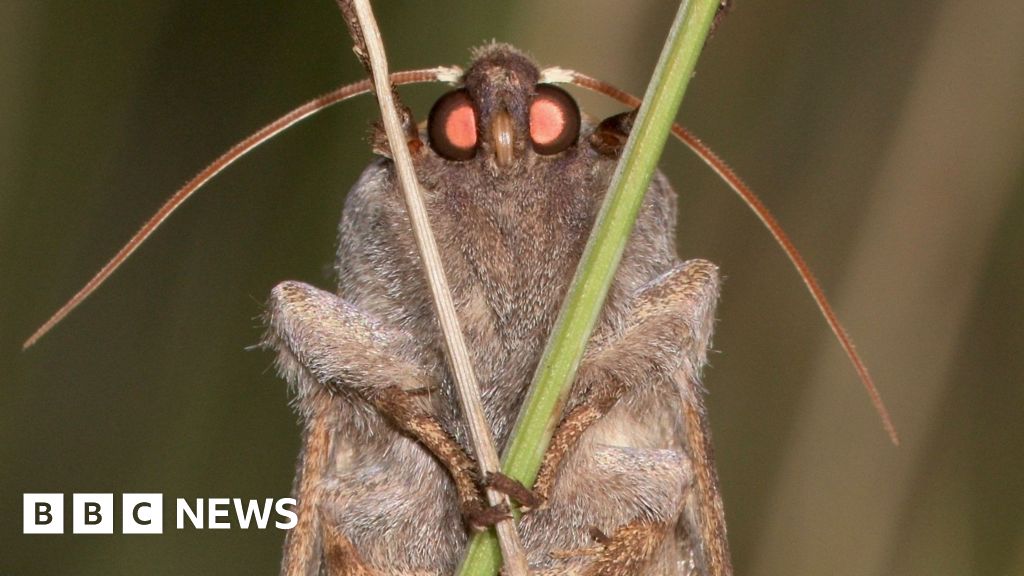
Wildlife enthusiasts have made a record-breaking number of sightings of an elusive moth at a nature reserve.
The Fisher's estuarine moth has been spotted 111 times at Abbotts Hall in Great Wigborough, near Colchester, in 2026.
Dr Zoe Ringwood, of Essex Wildlife Trust, said work to boost the highly threatened species' population had been an "important success story".
The charity has pledged to continue surveying new and existing plots on the Essex coast.
Fisher's estuarine moths can be recognised by their pale gold-brown wing colour with light and dark spots, and are naturally found in low-lying areas of natural grassland which are vulnerable to erosion.
They are reliant on rare hog's fennel for their survival, but the plant has been affected by rising sea levels.
To protect the species, Essex Wildlife Trust planted hog's fennel at Abbotts Hall in 2005 and introduced moth eggs five years later.
More than 100 of the scarce insect were recorded for the first time in 2025, before the record was broken again in 2026.
The charity said it was confident there was now a self-sustaining population at Abbotts Hall.
"[It is] a reflection of how taking evidence-based conservation action can achieve positive results for a threatened Essex species," said Ringwood, its senior conservation evidence manager.
Hog's fennel has also been planted at nature reserves in Fingringhoe, Wrabness and nearby Tollesbury.
Do you have a story suggestion for Essex? Contact us below.
Follow Essex news on BBC Sounds , Facebook , Instagram and X .
Rare moth spotted for first time in 50 years
Zoo's final batch of moths released into the wild
Topics in this story
Gathered from external sources. Rights to this text belong to whoever originally published it.