How drought is changing nature's calendar in the West
From early berries to falling leaves, drought is making parts of the West look like autumn.
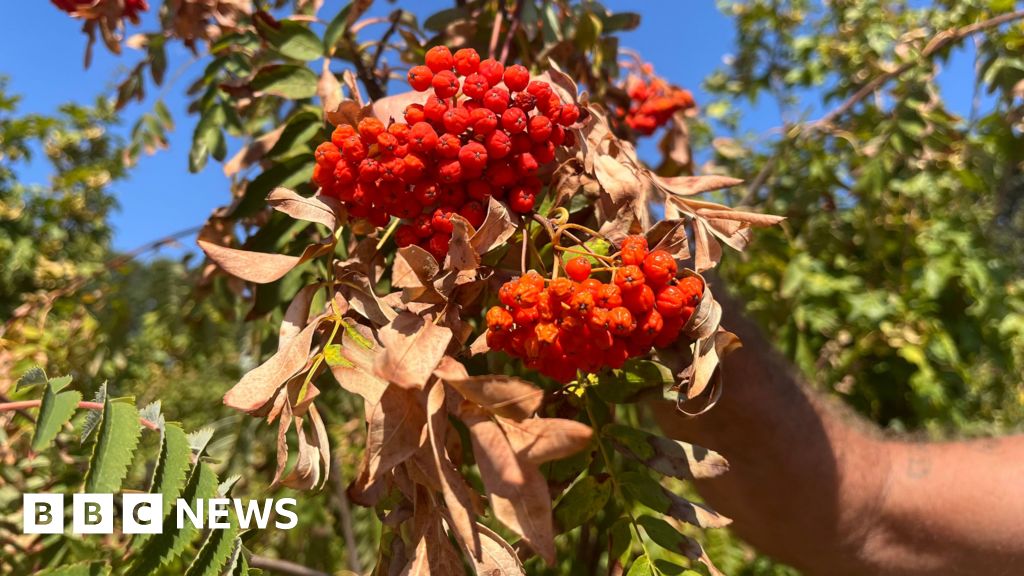
Trees shedding leaves, berries ripening weeks early and brown landscapes are giving parts of the West an autumn-like appearance despite it still being August.
Experts warn record-breaking temperatures and prolonged dry weather are having wide-ranging impacts on nature, from wildlife food supplies to the health of the soil beneath our feet.
Wildlife conservationist Steve England said: "Trees should be full of leaf. Instead, they look how they should in November, but we're only in August."
Professor Mark Everard, from the University of the West of England (UWE), said while there are "winners and losers" in nature, it is important to see it as "a highly integrated machine that's breaking down".
Heavy periods study to create world's largest biobank
Supercars seized ahead of wedding after M5 incident
Autistic DJ befriended at festival given 'dream' set
England, who has lived near Stoke Park in Bristol all his life, has also noticed fruit ripening much earlier than normal.
He remembers picking blackberries as a child at the end of the school holidays in August and September, but this year he was out picking in June.
However, some berries are also suffering in the drought. England said rowan berries should be double their current size by now, but many have shrivelled in the dry conditions.
He fears that could have consequences for migratory birds such as fieldfares and redwings, which rely on autumn berries as a food source when they arrive in the UK for winter.
If they're "ripening too quick" and disappearing before the birds arrive it could be a "big problem", he said.
He has also noticed trees dropping their leaves much earlier than usual due to the dry weather.
"They are going into survival mode," he added.
Everard described the heat as a "trend that's getting progressively worse" and compared the landscape of Wiltshire, where he lives, to India and Africa with its "Savannah colours".
But he said the "bigger problem" is what lies under the soil.
During intensively dry and hot periods, activity below ground "basically shuts down" and also soil begins to lose structure, which has "major ramifications for everything we can see above the surface" now and in years to come, added Everard, who is associate professor of ecosystem services at UWE.
Although nature has amazing resilience and is able to adapt to a range of extremes, Everard said the problem is "we've changed those extremes".
Record temperatures and record low rainfall can "break nature's capacities to respond" and the system begins to "disintegrate".
Everard said "nature gives us clues and we should be wise enough to listen to those clues".
Paul Keene, who runs a pick-your-own strawberry farm near Cheltenham in Gloucestershire, has also seen crops ripen much earlier than expected.
He said they normally start picking outside in mid to late June, but this year had their first pick in May, which is "incredibly early and all driven by the heat".
The dry weather has not caused major problems for the farm because it has its own reservoir, which collects water and feeds an automated watering system for the fruit.
At the height of the summer temperatures, strawberries were being watered up to 12 times a day.
It is not just strawberries that have ripened sooner than expected, pumpkins on the farm are already looking Halloween-ready.
In previous years, Keene said they have been "waiting for them to ripen in October" so this is very early and may mean they have to be brought in for storage to make sure they last.
Follow BBC Bristol on Facebook , X and Instagram . Send your story ideas to us on email or via WhatsApp on 0800 313 4630 .
Pictures show scale of drought across England as rivers dry up
More than half of England in drought, Environment Agency declares
The West is in drought - what does that really mean?
Topics in this story
Gathered from external sources. Rights to this text belong to whoever originally published it.