In 2023, a California materials scientist built a device that pulled drinking water from desert air; it produced 35 litres a day at just 20% humidity
US News: In a groundbreaking development, a California materials scientist created a solar-powered device that extracts drinking water from arid desert air, producing 35 litres a day even at low humidity levels. This revolutionary technology promises to combat water scarcity in dry regions.
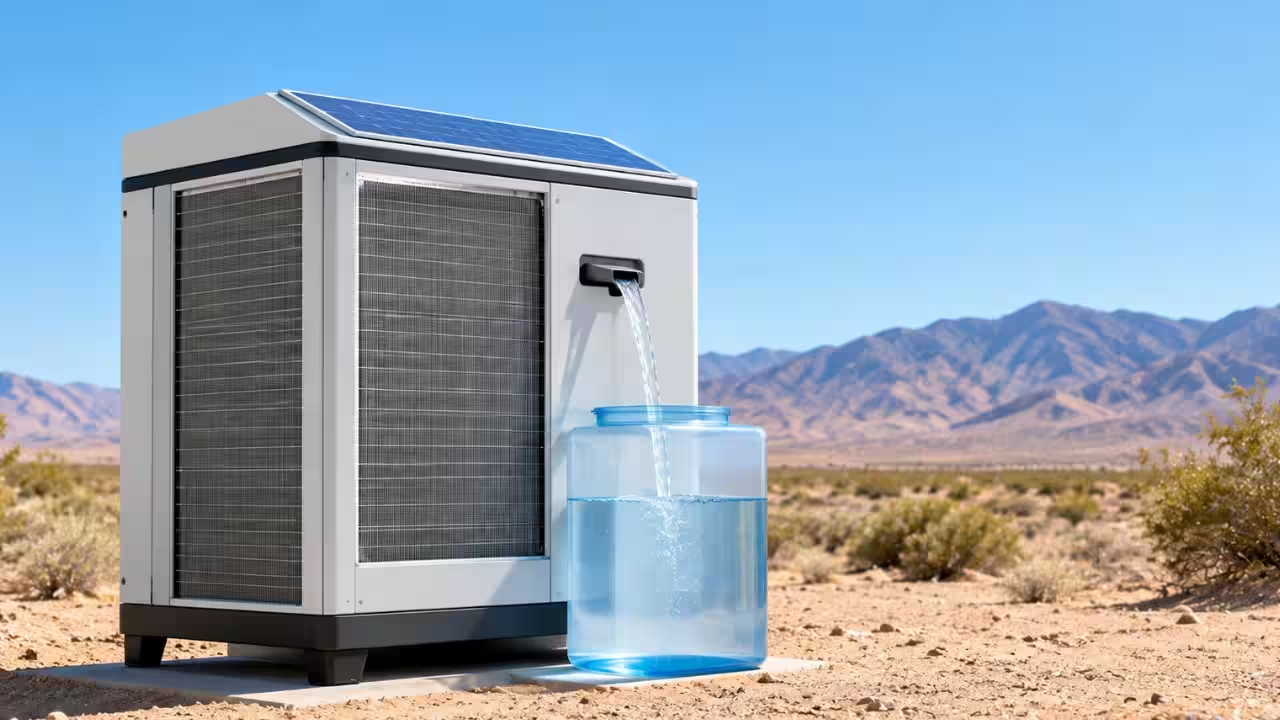
In the summer of 2023, scientists from UC Berkeley took a machine that could be held by two hands to Death Valley National Park in North America, which is one of the most arid and hot locations on the continent and allowed it to operate using only the energy of the sun. It pulled water vapor out of the desert air, converted it to liquid and produced drinkable water without a battery, a plug, or any moving parts drawing outside power. The chemist behind the work, Omar Yaghi, had spent years building toward that single field test.The harvester ran on ambient sunlight aloneThis device uses a MOF, or metal-organic framework, an ultra-porous crystalline structure that Yaghi's team has studied for years. The specific MOF used here is MOF-303, an aluminum MOF that captures water molecules from the air at night, when humidity is usually higher in the desert and releases them during the day as sunlight warms the material. The resulting vapor condenses on a cooler surface within the device and flows into a container.How the output shifted with humidity Testing the same device in two very different climates allowed the team to isolate the effect of humidity. In Death Valley, the harvester achieved up to 210 grams of water per kilogram of MOF-303 per day in a single day-and-night cycle, marking the highest output the team recorded at that site. By comparison, in the milder, more humid air of Berkeley, the same device reached up to 285 grams per kilogram per day under similar passive operation, though Berkeley's daily averages ran lower on some days. The results appear in a 2023 paper in Nature Water, MOF water harvester produces water from Death Valley desert air in ambient sunlight, by Woochul Song, Zhiling Zheng, Ali Alawadhi and Yaghi, and they mark roughly double what an earlier passive version of the harvester had managed.An earlier MOF proved the concept could work at 20 percent humidityDeath Valley’s new technology is a further development of the tests done on the material by Yaghi and his team six years back, in collaboration with mechanical engineers from MIT. This project, which was done in 2017, involved a totally new material made up of zirconium and referred to as MOF-801. The results proved that even at low humidity levels between 20% and 30%, a solar-driven water harvester could generate significant quantities of water.The findings, published in Science as Water harvesting from air with metal-organic frameworks powered by natural sunlight, reported a yield of about 2.8 liters of water per kilogram of MOF per day at relative humidity as low as 20 percent, using only sunlight to drive the release step; some press accounts described the same result as roughly 2.8 liters over a 12-hour test window, though the paper itself reports it as a daily figure. The 2023 Nature Water study notes that switching from zirconium-based MOF-801, priced at $160 per kilogram, to aluminum-based MOF-303, priced at $3 per kilogram, made the harvester far cheaper to build; the higher water yield came from MOF-303's own adsorption behavior, not from its lower price.Why dry air poses the harder engineering challenge Water extraction from moist air is fairly easy since most dehumidifiers function on the principle of cooling air below its dew point. Nevertheless, air in the desert presents a different challenge. This is because at relative humidity less than 20%, the dew point may be below the freezing point, meaning that a lot of energy will be required for the process of condensation. MOFs are designed such that their pores are capable of adsorbing water molecules, even at very low levels of humidity, while heat can desorb them.From a two-hand prototype toward household-scale unitsThe Death Valley test was, by design, a proof‑of‑concept prototype rather than a final, household‑scale product. The scientists pointed out that the tiny size and limited daily amount of water provided by the device were more appropriate for proving the concept behind the chemical reaction rather than for providing enough drinking water for a family's daily needs. Yaghi also disclosed in a public interview that further development along the same lines of MOF chemistry greatly enhanced production, and his firm began manufacturing more efficient devices capable of producing water in quantities of dozens or even hundreds of liters each day.Catch the latest World News and Live updates. Download the TOI app.
Topics in this story
Gathered from external sources. Rights to this text belong to whoever originally published it.