Australia’s ancient red desert rocks may be hiding a natural hydrogen secret; scientists find magnetite produces 5 times more hydrogen than solid rock
Rest of World News: Beneath Western Australia’s iron-rich landscapes, ordinary looking rocks may have a unique ability to produce hydrogen. A new study published in the ‘.
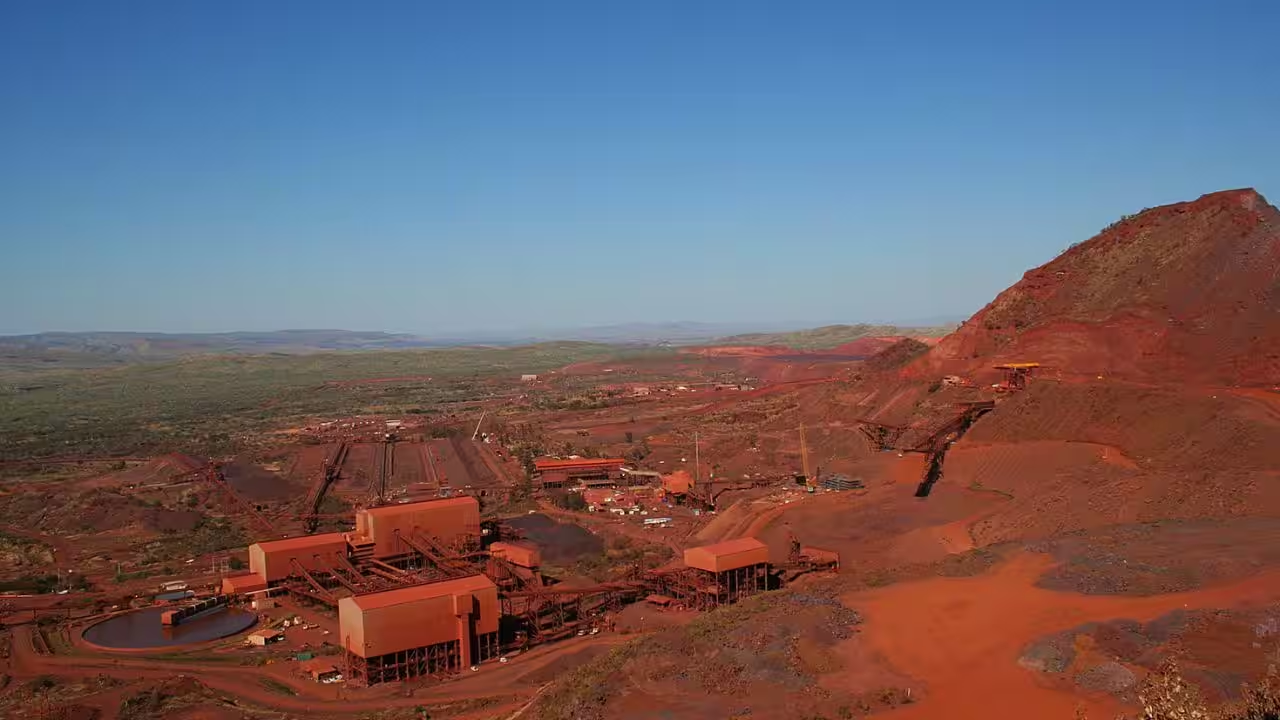
Beneath Western Australia’s iron-rich landscapes, ordinary looking rocks may have a unique ability to produce hydrogen. A new study published in the ‘International Journal of Hydrogen Energy’ has found that magnetite, an iron oxide found in many ancient rocks, can generate natural hydrogen when it reacts with water under hot, high-pressure conditions. The research focuses on a question that ‘does the physical shape of the rock affect how much hydrogen it can produce.’ The answer appears to be yes. In controlled experiments, finely powdered magnetite produced about 5 times more hydrogen than intact slabs of the same material. The finding does not prove that a huge underground fuel supply is ready to be extracted, but it shows why the structure, surface area and pathways through hydrogen-bearing rocks could be crucial to understanding this energy source.Production of hydrogen from Australia’s Red desert magnetiteThe study examines how magnetite behaves when exposed to hot water. Magnetite is an iron-rich mineral that occurs in a range of geological formations. The researchers were interested in natural hydrogen, which is produced through geological processes rather than manufactured using industrial methods. Their work examined whether magnetite could generate hydrogen under conditions involving hot water deep underground. The important discovery was not simply that magnetite can produce hydrogen. Earlier research had already indicated that possibility. Instead, this study investigated how the physical form of the mineral affects the amount of hydrogen produced. That distinction is important because rocks underground are not usually present as loose powder. They occur as solid formations, often with limited spaces through which water can move.How the researchers tested natural magnetiteTo investigate the effect of rock geometry, the researchers compared natural magnetite in two forms. A fine powder and an intact slab. Both were exposed to the same experimental conditions. The tests were conducted at 200°C, a pressure of 103.4 bar and a pH of 9, with the experiments running for 60 days. By keeping the same conditions, the researchers could focus on whether the shape and exposed surface of the magnetite changed hydrogen production. The results showed a striking difference. The powdered magnetite produced 0.052 millimoles of hydrogen per gram of rock. The intact slab produced 0.0105 millimoles per gram. In other words, the powder generated roughly 5 times as much hydrogen as the solid slab under the same conditions. The result suggests that ‘simply knowing how much magnetite exists in an underground formation may not be enough to estimate its hydrogen-generating potential.Importance of shape of the rock in hydrogen productionThe main reason appears to be the amount of ‘mineral surface’ available for the reaction. A fine powder has many small particles and a large amount of exposed surface. Water can come into contact with far more of the magnetite, creating more opportunities for the chemical reaction that produces hydrogen. An intact rock slab is different. Much of its magnetite remains inside the rock and is difficult for water to reach. The study found that the solid samples were affected by limitations on how easily fluids could move through and reach reactive areas. The researchers also found evidence that the surface of the magnetite changed during the experiment. The slab became rougher, while microscopic examination showed changes in its texture and the development of small porous features. These changes matter because they can alter the way water interacts with the mineral over time.Could this change the search for natural hydrogenThe findings could influence how scientists think about underground hydrogen resources. If hydrogen production depends strongly on surface area and the movement of water, then exploration cannot focus only on finding rocks containing large amounts of magnetite. Researchers may also need to understand fractures, pores and other features that allow water to reach reactive parts of a geological formation. This is particularly relevant to ‘magnetite-bearing banded iron formations,’ which can occur over large areas. The study specifically highlights the importance of these formations and other magnetite-rich rocks when considering natural hydrogen production and geological hydrogen storage.However, the findings should not be interpreted as proof of a massive underground hydrogen reserve ready for commercial extraction. The experiments were conducted under controlled lab conditions, and the study itself focuses on understanding the chemical and physical factors that influence hydrogen generation. Natural rock formations are much more complicated. Their permeability, fractures, mineral composition and fluid movement can vary considerably from one location to another. Instead of asking only how much magnetite is present, future investigations may need to ask how easily water can reach it. Western Australia’s rocks may have the ingredients for natural hydrogen generation, but understanding how that process works in real geological formations will be essential before its energy potential can be properly assessed. The study’s central finding is straightforward: ‘when it comes to natural hydrogen, the shape of the rock can matter almost as much as the rock itself.’Catch the latest World News and Live updates. Download the TOI app.
Topics in this story
Gathered from external sources. Rights to this text belong to whoever originally published it.