In 1924, Kansas City sealed a time capsule high inside its war memorial; 100 years later, crews drilled through concrete to uncover a president’s letter and century-old documents
Crews have unearthed a 1924 time capsule from Kansas City's Liberty Memorial containing historic objects, including President Coolidge's letter and documents from World War I, marking a century of remembrance.
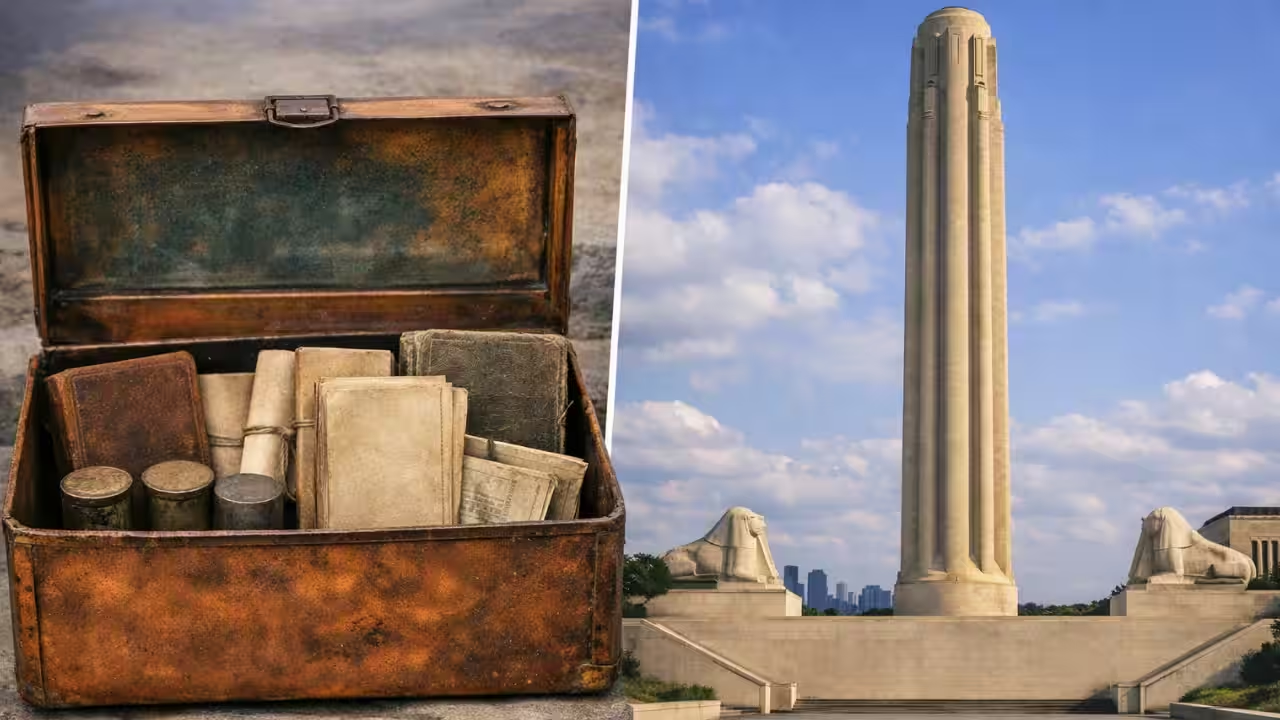
In the early 1920s, Kansas City residents rallied behind an ambitious plan to honor the men and women who had served in World War I. The Liberty Memorial Association, formed by a group of prominent local citizens, raised more than 2.5 million dollars in just ten days in 1919, a sum equivalent to roughly 45 million dollars today, to fund construction of a towering monument south of Union Station. Ground was broken in November 1921 in a ceremony attended by five Allied military commanders and an estimated 100,000 spectators, and three years later, as the tower's stonework was going up, a copper box was sealed into its cornerstone with instructions that it not be opened for a full century.The box remained untouched through the memorial's public dedication in November 1926, when President Calvin Coolidge addressed a crowd of over 150,000 people. It stayed sealed through the decades that followed, even as the structure neared collapse and later underwent major renovations at the turn of the twenty-first century. The box was unearthed in the summer of 2024, when workers for the National WWI Museum and Memorial drilled into eighteen inches of limestone and concrete to recover it, one hundred years after its initial placement.How workers reached a box sealed since 1924Removal of the capsule turned out to be much harder than cutting into the wall. Workers had to saw through layers of limestone and concrete that formed the cornerstone of the tower, and their work became even more difficult after it was discovered that there was probably old nitrate film stored in the box, a material that decomposes unpredictably and can become highly unstable and prone to spontaneous combustion as it breaks down. For this reason, the bomb squad from the Kansas City Police Department came to check out the capsule before it was opened.As the National WWI Museum and Memorial explains on its own site describing the 1924 Time Capsule Unveiling, the original cornerstone ceremony had been a spectacle in its own right, with airplanes circling overhead, a band playing patriotic music, doves released into the air and remarks read aloud by the Allied commanders and President Coolidge. After ensuring that there were no safety issues involved, the museum revealed the contents of the capsule in an official ceremony held on October 16, 2024. The museum’s president and CEO, Matthew Naylor, delivered the relics to the audience, explaining that this was an attempt by the people of Kansas City to make sure that some part of them lived on in future generations.What was found inside the copper boxThere were fifteen objects in total contained in the capsule, spread across several categories of documents and letters. Twelve had been reviewed and protected before the opening, and the other three were reviewed during the ceremony itself. Among them was a letter from President Coolidge to the Liberty Memorial Association in which he stated his delight in hearing that the association would be able to lay the foundation stone of the monument very soon, and a tube containing congratulatory letters of the Allied commanders who attended the groundbreaking ceremony of 1921. The capsule also held a copy of the U.S. Constitution and the American Declaration of War from April 1917, along with a Bible, newspapers from the period, the printing plate of the Kansas City Star from November 1921, and magazines from the Kansas City Chamber of Commerce describing the city in the 1920s.Why the memorial itself carries lasting historical weightThe Liberty Memorial's significance extends well beyond the time capsule buried inside it. In 2006, the National Park Service designated the memorial a National Historic Landmark, a distinction reserved for properties judged to hold exceptional value in illustrating American history. According to the National Historic Landmark Nomination, the Liberty Memorial, built between 1923 and 1938, embodies the Beaux-Arts Classicism style that was the preference of architects of the time during the City Beautiful era of early twentieth-century America. This monument's size and symbolism demonstrate how significant World War I was to the civic consciousness of Americans in the years following. It is this same importance that made the sealed cornerstone valuable enough to protect for one hundred years, rather than just preserving the records inside the archives.What the reopened capsule means for the memorial's next centurySince the contents of the 1924 capsule are all accounted for, work has already commenced at the museum on planning the next steps. The museum officials have declared that in 2026, there will be another time capsule assembled and buried in celebration of the hundredth year of the monument being dedicated to the community. This cycle of burying and unearthing time capsules that began as an initiative by one organization to honor the sacrifice of one war has turned into an ongoing cycle of memory in itself, from one generation to the next in Kansas City.You use AI every day. Now get your AI Quotient. Take the AIQ test.
Topics in this story
Gathered from external sources. Rights to this text belong to whoever originally published it.