In 1931, scientists last documented this mysterious lark; 95 years later, birders photographed one alive in Chad
Rest of World News: A bird missing from scientific records for nearly a century has been rediscovered in central Chad, turning a long-standing mystery into one of Africa’.
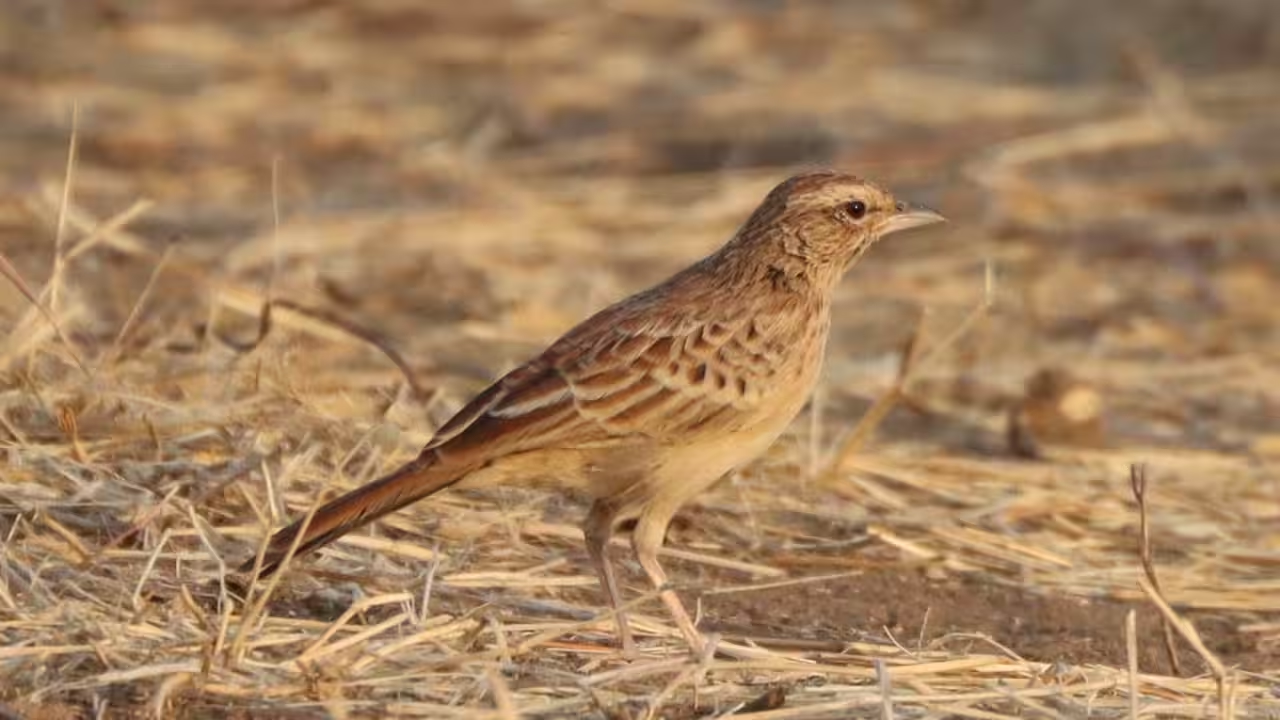
A bird missing from scientific records for nearly a century has been rediscovered in central Chad, turning a long-standing mystery into one of Africa’s most remarkable recent ornithological findings. The Rusty Lark (Calendulauda rufa) was documented on 2 February 2026 in the Abou Telfane wildlife reserve in Guéra province, where a Franco-Chadian team observed, photographed and filmed the elusive species. According to Tour du Valat’s account, the sighting is the first documented record since 1931 and produced the first known photographs of a living Rusty Lark. Birds of the World’s report also highlights the significance of finding a species that had remained extraordinarily poorly documented despite its presence across the Sahel.Rusty lark rediscovered in Chad after nearly a century without a confirmed recordThe historic observation took place on 2 February 2026, when Idriss Dapsia of Chad’s Directorate of Wildlife and Protected Areas, Julien Birard of Tour du Valat and Pierre Defos du Rau of the French Office for Biodiversity encountered the Rusty Lark in the Abou Telfane wildlife reserve, around 10 kilometres east of Mongo. Tour du Valat reports that the same individual was seen again on 15 February. The discovery ended a 94-year gap in confirmed records. The last documented record dated to 1931, meaning generations of ornithologists had no verified modern observation of the species. Crucially, the team captured photographs and video, providing physical evidence that could be independently examined. Experts including Joost Brouwer, Tim Wacher, Paul Donald and Per Alström subsequently confirmed the identification from the field images.Why the first photographs of the Rusty Lark are so importantThe rediscovery is particularly significant because the Rusty Lark had remained one of Africa’s least understood birds. Although it was never officially declared extinct, its extraordinary lack of records made its continued survival difficult to assess. The species is associated with dry Sahelian environments across countries including Niger, Chad and Sudan, regions where extensive areas remain poorly surveyed. The photographs taken in Chad therefore provide more than an exciting record. They offer researchers the first detailed visual evidence of a living Rusty Lark that can be compared and studied. According to Tour du Valat, expert ornithologists in Chad and specialists in larks examined the images and confirmed the identification. Birds of the World’s coverage further places the discovery within the broader effort to locate bird species that have disappeared from scientific observation. The finding demonstrates how targeted fieldwork can still reveal major biodiversity surprises in remote landscapes.What the Rusty Lark rediscovery reveals about Sahel biodiversityThe discovery also raises important questions about where the Rusty Lark lives, how many individuals survive and why it remained undetected for so long. Its apparent survival does not automatically mean the species is abundant. The Search for Lost Birds account notes that the bird is considered generally scarce, while much of its potential range receives limited ornithological attention. The Chad sighting could therefore encourage further surveys in suitable habitats and potentially help researchers reassess the species’ known distribution. The observation also demonstrates the value of international conservation partnerships. Tour du Valat says the discovery occurred through the RESSOURCE+ project, coordinated by the FAO and co-financed by the European Union and FFEM, bringing together Chadian and French specialists. For conservationists, the rediscovery is a reminder that species can remain hidden in under-surveyed ecosystems for decades, making continued field research essential to understanding Africa’s remaining biodiversity.Catch the latest World News and Live updates. Download the TOI app.
Topics in this story
Gathered from external sources. Rights to this text belong to whoever originally published it.