Role Women farmer producer companies (WFPCs) can play in redefining gender roles & turning women farmers into agri-entrepreneurs in Indian agriculture
Introduction Women-led Farmer Producer Companies (WFPCs) in India are emerging as powerful vehicles: Recognising women as farmers; Dismantling
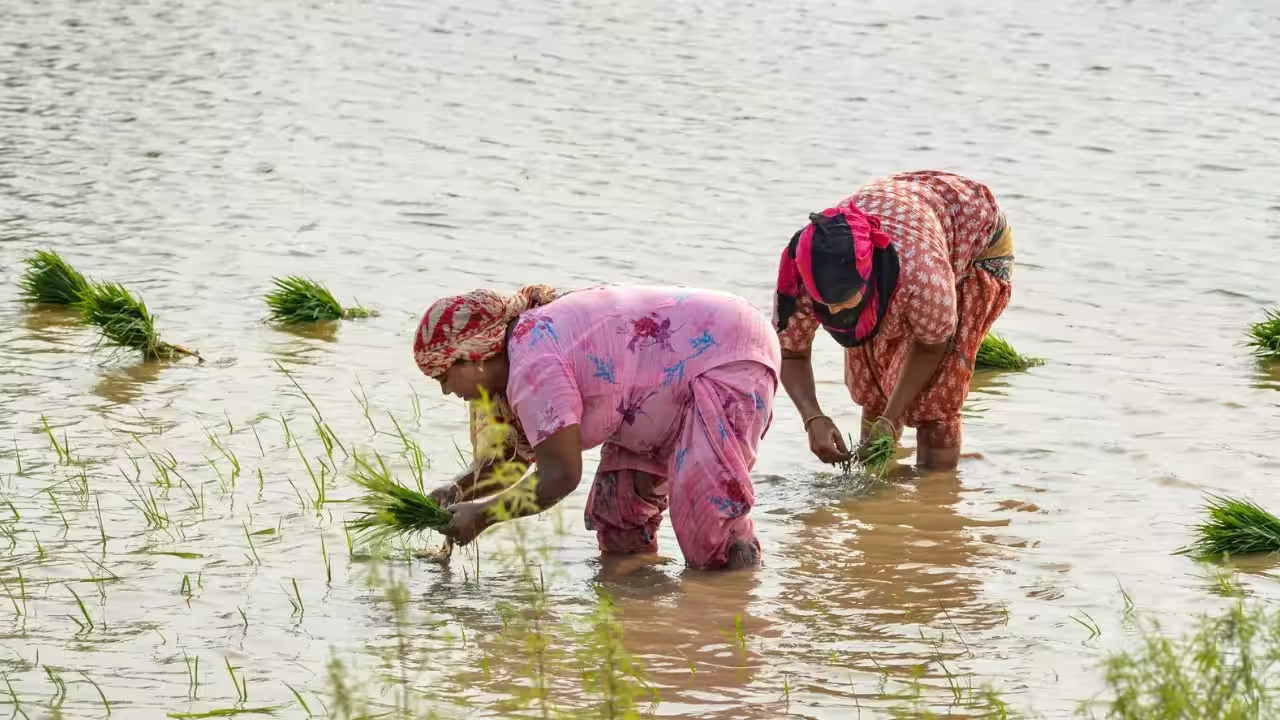
IntroductionWomen-led Farmer Producer Companies (WFPCs) in India are emerging as powerful vehicles:Recognising women as farmers;Dismantling land-ownership based definitions, and;Turning SHG (Self Help Group) members into agribusiness entrepreneurs, backed by:New laws,Global initiatives, and;SRLM (State Rural Livelihood Mission) support.WFPCs can:Reshape gender roles;Strengthen climate-smart agriculture, and give women:a) Formal ownership;b) Leadership, and;c)Market bargaining power, across agrifood value chains.Farmer Producer Company (FPC)The concept of the Farmer Producer Company in India originated from the recommendations of the Y.K. Alagh Committee in the early 2000s.The FPC framework was introduced in 2002 by incorporating it into the Companies Act, 1956, strengthening it further under the Companies Act, 2013.An FPC is a legal entity, Collectively Owned by Primary Producers, and designed to Collectivise:· Farmers;· Fishers, and;· Village artisans.The primary objective of an FPC is:· To collectivise marginal and small farmers;· Enable them to access markets through product aggregation, and;· Enhance their collective bargaining power.Acting as a Hybrid between Cooperatives and Corporate Companies, this model provides:· Mutual benefits to its members similar to a cooperative, while;· Offering the Corporate competitiveness required for the Agrifood market.Profile of Women Farmers & FPCs in IndiaAround 89.4 percent of farming households in India consist of small and marginal farmers holding less than two hectares of land with Agriculture contributing around 18 per cent to the Nation’s GDP (Gross Domestic Product).As regards the FPCs, a study by the Tata-Cornell Institute and BIRD (Bankers Institute of Rural Development) released in February 2026 reveals that:Out of 44,547 total registered FPCs in India, 6,442 are women-led, or around 15 per cent.Various State Rural Livelihoods Mission (SRLM) Programmes are actively working to graduate women’s Self-Help Groups (SHGs) into formal FPCs.Current Status of Women as FarmersHistorically, women have performed specific, labour-intensive tasks in Indian agriculture, such as:· Seed preservation;· Transplanting;· Weeding, and;· Harvesting.Despite their vital roles, Women:· Are seldom granted decision-making powers, or;· Economic ownership of their produce.However, they have rarely been recognised as farmers,as farmers are defined as land owners.Central Schemes now mandate that:At least 30 percent of funds and benefits be earmarked specifically for women farmers.State level Efforts to Recognise Women as FarmersOver the last two decades, State-led efforts have been made to recognise women as farmers by targeting them as beneficiaries under different Central and State-sponsored Schemes, such as:· MKSP (Mahila Kisan Sashaktikaran Pariyojana);· ATMA (Agricultural Technology Management Agency).Maharashtra Women Farmers Empowerment Act, 2026In July 2026, the Maharashtra Assembly passed the Maharashtra Women Farmers Empowerment Act, 2026, becoming the first state to grant activity-based legal recognition to women farmers via:A Woman Farmer Certificate, which decouples Farmer identity from Land ownership.The Act represents a massive socio-economic shift designed to address deeply entrenched gender inequalities regarding access to:1. Land;2. Water;3. Credit, and;4. Other vital natural resources.Women Farmers Producer CompaniesThe history of the Women Farmers Producer Company (WFPC) is rooted in the SHG movements of the 1970s, which have evolved into the Largest Women-led Microfinance Initiative in the world.This movement has been patronised by the government since the 1990s with the perspective of empowering women by:· Overcoming gender stereotypes through financial inclusion;· Providing access to credit;· Promoting leadership skills, and;· Creating platforms to address social issues.EpilogueLimitations & SolutionsOut of the total FPCs promoted nationwide, only 43 per cent to 49 per cent continue to operate effectively, once formal government financial support concludes, highlighting the urgent need to design strategies for the sustainable, independent functioning of WFPCs.Feminisation of agricultureWhile women increasingly play essential roles across agrifood value chains and contribute substantially to the agricultural economy, they are still rarely independent enough to make decisive choices within the household farm economy, such as:· Buying inputs;· Purchasing machinery, or;· Selling farm produce.This limitation stems from embedded structural inequalities that restrict women’s access to:· Information;· Resources;· Opportunities, and;· Strategic decision-making.Because women are culturally left less informed regarding these economic roles, men largely control these decisions, as they are traditionally perceived to be better equipped with:· Market intelligence, and;· Exposure and experience.WFPCs represent an opportunity for a major structural shift, preparing women to actively drive and manage the agricultural sector.WFPCs are powerful tools for women’s empowerment, enabling women to become informed enterprisers:· To take decisive actions, and;· Build a gender-inclusive farm economy.FPCs provide unique opportunities for rural women to be formally recognised as:· Company shareholders, and;· Boards of Directors.Requirement of Community-level actions:Deep-rooted challenges exist at the household and community levels. It is therefore vital to orient both women and men to visualise the benefits of a WFPC.Besides, intensive community engagement is required, specifically targeting men, rather than women.Reshaping deeply ingrained social conditioning is a primary requirement to create a level playing field, where women can confidently occupy decisive, enterprising roles.Policies also must articulate this paradigm shift through time-bound, measurable action plans.Besides, as many women are new to the competitive skills required for contemporary farming, such as:· Precision agriculture;· Climate-compliant practices, and;· Regenerative farming, intensive capacity building is essential, they need to be provided:a) Training in sustainable farm practices;b) Value-chain mechanics;c) Post-harvest management;d) Supply chain negotiations, and;e) Financial literacy, to engage effectively with buyers and bankers.Besides, it is opined, handholding support must be intentionally designed to introduce WFPCs to modern digital market opportunities.The WFPCs open up unprecedented possibilities for the 21st-century agricultural food markets driven by global demand for:· Climate-smart regenerative agriculture;· Safer food systems, and;· Nutrient-dense diets.WFPCs, it is opined, can lead the way by explicitly interlinking these opportunities.Disclaimer: Views expressed above are the author's own.
Topics in this story
Gathered from external sources. Rights to this text belong to whoever originally published it.