In 2021, an 88-acre former limestone quarry in Indiana became a reservoir holding 3.2 billion gallons of water to protect supplies during droughts
In Fishers, Indiana, an 88-acre abandoned limestone quarry has been transformed into a reservoir capable of holding 3.5 billion gallons of water, serving as a vital buffer against droughts and helping meet the rising water demand in Central Indiana.
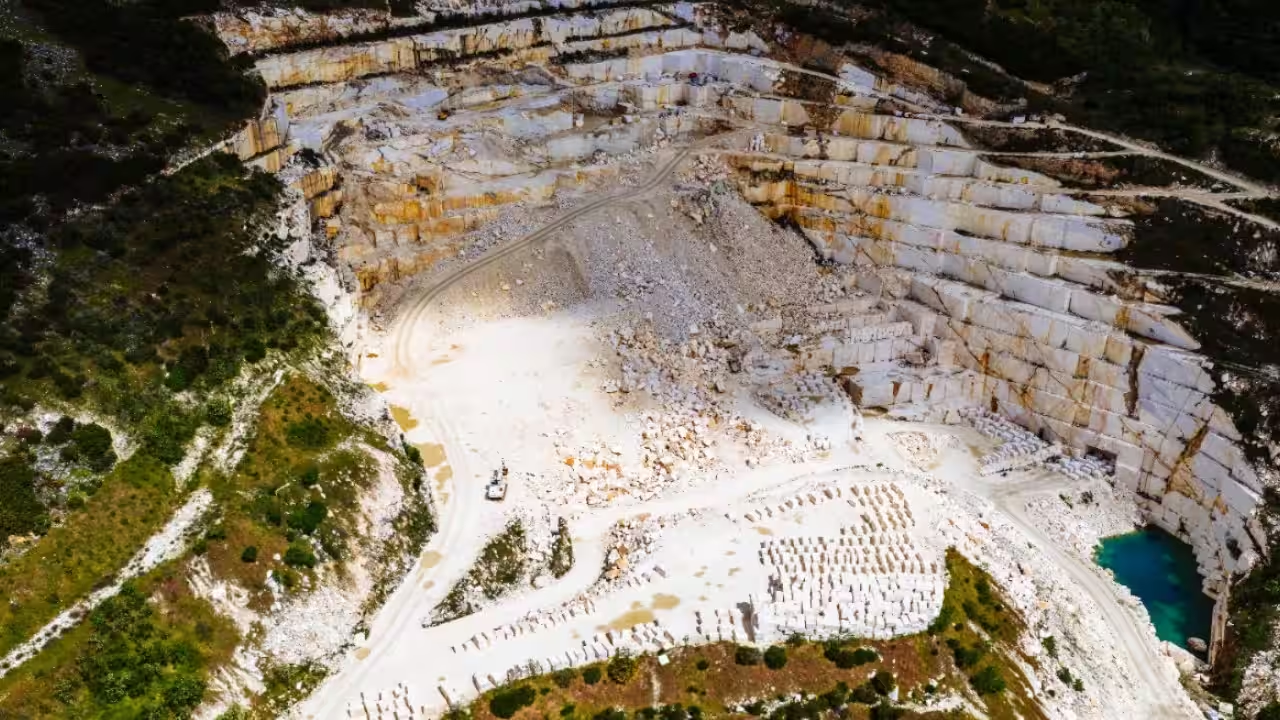
A retired limestone quarry was converted into a reservoir in Fishers, Indiana, near Geist Reservoir in 2021, to act as an additional buffer against drought and meet the rising demand across Central Indiana. According to Schnabel Engineering, the facility provides water storage of 3.2 billion gallons and can hold roughly half the volume of neighbouring Geist Reservoir, despite occupying less than one-twentieth of its surface area. Central Indiana was projected to require an additional 50 million gallons of water per day by 2050, making additional storage an important part of preparing for future demand.Why Central Indiana required additional water storage As per the Environmental Resilience Institute, the Indianapolis region receives about 42 inches of rainfall annually, but the timing is unpredictable. The region has to navigate the problem of heavy rainfall that exceeds storage capacity and, conversely, dry spells, which strain the water supply. During the 2012 drought, the severity of this problem became apparent when Geist Reservoir fell 18 inches, while Eagle Creek Reservoir dropped a foot, as per the Indianapolis Business Journal. Moreover, restrictions were imposed on water supply in communities as a sustainable measure during the dry conditions.The event served as a stark reminder of how water can be affected under extreme weather, and this vulnerability was further aggravated by population and economic activity. Citizens Energy Group began preliminary planning for the new facility in 2013. During the feasibility stage, engineers examined whether the abandoned quarry's limestone walls could contain stored water over extended periods. The utility also worked with the City of Fishers to assess planning requirements, construction impacts, and potential conflicts with future development.How an abandoned quarry became a water reserve Rather than simply filling the excavation, the intake and pumping systems had to go underground. According to Schnabel Engineering, there were four 220-foot-deep, 60-inch excavated-diameter well shafts, alongside a separate tunnel approximately 250 feet long. Drill and blast methods were used to construct the intake shafts and tunnels, while slope stabilisation was used around the quarry walls and rim, and a dedicated access road and perimeter fencing were added.The reservoir's operating principle is quite straightforward: if Geist Reservoir receives more water than its storage capacity, an intake structure diverts some of the excess into the quarry. Whereas when supplies are needed, the water stored is returned by a pump station to Geist Reservoir, from which it goes directly into the downstream system serving the region. As per the Indianapolis Business Journal, the intake could divert up to 100 million US gallons daily, while the pumping system could return up to 30 million gallons. These are maximum transfer rates, distinct from the reservoir's overall storage capacity.As per the Environmental Resilience Institute, the cost of the land was $13 million and construction added another $17 million. This brought the total amount to $30 million, which was financed through Citizens Energy Group's capital budget. To put savings in perspective, the university’s case study estimates that constructing a conventional reservoir of comparable capacity would have cost between $600 million and $700 million. So, reusing the quarry was a more feasible alternative; however, these initial figures do not represent an exhaustive comparison of every possible reservoir design.You use AI every day. Now get your AI Quotient. Take the AIQ test.
Topics in this story
Gathered from external sources. Rights to this text belong to whoever originally published it.