In 1953, a Hong Kong imam brought eight date palms from Mecca; one survived and later officials changed a road route rather than cut it down
China News: In 1953, an imam named Ai Pok-tak returned to Hong Kong from a pilgrimage to Mecca carrying eight date-palm saplings, hoping to grow a piece of his fa.
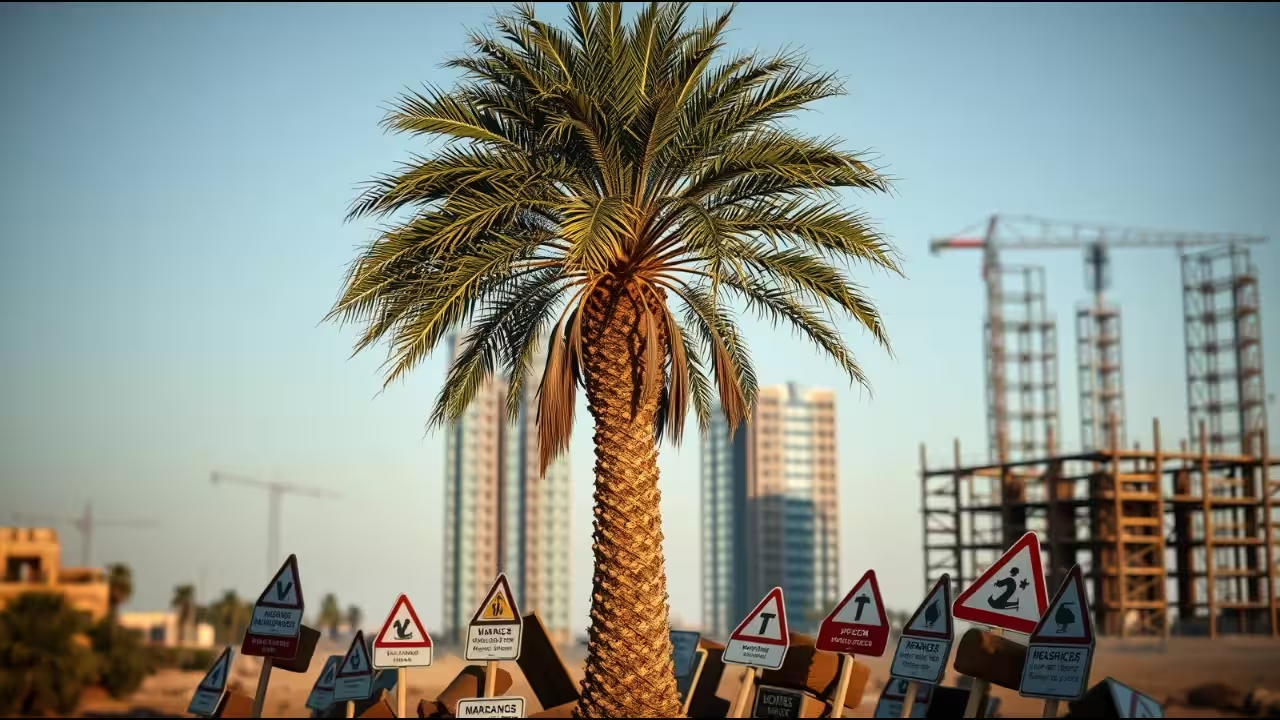
In 1953, an imam named Ai Pok-tak returned to Hong Kong from a pilgrimage to Mecca carrying eight date-palm saplings, hoping to grow a piece of his faith in a city where the tree was rarely seen. Only one survived. Planted outside the family's home near Hong Kong's border with mainland China, it eventually grew to more than twice the height of the family's two-storey house. Ai and his wife, Ma Yuk-lan, had moved to Hong Kong from Gansu province in 1949, and the palm's survival became deeply intertwined with their family's faith and history. Decades later, the same tree became the centre of a long-running dispute over road construction. What began as an effort to save the palm from demolition under British colonial rule continued after Hong Kong's return to Chinese sovereignty in 1997, with Ma repeatedly asking authorities to find a way to preserve it.How British colonial officials agreed to reroute a road around the palmAccording to the Los Angeles Times, Ma first faced the threat of losing the tree in 1972, when British colonial authorities planned a road that would have required its removal. She recalled appealing to David Akers-Jones, who was then serving in the New Territories administration, and asking that the road be shifted slightly instead of cutting down the palm. Ma and her family pleaded with officials to spare the tree, and the road was ultimately rerouted, allowing the date palm to remain where it had grown for decades. The distinction over Akers-Jones' position is important: he did not become Hong Kong's Chief Secretary until 1985, so that later title should not be attributed to him when describing the 1972 episode.Why the date palm became so important to the familyThe tree's importance extended beyond its unusual presence in Hong Kong. Date palms have a strong cultural and religious association with Islam, and dates themselves hold an important place in Muslim traditions. Retired senior imam Cheung Kwong-yee told the Los Angeles Times that Islamic clerics do not regard date palms as formally sacred, but acknowledged their considerable symbolic significance within the faith. The palm also became a living connection to Ai's journey from Gansu to Hong Kong and to the family's pilgrimage history. After the original group of eight saplings was reduced to one surviving tree, its continued growth gave the family a tangible link to the place from which Ai had brought it.Why Hong Kong authorities wanted the palm removed againThe tree faced another threat after Hong Kong returned to Chinese sovereignty in 1997. Authorities eventually told Ma that it would have to be removed to make way for road widening. Government engineer Fun Yat-fu said he knew of only two date palms in Hong Kong at the time, highlighting the rarity of the species in the territory. Ma resisted the proposal and explored alternatives, including asking whether the palm could be moved to land behind her home rather than being destroyed. She also approached her landlord about relocating it elsewhere on his property, but securing permission from the wider family associated with the land proved difficult. Officials offered another option: transplanting the palm to a public park. For Ma, however, moving the tree away from the place where it had grown for decades was not an equivalent solution.The family kept looking for a way to save the treeAs the deadline for dealing with the palm approached, Ma continued pressing authorities to reconsider. She even wrote to Hong Kong Chief Executive Tung Chee-hwa asking whether the tree could be preserved behind her home. The family's attachment to the palm had also grown through the natural changes around it. Ma described two smaller trees that had appeared near its base without being deliberately planted. She believed they had helped stabilise the larger palm against Hong Kong's powerful typhoon winds. The dispute also produced an unusual coincidence. Akers-Jones, the official whom Ma remembered helping save the palm decades earlier, was himself facing a road project that threatened his seaside home and a large banyan tree on his property.For Ma, the date palm was more than an obstacle in the path of a road. It was a surviving link to her family's past, a symbol of faith and a tree that had already outlasted one government decision to remove it. The family's decades-long effort to protect it showed how a single tree can become intertwined with questions of heritage, religion, memory and the rapidly changing landscape of Hong Kong.Catch the latest World News and Live updates. Download the TOI app.
Topics in this story
Gathered from external sources. Rights to this text belong to whoever originally published it.