How did five baby orangutans end up abandoned in India?
CNN has spent weeks investigating the shadowy, brutal trade in which endangered animals are poached and moved through networks of brokers across borders and seas.
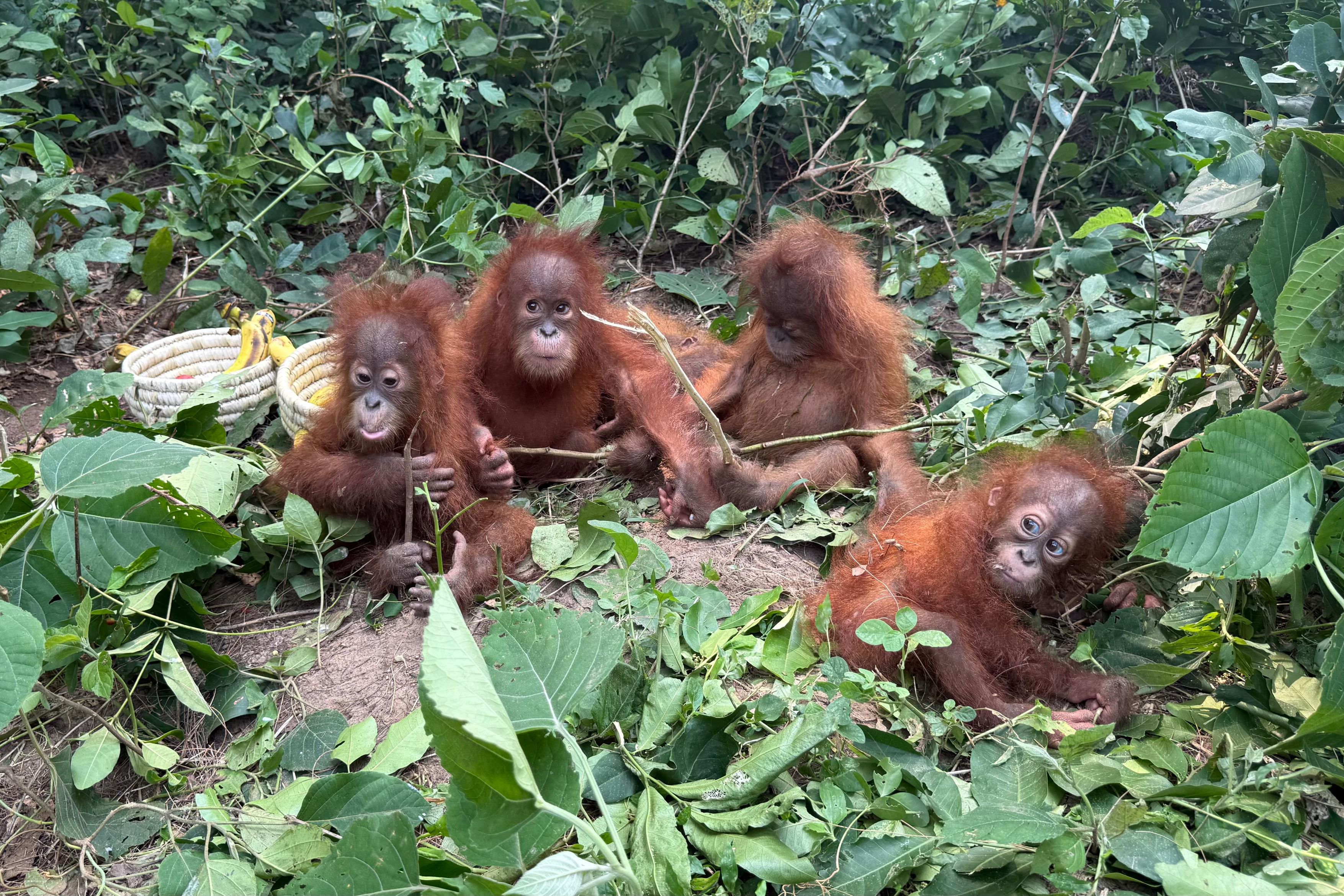
Huddled and frightened, adjusting to an alien environment, five newly orphaned babies lay inexplicably in the forest’s undergrowth. With shaggy, reddish-orange fur, wide eyes and long limbs, they were unlike any other animal found in this corner of eastern India. They were soon surrounded by a crowd of about 1,000 bewildered villagers, who alerted forest officials patrolling nearby. When officers arrived, they were stunned. The animals were baby orangutans: critically endangered great apes; some of the world’s most intelligent animals, and a species prized by private collectors. They belong thousands of kilometers away, in the Southeast Asian rainforests of Borneo and Sumatra. Yet here they were in India’s Odisha state, all under 18 months old, separated from their mothers, and then abandoned. Pratik Prakash Indalkar, a forest officer from Balasore, a coastal city in eastern Odisha, told CNN his staff were not sure how to handle the find, which he characterized as “very surprising.” Their discovery gripped India. For days, the plight of the Odisha quintet dominated headlines and primetime broadcasts. Yet for conservationists, their ordeal is a grim reminder of a far larger reality: a $20 billion illicit trade that tears critically endangered animals from their habitats and traffics them with ruthless efficiency. Indonesia’s government says the available evidence suggests the babies originated in Sumatra, the massive island in the west of the archipelago nation. Since their discovery, CNN has spent weeks investigating the shadowy, brutal trade in which endangered animals are poached and moved through networks of brokers across borders and seas. Drawing on conversations with wildlife sellers, social media posts and interviews with nearly a dozen experts, including environmentalists, researchers and a former trafficker, we chart the likely journey that took these orangutans from Indonesia to India. It is a journey that almost certainly began with violence. To capture an infant orangutan, poachers typically must first kill its mother, who will fiercely defend her young. By the time these babies reached India, they had likely endured weeks of fear, hunger and dehydration. They showed little interest in climbing nearby trees – unusual behavior for these arboreal animals, who spend their lives in the forest canopy and rarely descend to the ground. Authorities rushed in food and water before transporting the babies to a nearby government office. Video from the rescue shows them being carefully carried away before making the nearly 400-kilometer (250-mile) trip to Nandankanan Zoo. There, they remain in quarantine, far from the forests where they were born and the mothers they lost. And their story is just one of many in the illegal wildlife trafficking industry. Deep in the humid greenery of a Sumatran rainforest, serenaded by birdsong and the jungle’s endless thrum, a baby orangutan clings to its mother. Their bond, like all maternal bonds in primates, is incredibly difficult to break. Orangutans are among nature’s most devoted mothers, rarely letting babies out of reach, and raising their young for up to nine years. Young orangutans learn the essentials of survival from their mothers: how to forage, swing through the canopy and avoid danger. Several experts say this is why poachers in the illegal wildlife trade often kill the mother first. “To me, it’s almost certain they were taken from the wild,” said Lionel Hachemin, global director of the Wildlife Crime Program at the International Fund for Animal Welfare. “Obtaining five orangutan infants of the same age would be extraordinarily difficult, even for the world’s best-resourced breeding facilities. It would require years of coordinated effort, an ideal breeding population, and at least 20 adult females.” Conservationists who have spent decades tracking the trade describe the process as ruthless and predictable. “If you find one baby orangutan, it means one mother orangutan has died,” said Binur D. Naibaho, director of Sustainable Landscape at the Orangutan Information Centre (OIC), a non-governmental organization based in North Sumatra. Naibaho described how some villagers in Sumatra are paid up to 15 million Indonesian rupiah ($846) to poach a baby orangutan. “The local people will hunt the orangutan, kill the mother and take the baby and give to the agent to go to the black market,” he said. The mother’s protective instinct becomes her death sentence. “There is no way that the mother would leave her baby,” according to Femke den Haas, co-founder and director of Jakarta Animal Aid Network (JAAN) Indonesia. “She will fight for her baby till the end.” Once the mother is dead, poachers wrench the infant from her chest. “The baby will still be clinging onto the mother, holding on really tight, screaming.” In moments, the baby becomes an orphan and loses everything it knows: the rhythm of its mother’s heartbeat, her protection, and the only bond it has in the world. Then comes a terrifying journey into captivity. It could have taken anywhere from one to three weeks to convey the babies from source to India, according to Hachemin. “Our experience is that syndicates try to minimize transit time for live animals such as great apes because the mortality rate makes delays expensive, thus impacting profits,” he said. The conditions they were transported in may never be known. But testimony, videos and photographs shared with CNN by conservationists offer a window into the suffering these animals often endure during trafficking. “You’re being placed in a dark box, moved to different locations,” den Haas said, adding that many don’t make it because of the harsh conditions. Posing as a potential buyer several years ago, conservation photojournalist Paul Hilton recalled being led deep into a rural Sumatran community after a tip-off of an orangutan for sale. The animal’s treatment laid bare the cruelty of the illegal wildlife trade. “Every time it started to move, they slapped it on the head,” Hilton said. “It’s suffering and getting a little bit of rice every day. Maybe a bit of fruit now and again.” The orangutan was rescued and now lives in a rehabilitation center. Other footage shared with CNN by JAAN Indonesia shows similarly grim scenes. In one video, a young orangutan can be seen crouching in the corner of a small, dark crate, its frightened eyes wide open. Den Haas said the infant was one of two hidden beneath bananas and luggage on a passenger bus in southern Sumatra. They were discovered by JAAN’s wildlife detection dog. “They were extremely scared, they were less than a year (old), and they were in a very bad condition,” den Haas said. “The trauma of that can last for years. Some never truly recover.” Providing a faint ray of hope in this otherwise bleak start to life, the five baby orangutans have been settling into their new surroundings in Odisha at the Nandankanan Zoo. Veterinarians are closely monitoring their health, tracking their temperature, and providing daily updates on their condition. For comfort, the orphans have been given orangutan plush toys. They haven’t been given names yet, but the babies have started recognizing their carers. The slightly older babies are “climbing and swinging,” said the zoo’s deputy director, Pradeep Mirase. The younger ones keep clinging to each other. Rescuers who transported the animals to the zoo moved at a painstaking pace, carefully navigating every bump and turn to avoid stressing or injuring them, said Indalkar from the forest department in Odisha. “We had to give them cushioning and something to play with, because they would get stressed without it. We had staff inside the vehicle, and insulated ice boxes on hand, since we weren’t sure about ventilation,” he said. “We also had (straw) for them, to make them feel more at home.” Orangutans are classified as “critically endangered” on the IUCN Red List of Threatened Species. An estimated 104,000 Bornean orangutans, 13,000 Sumatran orangutans, and just 800 Tapanuli orangutans remain in the wild, according to the World Wildlife Fund. Decades of deforestation have devastated vast areas of orangutan habitat, pushing the animals into smaller pockets, increasing their vulnerability to poachers. Currently, raging wildfires in West Kalimantan, Borneo, further threaten their survival. International trade of Sumatran orangutans is prohibited under the Convention on International Trade in Endangered Species of Wild Fauna and Flora (CITES), and the species is protected under Indonesian law. Yet, trafficking these apes is a criminal enterprise that spans multiple countries, fueled by a lucrative black-market demand for exotic pets, experts say; demand from people who admire the animals enough to covet one, but are paradoxically callous to the suffering their purchase inflicts. CNN spoke to a former wildlife trafficker, who described the trade as a sophisticated machine; a syndicate that involves poachers, brokers, sellers and smugglers. He said he spent years collecting exotic animals as a hobby before realizing around 2012 that he could make money from the trade. His business started with baby gibbons and other primates, Komodo dragons, exotic birds and wild cats – animals he would usually buy directly from poachers. He agreed to speak with CNN on condition of anonymity, to avoid retribution for speaking out. We’re calling him Budi. Budi said profit was his primary motivation. “It’s easy money,” he said. “You give me the money, I give you the animals. Then that’s it. The deal is over.” Budi said he was once offered an orangutan from a poacher for 30 million rupiah ($1,668), which he could then go on to sell for about 10 times that on the international market. He ultimately turned it down, because it is “really hard work to keep them alive.” He explained that wildlife trafficking relies on a network of actors, each playing a distinct role. After poachers or hunters capture an animal, they sell it to intermediaries like Budi, who then resell it at a profit. The supply chain also includes transporters or couriers responsible for moving the animals, and specialist marketers who connect sellers with potential buyers. In recent years, some poachers and traders have increasingly turned to middlemen to broker transactions and facilitate sales. “Every seller has their own hunters or poachers, and every seller has their own specialized marketers,” Budi said. “Every seller tries to hide their identity. Mostly they do not have a link with another seller. They just interact by the middleman if they have a transaction.” Budi said he gave little thought to the animals’ ordeal, or to the suffering they endured after being poached from the wild and trafficked. “Sometimes some of the animals died, some of them got sick,” he said. “We just get rid of the sick and the diseased ones.” Budi did most of his selling on social media platforms and said he’d be concerned about being caught after every transaction. “You’re doing the illegal activity, so every time you are getting concerned.” But ultimately, he said, wildlife trafficking is not a dangerous industry to be a part of, citing poor law enforcement and punishment. In 2024, Indonesia revised its anti-wildlife trafficking law to bring in stricter fines and longer jail sentences. Individuals can now be fined as much as $5 billion rupiah ($280,000) and jailed up to 15 years. But Budi said many traffickers spend about a year and a half in prison and return to the illegal trade after their release. CNN has contacted Indonesia’s Ministry of Forestry and its national police force for a response. Budi stopped trafficking animals in 2019, after a friend warned him that he could go to jail, and he now works as an informant on wildlife crime for a non-governmental organization. “It’s like you just paid the sin, and it’s really good just working for the future of the animals and the nature itself.” Based on known trafficking routes, experts say the baby orangutans’ journey to India likely started in Indonesia’s Aceh province, at Sumatra’s northern tip. From there, they likely boarded small fishing vessels for the journey to Thailand, one of the region’s most important wildlife trafficking hubs, according to multiple conservationists and researchers familiar with the route. Investigators and conservation groups say this is often the stage where animals are moved between trafficking networks before continuing toward their final destination. If that destination is India, the trail then likely moves overland into Myanmar, a segment of the route that is significantly murkier, according to Hachemin. Wildlife is believed to travel through a series of border crossings linking Thailand and Myanmar, including the Mae Sot-Myawaddy and Tachileik-Mae Sai corridors, both of which have long been associated with all manner of illicit trafficking. However, five years of civil war in Myanmar has altered trafficking patterns. With some roads blocked or heavily controlled, traffickers are increasingly believed to be using secondary roads and remote jungle trails, making movements harder to track. The final leg of the journey takes the animals across the India-Myanmar border. Experts from the Wildlife Trust of India (WTI) identified two principal Indian entry points: the northeastern states of Manipur and Mizoram. Open-source data gathered by the WTI and shared with CNN showed 23 cases of illegal wildlife trafficking-related seizures in India’s northeast states between 2015 and 2026. The most frequently seized commodities, it said, were pangolin scales and live pangolins, followed by live exotic non-native mammals, including primates. The data indicates there may be more such cases. “My suspicion is that (the five orangutans) must have come through the northeastern land border which is porous and which is also the preferred border,” said Jose Louies, WTI’s chief executive. “You have to look at the low-risk border. So, if I am a smuggler, I will be using the northeastern border to bring the animals in.” They could have also traveled via Bangladesh, according to several experts. Dwi Adhiasto, an Indonesian wildlife conservationist and criminologist, said he has been detecting the smuggling of wildlife, including primates, into Mizoram since around 2015. The state is a “key transit point,” said Adhiasto, senior technical adviser with the Science for Endangered and Trafficked Species (SCENTS) Foundation, an Indonesian non-profit that works to combat endangered wildlife trafficking and poaching. He added it “serves as a heavy end point or transit point for wildlife from Indonesia.” While the industry’s trafficking routes are kept obscured, its advertising is done in the open. Primates of all kinds – including endangered species like slow lorises and gibbons – are advertised blatantly in public Facebook groups. Photos and videos show them caged, leashed or clothed, or cuddling children to highlight their gentle temperament. CNN spoke to several sellers advertising animals online in lengthy conversations over several days, who claimed they could ship them internationally using regular regional air couriers like J&T Express. “There won’t be any issues with customs,” one Indonesia-based suspected trafficker told CNN when asked about shipping a monkey to Mumbai. “If you place your order now, you can receive the baby monkey and pick it up at the airport within seven hour (sic),” he says, explaining that a flight attendant will hand over the animal. The traffickers appear to know the animals well, commenting on their preferences and personalities. “It’s a bit fierce… like a tiger cub,” another trafficker says about a jungle cat. The animals are said to be caught from the wild. In videos sent by the traffickers, a group of small monkeys stare wide-eyed at the camera as they cling to one another. Others huddle in the corner of a cage. Asked whether the animals will need any certificates to fly across the continent, one user advertising wildlife simply responds that the animal is “illegal.” Facebook owner Meta’s website says it prohibits content that “attempts to buy, sell, trade, donate or gift or asks for endangered species or their parts.” The company told CNN it will get the Facebook groups investigated. CNN has reached out to J&T for comment. Its website says it prohibits the delivery of dead or living animals. We may never know the exact route the five orangutans took on their multinational odyssey, but some clues have emerged about what happened once they reached India. CCTV footage from Digha, a coastal town in West Bengal bordering Odisha, captured what’s believed to be a handoff involving two vehicles, including a black SUV and a white car, according to Indian media reports citing investigators. Authorities are examining whether one of those vehicles transported the animals before they were ultimately abandoned in Odisha’s forests, the reports said. Authorities are also looking into a Digha hotel and its owners to determine whether the animals were kept there. Three individuals were temporarily detained, according to local reports. Multiple officials contacted by CNN declined to comment on the ongoing investigation. According to IFAW’s Hachemin, these are the hallmarks of a multi-layered trafficking network designed to obscure the identities of key players. “This pattern suggests sanitized handoffs,” said Hachemin, adding that the objective is to create distance between suppliers, transporters, and eventual buyers. This all raises the question of why the orangutans were abandoned, alone on the forest ground. Did traffickers hastily ditch their extremely valuable cargo, maybe after being spooked by nearby patrols? Were the animals dropped with the intention that some other criminal operatives would come and pick them up for the next leg of their journey? Or were they, for some reason, intended to be found by the authorities? Some experts told CNN they believe India was likely meant to serve as the destination, rather than a transit hub. Based on previous patterns, they said, the babies were likely intended to become part of someone’s private pet collection or placed in an unlicensed zoo. Fahmi Prayoga, minister counsellor at Indonesia’s embassy in New Delhi, said a delegation from Indonesia is expected to visit India to carry out a DNA and morphology test on the animals. He said authorities in both countries are cooperating to ensure the infants are sent to their rightful home, and urged the two to work together to combat illegal wildlife trafficking. “We have to do this together,” he said. CNN has contacted India’s Ministry of Environment, Forest and Climate Change, and the foreign ministry, for a response. For now, the five young orangutans are safe, and may yet live happier, healthier lives than they faced at their intended destination. For the people now caring for them, the road ahead will be long. The traumatized orphans must slowly be taught the survival skills they should be learning from their mothers. For Indalkar, the forest officer from Balasore, protecting the orangutans is a responsibility that weighs heavily on every handler. “This is a very big asset,” he said. “Five babies like this, it’s like an international treasure.”
Topics in this story
Gathered from external sources. Rights to this text belong to whoever originally published it.