Ultra-Orthodox conscription debate ignites Israel’s election battleground
Israel’s election heats up over ultra-Orthodox conscription debate, reflecting deep societal and political divides.
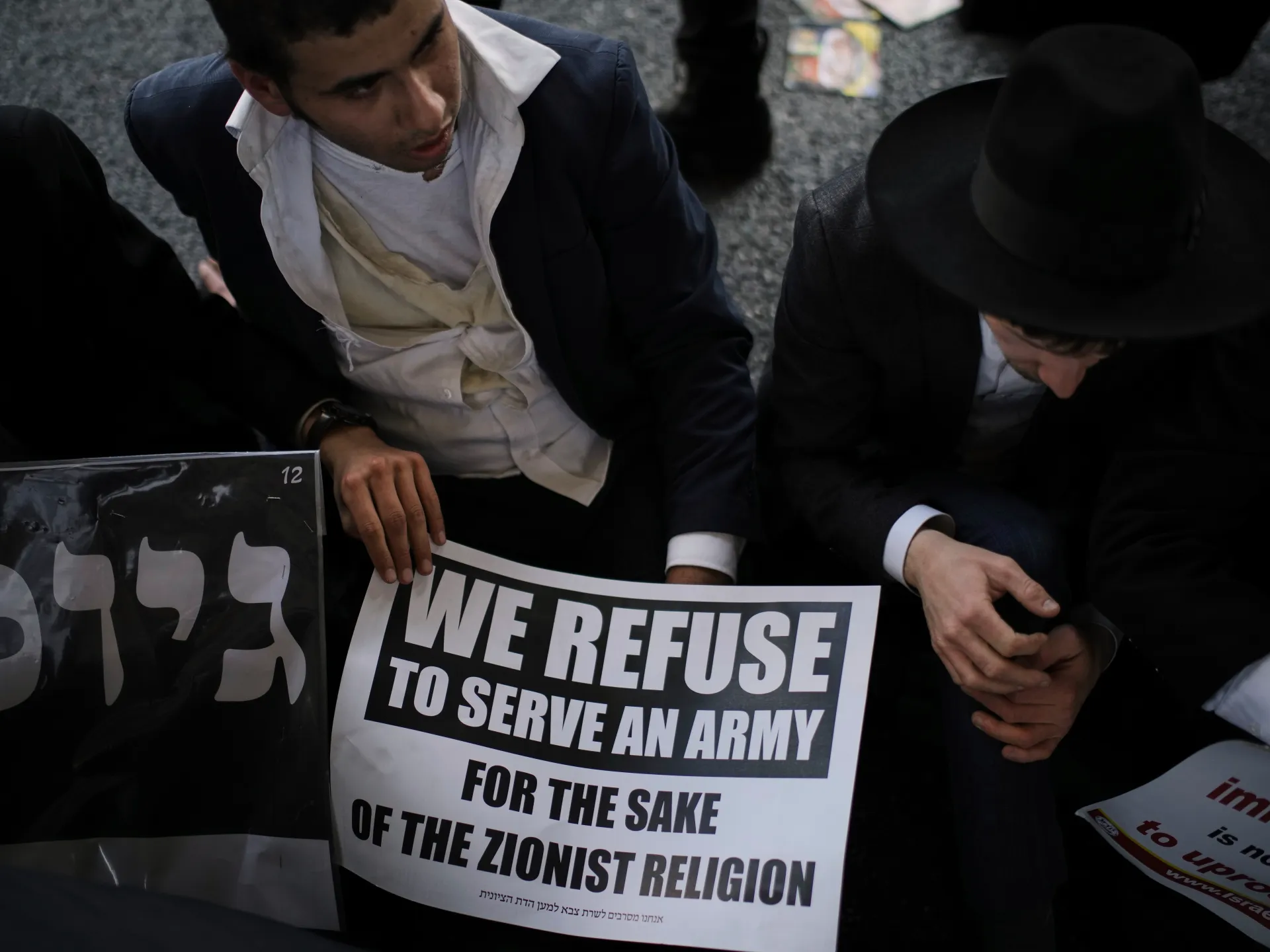
From the fallout of multi-fronted wars and demands for accountability over security failures to mounting concerns over the cost of living, Israelis are grappling with a series of crises ahead of the October 27 election .
Yet one contentious issue has come to dominate headlines during the campaign: whether Israel’s ultra-Orthodox Jewish minority should serve in the military.
An estimated 80,000 ultra-Orthodox, or Haredi, men aged between 18 and 24 are currently avoiding military service, a figure whose significance grows with every report of staff shortages in the Israeli army.
For their political supporters in the Knesset’s Haredi Shas and United Torah Judaism (UTJ) parties, they are helping preserve the essential character of Israel through Torah study and prayer.
But for their detractors, they are draft dodgers refusing to undertake their share in the multiple wars Israel has embarked upon in the wake of the Hamas-led attack of October 7, 2023.
Critics include the self-styled Zionist opposition bloc that is locked in a tight race with Prime Minister Benjamin Netanyahu ‘s Likud Party and the far-right coalition it leads.
In May, as Haredi anger over the jailing of draft evaders spilled into street protests following a 2024 Supreme Court ruling that the military must begin drafting ultra-Orthodox men, the issue proved toxic enough to threaten Netanyahu’s government.
His ruling coalition has relied on the support of the Haredi parties in return for softening measures aimed at forcing their supporters to serve in the army. But after Netanyahu told the parties that he lacked the votes to pass an exemption bill, they pushed to dissolve the Knesset and effectively weakened the government.
On Tuesday, Netanyahu said he opposed the arrest of 40 Haredim – plural for Haredi – who were taken in for evading the draft after returning to Israel from the United States, despite a law this year meant to temporarily halt such arrests.
“We must preserve the world of Torah because it preserved us,” Netanyahu told the Haredi Kol Barama radio station. “These arrests are a deliberate attempt to harm the process of drafting Haredim without coercion.”
However, how well Netanyahu’s comments will land with the rest of the population is unclear, with the issue seen as offering an opportunity for those seeking to oust him as well as opening up divisions within his own base.
A September poll by the Israel Democracy Institute found an overwhelming 72 percent wanted to see the Haredim drafted alongside other Israelis eligible for military service.
In early October, a group of Haredim clashed with Israeli forces seeking to arrest a draft dodger in Modi’in, drawing condemnation from Netanyahu’s opponents. Former Chief of Staff Gadi Eisenkot, whose Yashar (“straight” or “honest”) party currently holds a narrow lead over Netanyahu’s Likud, described the incident as reflecting “the same dangerous world view that seeks to make draft evasion the norm and portray those who fulfil their duty to the state as suckers”.
He added: “That is what the upcoming election is about: Netanyahu’s draft-dodging government, or a government of conscription led by me.”
Critics of the Haredim’s refusal to serve have even found voice within Netanyahu’s party, with Likud lawmakers arguing the issue of ultra-Orthodox non-conscription could pose a threat to the future of the State of Israel.
“It is a paradox,” said Daniel Bar-Tal, a professor of psychology at Tel Aviv University.
“On the one hand, the issue of equal service unites all the secular and Zionist religious public,” he said. “On the other side, the ultra-Orthodox are rightist … This does not go together, so [Netanyahu] has a dilemma.”
Despite popular anger over the refusal to serve, and the potential consequences for their allies in the Knesset who are striving to protect that exemption, Haredi intransigence shows no sign of easing.
The two Haredi parties – Shas and UTJ – have ruled out joining any coalition that does not pass laws exempting members of their community from military service, even if it makes forming any coalition sympathetic to the ultra-Orthodox impossible.
“This is a big deal,” said Israeli pollster Mitchell Barak. “The opposition parties are trying to pitch the election as the draft dodgers versus those who protect and serve – and that is the decisive point of the election.”
Next week’s polls are the first since Israel’s genocidal war against Palestinians in the Gaza Strip began in October 2023, killing nearly 74,400 people and leaving most of the besieged territory in ruins, as well as the multiple conflicts across the region that followed it.
The military campaigns have placed a big burden on the state’s finances, with the high cost of living being a major source of public discontent ahead of the polls. Higher taxes have added to the economic pressure, with surveys showing that families of reservists deployed to Israel’s war zones face increased emotional and psychological strain, alongside stagnant household incomes.
According to an August survey, 42 percent of Israelis said their finances had worsened since the war on Gaza began three years ago, with the families of reservists hit hardest.
That squeeze comes as the Haredi population keeps expanding, with 1.26 million, or 12.5 percent of Israelis identified as Haredi. Projections suggest that by 2065, somewhere between 20 percent and a third of the population will be Haredi, with a large portion refusing to either work or serve in the army in place of Torah study.
“The great burden of having to serve became much more pronounced – and at the same time the Haredi sector keeps growing,” said Shmuel Rosner, a senior fellow at The Jewish People Policy Institute, “which means that a large cohort of potential soldiers does not ease the burden on others.”
He added: “The blunt refusal of Haredi leaders to even consider a change in times of such dangers demonstrated to many Israelis that this community is one that depends on Israel financially and otherwise contributes little.”
Topics in this story
Gathered from external sources. Rights to this text belong to whoever originally published it.