In 2016, Frank and Monica Woll bought two tiny Florida Keys islands for semi-retirement; hurricanes soon washed away much of them
Rest of World News: Frank and Monica Woll purchased the Molasses Keys in 2016 for a peaceful retirement, but hurricanes threatened their effort to preserve the islands. Discover their ongoing fight against erosion and commitment to conservation in the Florida Keys.
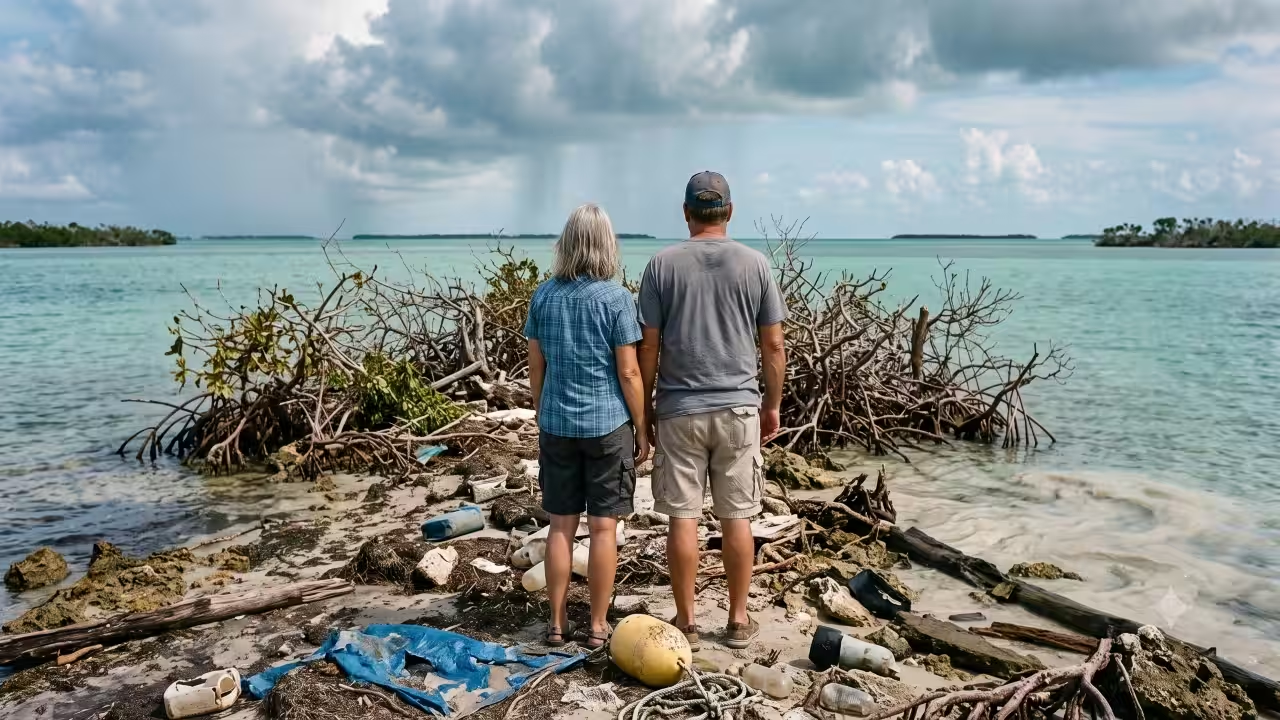
Frank and Monica Woll bought two small islands south of the Seven Mile Bridge in the Florida Keys, known locally as the Molasses Keys, taking on the property in the mid 2010s according to accounts from visitors and local boaters. After decades running a paddling and outfitting business on Key Largo, the couple wanted a quieter retirement caring for a patch of mangrove and sand instead of running a shop. Instead, they saw how quickly a low-lying Florida Keys island can lose ground after a major hurricane, a lesson that has played out repeatedly in the decade since, from Hurricane Irma in 2017 through to the present day.A modest preserve, not a resortThe islands the Wolls bought were never likely to be developed conventionally. The islands' own preserve materials describe a handful of low-lying islands considered environmentally sensitive, home to nesting birds, several species of crab and stands of state-protected black, red and white mangrove. Rather than build anything permanent, the couple treated the purchase as a stewardship project, setting up a system that let day visitors and the occasional camper register in advance, on the condition that they left the islands exactly as they found them. Frank Woll's ownership of the preserve was confirmed in local reporting describing him ferrying emergency responders from the islands to the scene of a boat crash near the bridge in 2025. That low-key approach suited the couple, who had spent years serving paddlers and boaters through their outfitting business before choosing to spend retirement on conservation.Storms that reshape land within hoursOwning land in the lower Keys, however modest, comes with an exposure to hurricanes that few other retirement projects carry. The islands sit on the Atlantic side of the archipelago, in the path of major storms that have long crossed the region, and each hurricane season brings the risk of losing ground that took centuries to build. Scientists who study similar low-lying Florida Bay islands have documented how dramatic that loss can be in a single event. A study from the US Geological Survey comparing elevation measurements on nearby islands before and after Hurricane Irma in 2017 found that the island closest to the storm's path lost between 32 and 42 per cent of the width of its eastern berm, along with a meaningful share of its vegetated cover.Although no equivalent survey has measured exactly how much shoreline the Molasses Keys have been lost since 2016, but the islands sit in the same exposed conditions described by the study: low to the water, thinly vegetated in places, and dependent on mangrove roots to hold sediment against wind and surge. When a hurricane tracks close enough, the same forces that shaped the islands over centuries can strip away ground in a single tide cycle, leaving landowners to assess the damage after the water recedes.Rebuilding by hand, one storm at a timeThe islands have not disappeared, but they have shrunk and reshaped considerably since the Wolls took them on, and for the couple, erosion control became an ongoing part of caring for the islands rather than a one-time repair. Their approach has reportedly involved simple, manual methods, stacking rock to slow further erosion along the most exposed shorelines and replanting mangrove seedlings in the hope that new root systems will eventually do the work that machinery cannot. Mangrove restoration of this kind is notoriously difficult on small, storm-battered islands, since young saplings often struggle with salinity shock and tidal exposure long before their roots are established enough to hold sediment in place.Even so, the Wolls have treated each setback as a reason to keep working rather than give up on the project. Their islands show what it means to hold onto a piece of coastline in a part of Florida where hurricanes can bring sudden, severe flooding and erosion. Whether that stewardship can keep up with erosion in the decades ahead remains to be seen.Catch the latest World News and Live updates. Download the TOI app.
Topics in this story
Gathered from external sources. Rights to this text belong to whoever originally published it.