A former soldier pulled a 1.5-tonne Land Rover for 100 km in 100 hours; he was trying to raise £100,000 for families with a rare brain disease
A former British soldier took an extraordinary test of strength and endurance by pulling a 1.5-tonne Land Rover across 100 kilometres in 100 hours.
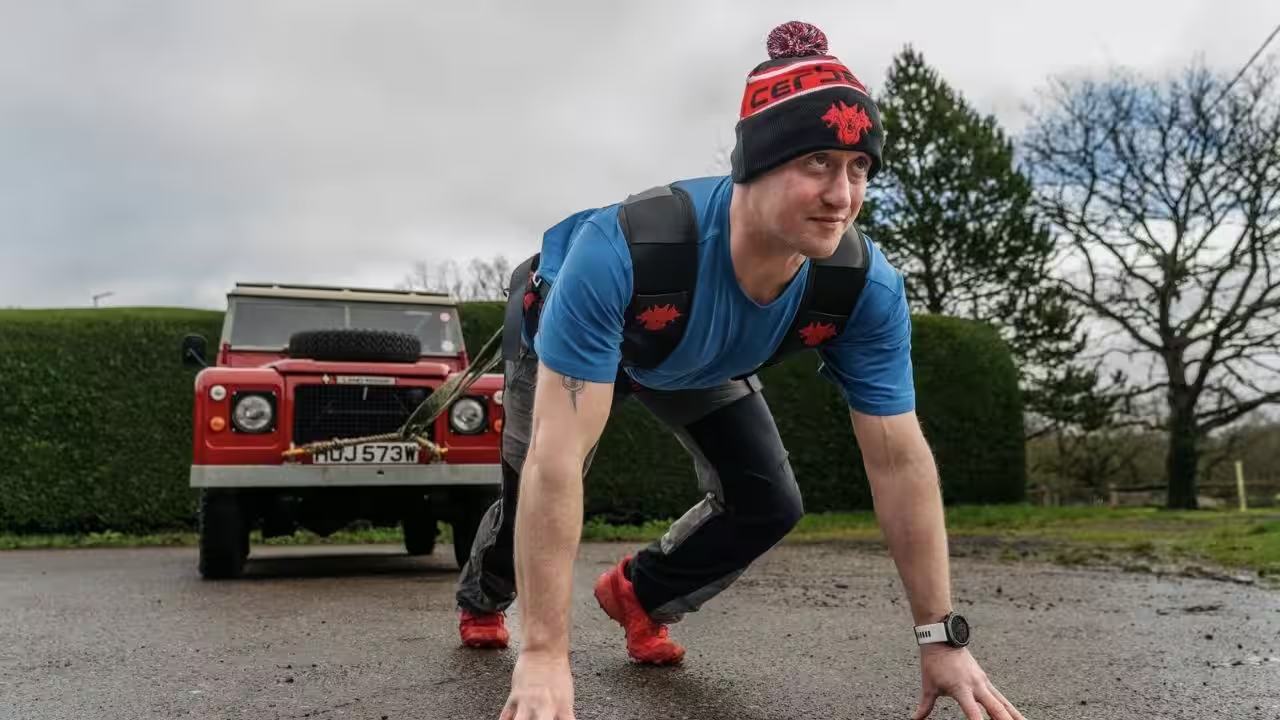
A former British soldier took an extraordinary test of strength and endurance by pulling a 1.5-tonne Land Rover across 100 kilometres in 100 hours. Darren Hardy, an extreme athlete from Fleet in Hampshire, launched the challenge to raise £100,000 for research into a rare and incurable brain disease affecting children. His efforts were focused on helping 17-year-old Aggie Candy-Waters and other families living with hypomyelination with atrophy of the basal ganglia and cerebellum, commonly known as H-ABC.Former soldier pulling a 1.5-tonne Land Rover for 100 kmAccording to Hobbs Independent, Hardy's challenge was designed to set a world record for the furthest distance a vehicle has been pulled. The attempt was scheduled to begin at noon on 20 March 2026 at Blackbushe Airport in Camberley, Hampshire. The goal was to cover 100 kilometres within 100 hours, demanding sustained physical effort rather than a short burst of strength.The Dunsfold Collection described the attempt as Hardy's biggest challenge yet. The distance was more than two marathons, but the difficulty extended beyond covering the ground. The challenge was to keep moving while managing exhaustion, changing weather conditions and the physical strain of dragging a heavy vehicle.Hardy explained that the challenge requires careful attention to food and hydration. He expected to consume approximately 45,000 calories and drink around 50 litres of water and electrolytes during the 100-hour attempt.The rare brain disease behind the fundraising effortThe money raised through the challenge was intended to support the H-ABC Foundation and SynaptixBio, a UK biotechnology company developing a potential treatment for the condition. As reported by Hobbs Independent, H-ABC is a severe form of TUBB4a leukodystrophy, a genetic condition that affects the central nervous system. It is rare, progressive and currently has no approved cure.Hardy's commitment to the cause began in 2019, when he came across the story of Aggie Candy-Waters. Her experience motivated him to use his endurance challenges to support research that could improve the lives of children affected by the disease.The Dunsfold Collection reported that Hardy raised more than £120,000 through his previous charitable efforts. This attempt was aimed to generate another £100,000 specifically for work that could help make treatment more accessible to patients and their families.A safer way to deliver treatment is importantSynaptixBio is developing an antisense oligonucleotide therapy for H-ABC. According to Hobbs Independent, preclinical studies had indicated that the treatment could halt disease progression and potentially reverse some symptoms. The company selected a lead candidate, identified as SB H-19642, and had been working towards clinical trials, potentially in early 2027.However, developing a potential treatment is only part of the challenge. Delivering it safely into the body is another important consideration, particularly because many people affected by H-ABC are young children.The funds from Hardy's challenge had been earmarked for developing a safer and simpler delivery method. The approach involves injecting medicine directly into the cerebrospinal fluid, a procedure that presents risks and practical difficulties.Researchers hope to develop a method that would allow the drug to be administered intravenously, through a vein. Such an approach could make treatment easier to deliver while avoiding the challenges associated with direct injection into the fluid surrounding the brain and spinal cord.Hobbs Independent reported that SynaptixBio had received a £2 million BioMedical Catalyst grant from Innovate UK. The company also received Rare Paediatric Disease Designations from the US Food and Drug Administration for H-ABC and related conditions.The Land Rover collection supported the attemptThe challenge had also brought together an unusual piece of automotive history. The Dunsfold Collection lended Hardy two prototype Land Rovers built in 1981. Only four were originally made, and just two have survived.One vehicle was supposed to be used for Hardy's record attempt, while the second was for other participants to pull alongside him. This arrangement gave members of the public an opportunity to take part in the event rather than simply watch from the sidelines.Hardy's military past and commitment to charityHardy's determination to take on physically demanding challenges developed after a difficult period in his life. According to The Dunsfold Collection, he was medically discharged from the Army in 2017 after experiencing complex post-traumatic stress disorder, following incidents in Iraq and a training exercise in Canada.He subsequently channelled his energy into extreme physical challenges for charitable causes and founded StayStrong. His previous efforts had included pulling a car for 50 kilometres, running 317 kilometres over 92 hours and completing multiple marathons within short periods.These achievements helped him raise money for H-ABC research while drawing attention to the families affected by the condition. Since Hardy began supporting the cause, SynaptixBio had been established and attracted £11 million in additional investment towards treatment development. The 100-kilometre Land Rover pull was another step in his continuing efforts to support children living with H-ABC.You use AI every day. Now get your AI Quotient. Take the AIQ test.
Topics in this story
Gathered from external sources. Rights to this text belong to whoever originally published it.