A Montana family spent 20 years deciding what to do with their 2,330-acre ranch; they finally found a way to keep it intact for generations by placing it under a permanent conservation easement
US News: For nearly a century, the Case family has been connected to a broad stretch of land in Montana’s Potomac Valley. But deciding how to secure the future.
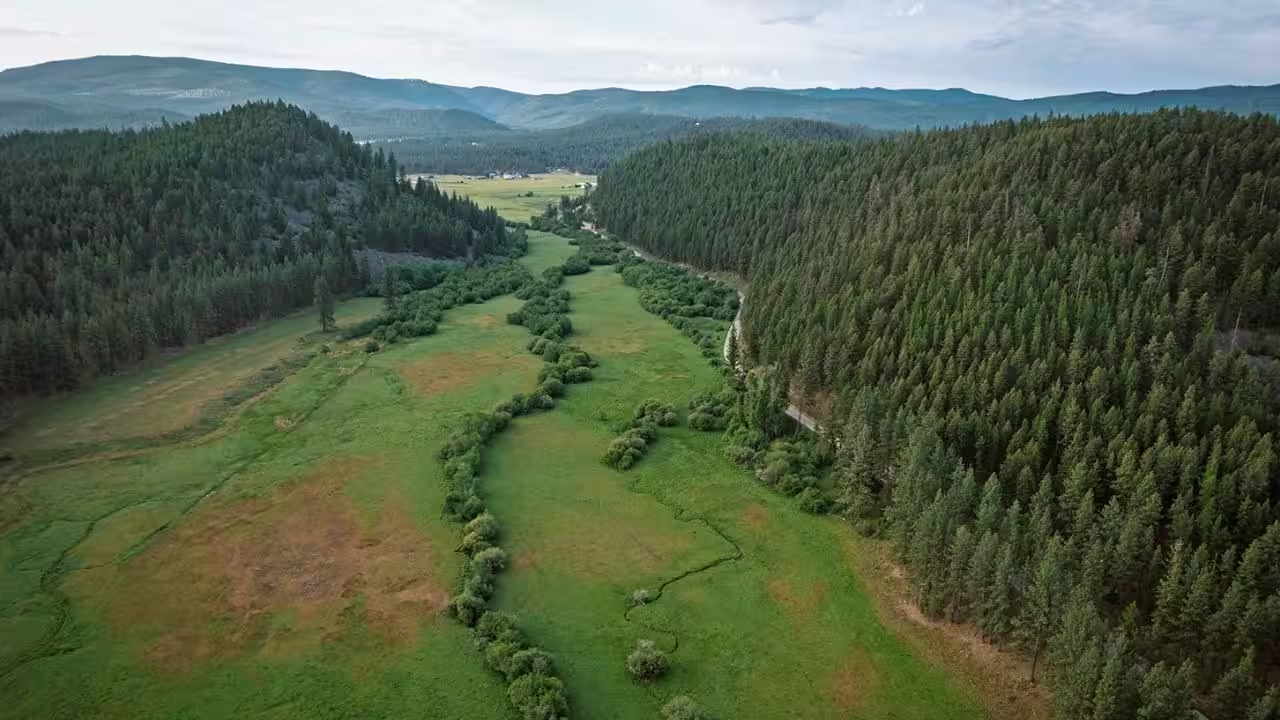
For nearly a century, the Case family has been connected to a broad stretch of land in Montana’s Potomac Valley. But deciding how to secure the future of the 2,330-acre Case Ranch proved to be a long process, spanning about 20 years and two generations. In March 2026, that process finally reached its destination when a conservation easement permanently protected the ranch while allowing it to remain in family ownership and continue operating as a working landscape. The agreement protects forests, meadows, wetlands and important wildlife habitat, while also preserving agricultural land and public hunting access. According to Five Valleys Land Trust, the project required the agreement of seven family members and the support of a wide coalition of public and private partners. For the Case family, the decision was ultimately about ensuring that the ranch would remain whole rather than being divided and developed. Case family's journey of securing the future of their 2,330-acre Montana ranchAccording to Five Valleys Land Trust, the conservation easement was roughly 20 years and two generations in the making. The central challenge was finding a solution that would protect the land without forcing the family to give it up. A conservation easement offered that possibility. Five Valleys Land Trust will hold the easement permanently, but the Case Ranch Company will continue to own and manage the property. For family members, keeping the ranch together was particularly important. Landowner Matt Case said that nobody wanted to see the property ‘chopped up,’ reflecting a concern that dividing the land could eventually change its character and reduce its value as both a working ranch and a wildlife landscape. The proceeds from the easement are also expected to help the family care for the property in the future. In that sense, the agreement was not simply about preserving a view or preventing development. It was designed to give the family a practical way to continue looking after the ranch for generations.How did the Case family’s ranch story beginAccording to Five Valleys Land Trust, Arnold H. and Annabelle Case bought a homestead in the Potomac Valley in 1932 and began building a life as ranchers. Their early years were far from easy. The region was still feeling the effects of extensive logging connected to the Anaconda Copper Company, while the Great Depression made rural life even more difficult. The three historic buildings that can still be seen from Highway 200 were once used to house mule teams that hauled logs. Over time, however, the Case family expanded the ranch and built a business based around cattle, forage and timber. The family connection to the land continued across generations. Five Valleys Land Trust explains that the Case Ranch Company is now made up of seven cousins, representing the descendants of Arnold and Annabelle’s two children, Arnold and Julie. That shared ownership also meant that deciding the ranch's future could not happen quickly. Every family member had to agree on a path forward.Value of public access to the Montana RanchThe Case family had already allowed public hunting access on the property for decades through Montana Fish, Wildlife & Parks’ Block Management programme. The new arrangement ensures that this access will continue into the future. The ‘Montana Fish, Wildlife & Parks decision notice’ states that the agency will secure and manage public hunting access on 1,710 acres of the ranch. Under the arrangement, the landowner must provide at least 200 hunter days of fair and equitable, free public hunting access each year. It also explains that the ranch provides access to more than 65,000 acres of adjacent state and federal land. Protecting that route therefore has significance beyond the Case Ranch itself. For the family, public access was part of the ranch's long-standing relationship with the surrounding community. Donna Hacker said that many people in the Potomac Valley rely on hunting to obtain meat for their families and value access to the wilderness.What makes the Montana ranch so important for wildlifeThe Case Ranch sits along the north-eastern edge of the Potomac Valley, an area recognised for its position between several major ecosystems. According to Atira Conservation, the property provides an important connection between the Northern Continental Divide, Greater Yellowstone and Bitterroot-Selway ecosystems. Five Valleys Land Trust reports that the ranch contains a mixture of conifer forest, grasslands, lush meadows and around three miles of Union Creek frontage. These habitats support elk, moose, black bears, grizzly bears, native trout, raptors and numerous resident and migratory birds, including sandhill cranes. The ranch also plays an important role in allowing wildlife to move across the wider landscape. Atira Conservation notes that the easement protects habitat connectivity for numerous species, including 14 Montana Species of Conservation Concern. The importance of that connection was one reason the project attracted support from several conservation organisations. According to Five Valleys, the permanently protected land could help preserve routes used by animals moving through the Potomac Valley and the wider Blackfoot River watershed.Source of funding to sustain such a large projectThe final agreement required a substantial financial partnership. According to Five Valleys Land Trust, the overall $4.8 million project received $2.34 million from the US Department of Agriculture's Natural Resources Conservation Service through its Agricultural Land Easement programme. Missoula County residents also supported the project through the county's Open Space Bond programme. Five Valleys reported that the Missoula County Commissioners awarded the project $994,550 in November 2024, the largest award in the programme's history.Additional support came from the Montana Fish and Wildlife Conservation Trust, The Montana Land Reliance, Atira Conservation, the Cinnabar Foundation, the Case Ranch Company and community donations to Five Valleys. The Case Ranch project demonstrates how a family decision can eventually become a wider community effort. After two decades of discussion and planning, the seven members of the family found a way to preserve the land without ending their connection to it. The historic ranch will remain in private ownership and continue as a working landscape. But its forests, meadows, agricultural land and wildlife habitat now have a permanent layer of protection. For a family whose history on the ranch stretches back to 1932, the agreement offers a future in which the Case Ranch can remain intact.Catch the latest World News and Live updates. Download the TOI app.
Topics in this story
Gathered from external sources. Rights to this text belong to whoever originally published it.