In 2003, a New York woman pulled a painting from trash on Manhattan’s Upper West Side; four years later she learned it was a stolen Rufino Tamayo work, and Sotheby’s sold it for $1,049,000
In 2003, Elizabeth Gibson was taking a morning walk on Manhattan’s Upper West Side when she noticed a brightly coloured abstract painting lying in the
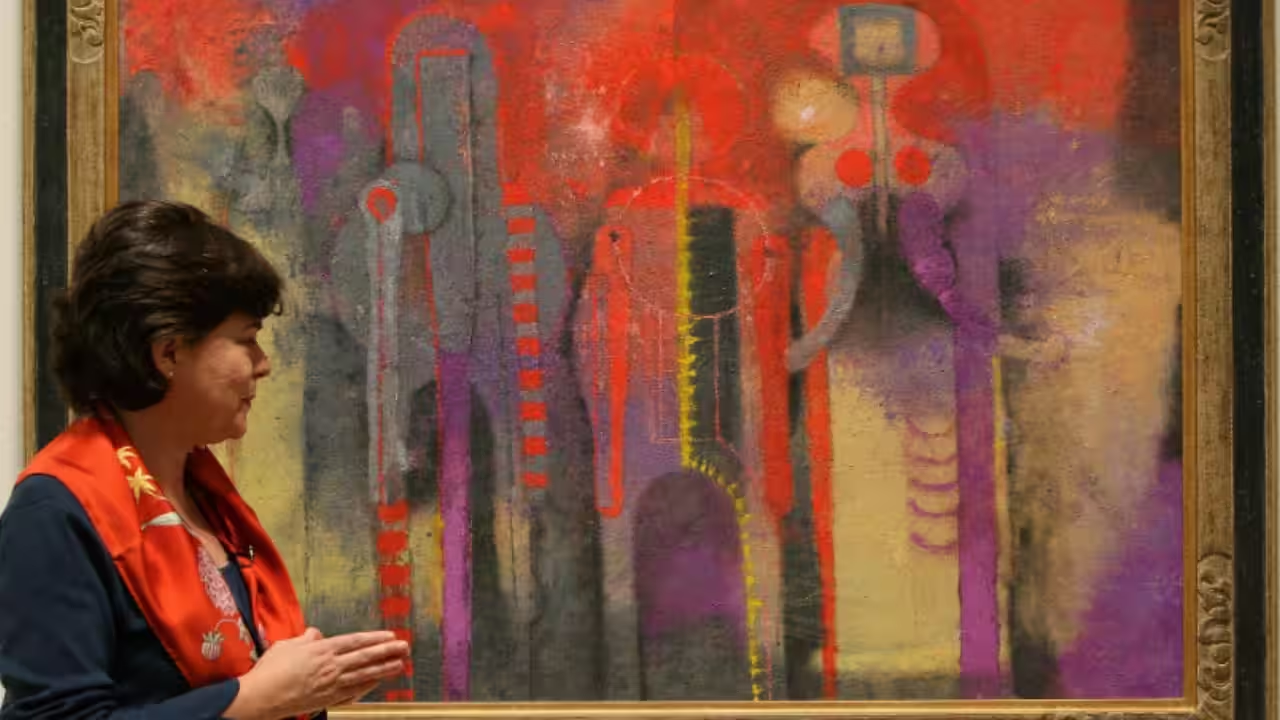
In 2003, Elizabeth Gibson was taking a morning walk on Manhattan’s Upper West Side when she noticed a brightly coloured abstract painting lying in the trash. She did not know who had painted it or why it had been thrown away. Still, something about the work made her stop and take it with her.Gibson later began looking into the painting she had found. Her search eventually led her to the website of “Antiques Roadshow FYI”, a companion programme to the PBS show “Antiques Roadshow”, CBC news reported. That was when she discovered that the painting was not an ordinary piece of discarded artwork.The painting was identified as “Tres Personajes” (Three People), a 1970 work by Mexican artist Rufino Tamayo. It had been bought by a Houston couple at Sotheby’s in 1977 and was stolen from a warehouse in 1987 while the couple were moving.The discovery came four years after Gibson had found the painting. Sotheby’s was preparing to sell the work at its Latin American Art auction on November 20, 2007. The auction house estimated that it could fetch up to $1 million.The 1987 stealingThe Houston couple had bought “Tres Personajes” at Sotheby’s in 1977. The painting is an oil on canvas, with marble dust and sand worked into the paint. According to August Uribe, Sotheby’s senior vice president of Impressionist and modern art, the husband had paid $55,000 for it as a gift for his wife.The painting was kept in a warehouse while the couple were moving. It was stolen from the warehouse in 1987. The couple then reported the theft to Houston and federal authorities.Information about the missing painting was also entered into databases maintained by the International Foundation for Art Research and the Art Loss Register. Despite those efforts, there were no credible leads about where the work had gone.The painting eventually turned up in a completely different setting. Gibson found it lying in rubbish on a street in Manhattan, apparently unaware that it was a valuable work that had been missing for years.For Gibson, the discovery was not simply about finding an unusual painting. She said she immediately felt that the artwork had some importance, even though she did not understand why.“I would say it was an appointment with destiny,” Gibson said in a telephone interview with the Los Angeles Times. “I just knew it meant something. It was extremely powerful, and even though I didn’t understand it. I knew it had power,” she added.Discovering the identityGibson's search for information about the painting eventually connected her to “Antiques Roadshow FYI”. Uribe had featured “Tres Personajes” on the programme’s “Missing Masterpieces” segment.That helped Gibson realise that the painting she had taken from the rubbish was the same work that had been stolen from the Houston couple two decades earlier.By then, Tamayo's work had become highly valuable. Sotheby’s described “Tres Personajes” as an important work from the artist’s mature period and prepared it for the upcoming auction.The original owner, whose husband had since died, was putting the painting up for sale. The couple had also offered a $15,000 reward for information leading to the recovery of the stolen work.Gibson was due to receive that $15,000 reward. She was also set to receive an undisclosed percentage of the eventual sale price.Rufino Tamayo and ‘Tres Personajes’Tamayo was born in 1899 in the Mexican state of Oaxaca. He studied at Mexico’s School of Fine Arts and began his career with work that had similarities to the style of well-known Mexican muralists such as Diego Rivera.His later work became more individual. It included vivid colours and expressions associated with Oaxaca, along with influences from pre-Columbian art.“Tres Personajes” reflected this later period of his career. Sotheby’s considered the 1970 painting an important example of Tamayo’s mature work.Tamayo became internationally known during his lifetime. He received numerous prizes and exhibited his work in the United States, South America, Europe and Russia. He died in 1991, but his paintings continued to attract strong interest.You use AI every day. Now get your AI Quotient. Take the AIQ test.
Topics in this story
Gathered from external sources. Rights to this text belong to whoever originally published it.