In the 1870s, Russian Thistle was accidentally introduced to South Dakota by Russian immigrants, but it spread to 100 million acres and became the iconic tumbleweed
US News: Discover the fascinating history of Russian thistle, a plant that inadvertently became a significant invasive species in the US, transforming landscapes and agriculture since its introduction in the 1870s.
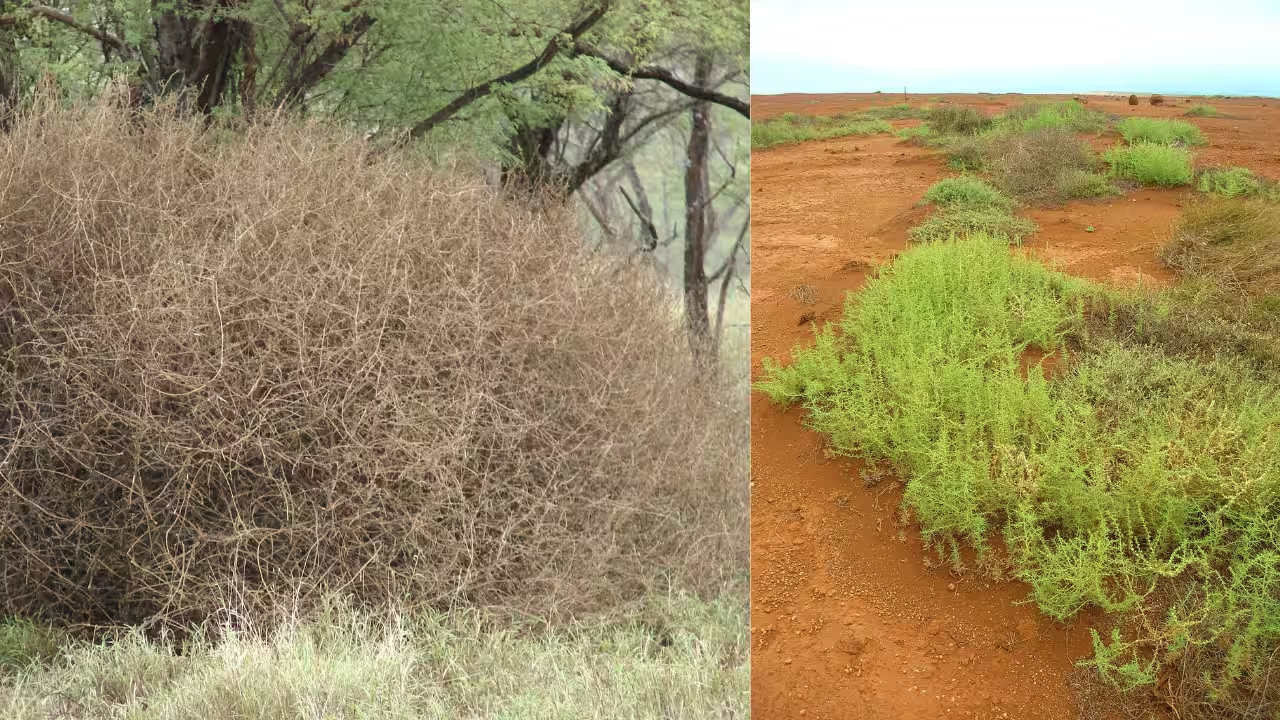
Russian thistle first appeared in North America in the 1870s near Bon Homme County, South Dakota, after its seeds seemed to have arrived after mixing with flaxseed brought from the Russian Empire. The plant had spread across much of the American West within a few decades, and by 1910, it was estimated to occupy about 100 million acres of arid and semi-arid land. Today, the plant is better known as the tumbleweed.Salsola tragus is commonly called Russian thistle, and originated in dry parts of Europe and Central Asia. Its first known North American appearance was in South Dakota, where it found a landscape increasingly altered by farming. Farmers were clearing native prairie vegetation and repeatedly disturbing the soil to grow crops. Russian thistle was well suited to those conditions because it could establish where competing vegetation had been removed.The weed followed farms and railroadsIts seeds were similar in size to some cereal grains that made separating them mechanically difficult. Seeds could therefore remain mixed with agricultural shipments and move between farms, and threshing equipment also carried seeds from one field to another. Grain and other agricultural materials could travel hundreds of miles, while seeds could also move through irrigation canals and ditches.The Natural History Museum in London describes Russian thistle as one of the fastest plant invasions in US history. By the beginning of the 20th century, it had reached California, where disturbed landscapes that were created by agriculture and overgrazing gave it additional territory. Its spread also coincided with a period when large areas of the Great Plains were being transformed for agriculture. Loose soil, reduced competition from native grasses and dry conditions created an environment in which Russian thistle could establish quickly, and by the time farmers understood the scale of the invasion, the plant was no longer confined to the place where it had first appeared.A plant built to rollThe plant begins as a relatively soft seedling, but it develops stiff and spiny branches as it matures. Eventually, the plant dries out and breaks away from its root, while its rounded structure allows wind to push it across open ground. Thousands of seeds can shake loose as the dead plant rolls, and the seeds may then remain dormant until conditions become suitable for germination.The Natural History Museum says an individual plant can produce as many as 250,000 seeds, depending on its size. Russian thistle can also tolerate low moisture and alkaline or saline soils, which gives it an advantage in the dry environments where a lot of the invasion occurred. Dense infestations could interfere with ploughing, compete with crops and restrict grazing, while dry tumbleweeds also created a fire hazard as they accumulated against fences, buildings and other structures.About 100 million acresThe USDA Agricultural Research Service has described Russian thistle as an invasive alien weed that occupies about 100 million acres in the western United States. Its documented effects include infestations of fallow fields, blocked irrigation systems, traffic hazards and increased wildfire risk. In 2025, the USDA’s Animal and Plant Health Inspection Service described Russian thistle as an alien annual weed that was infesting about 41.3 million hectares, which is equivalent to 100 million acres, across the western United States. The agency was evaluating the use of the blister mite Aceria salsolae as a biological-control agent to reduce infestations.Catch the latest World News and Live updates. Download the TOI app.
Topics in this story
Gathered from external sources. Rights to this text belong to whoever originally published it.