Duke University began exposing North Carolina forest plots to elevated CO2; after 10 years, loblolly pines produced about 20% more biomass
US News: A decade-long study by Duke University reveals that loblolly pines exposed to 1.5 times normal CO2 levels show a 20% biomass increase, highlighting the complexities of carbon sequestration in forests.
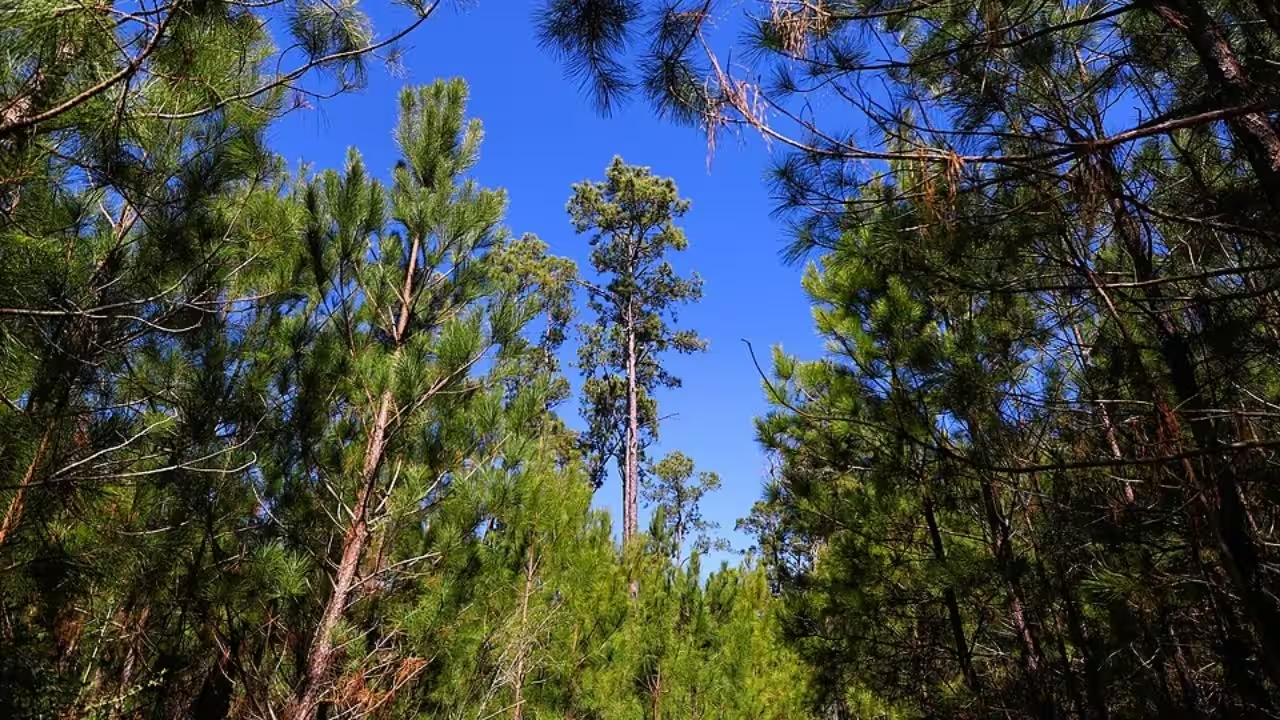
In a forest outside Durham, North Carolina, Duke University spent over a decade testing a simple question: what happens when mature trees grow in air containing relatively more carbon dioxide than they normally experience? The long-running Free-Air Carbon Enrichment (FACE) experiment exposed forest plots to elevated carbon levels under open-air conditions instead of enclosing the trees in chambers. By 2007, researchers reported that after a study of over 10 years, the treated, loblolly-pine-dominated plots had produced around 20% more biomass on average than matched plots receiving ambient carbon dioxide levels.In 1994, a prototype FACE plot at Duke began receiving elevated CO2, while a completely replicated experiment began in August 1996 with three elevated CO2 plots and three controls. Following this, the facility later expanded to four elevated and four control plots that were described in Duke’s 2007 report. Therefore, 1997 is associated with the four-plot configuration used in the long-term study instead of being the absolute beginning of CO2 enrichment at Duke Forest.After nearly a decade of elevated CO2 exposure, the treated forest landscapes had accumulated around one-fifth more biomass on average. The experiment also showed why the average could not be interpreted as a universal response, because localised soil conditions and resource constraints have a huge impact on how the trees synthesise the changed atmosphere from plot to plot.A higher atmospheric CO2 experiment was conducted by The Duke FACEThe Duke FACE facility was built in a loblolly pine plantation that was established in 1983. Loblolly pine (Pinus taeda) was the dominant tree, making the site useful for studying species widely distributed and commercially important across the southeastern United States. Rather than growing seedlings inside a greenhouse, researchers raised the carbon dioxide concentration around standing trees while allowing the forest to remain exposed to natural environmental conditions.The FACE system used rings of towers fitted with computer-controlled valves to release additional CO2 around the plots. Operating across these matched treatment and control parcels, the system adjusted output to reflect 1.5 times the CO2 concentration of the period, while the experimental literature more precisely describes the target as approximately 200 parts per million above ambient.The elevated-CO2 lands were maintained at concentrations around 550-570 parts per million during the experiment, depending on the ambient conditions and the treatment protocol. Therefore, the trees experienced higher carbon dioxide while continuing to grow in the open forest, with natural variation in temperature, rainfall, soil moisture and competition.The goal of the experiment was to see how additional atmospheric carbon affected biomass production, carbon storage, water usage and nutrient cycling. Those questions became increasingly important as scientists considered whether forests could absorb any of the additional CO2 entering the atmosphere from human activities.The 20% increase came with a major qualificationDuke reported that trees in the elevated-CO2 plots produced about 20% more biomass on average than those in the control plots. The researchers found a growth increase of only around 5-10% in some areas, compared with increases approaching 40% in others.The difference was closely related to resources available to the trees, as where water and nitrogen were scarce, the extra CO2 produced little additional growth. Where both resources were abundant, the response was much larger. This result indicated that carbon dioxide was only one part of the growth equation because trees also needed enough water and nutrients to turn the additional carbon available from photosynthesis into new tissue.The finding complicated the idea that forests could simply be used to bank excess atmospheric carbon. If rising carbon dioxide coincides with reduced water availability, Duke researchers cautioned, the increase in carbon sequestration could be much smaller or even disappear. A similar constraint applied to nutrients: increasing CO2 alone did not guarantee that a forest would continue to produce proportionally more biomass indefinitely. Thus, the researchers warned against treating the 20% average as a universal prediction for every forest, as this was only an experimental result from a particular loblolly-pine-dominated ecosystem, under particular soil, climate and resource conditions.It is worth noting that earlier observations by the same facility had already shown that the response could change with time. In 2005, Duke reported that pine growth under elevated CO2 had been substantially higher in several early years, with the largest increase reaching 25% in 1999. That early response did not mean the stimulation would continue indefinitely.What a decade of extra CO2 elevation revealedThe Duke experiment offered a more complicated picture than the simple idea that higher atmospheric CO2 automatically means proportionally larger carbon storage. The trees responded with 20% more biomass on average in the treated plots. But the response varied significantly with water and nitrogen availability, and the destination of that additional carbon mattered when assessing long-term sequestration.Furthermore, the experiment showcased the value of studying mature vegetation under open-air conditions, with the FACE technology allowing researchers to raise CO2 without sealing the forest inside an enclosure, thus preserving many interactions that occur in an actual ecosystem.Later research continues to refine the picture. A study examining trees harvested from the Duke FACE site found that the plots exposed to elevated CO2 from 1996 to 2010 contained around 21% more aboveground biomass when standard diameter-based biomass equations were used; accounting for changes in tree form increased the estimated treatment effect to around 27%. These later measurements are consistent with the general finding that elevated carbon dioxide increased wood volume, while demonstrating that the initial 10-year estimates remained highly conservative.Catch the latest World News and Live updates. Download the TOI app.
Topics in this story
Gathered from external sources. Rights to this text belong to whoever originally published it.