In 1973, former Army diver Eric Shaw began dropping donated boats off Gibraltar; over 30 vessels later, the sandy seabed had become a fish nursery
Rest of World News: Discover how former Army diver Eric Shaw's initiative in 1973 transformed Gibraltar's sandy seabed into a thriving artificial reef, providing a habitat for diverse marine life and reshaping ecological dynamics in the region.
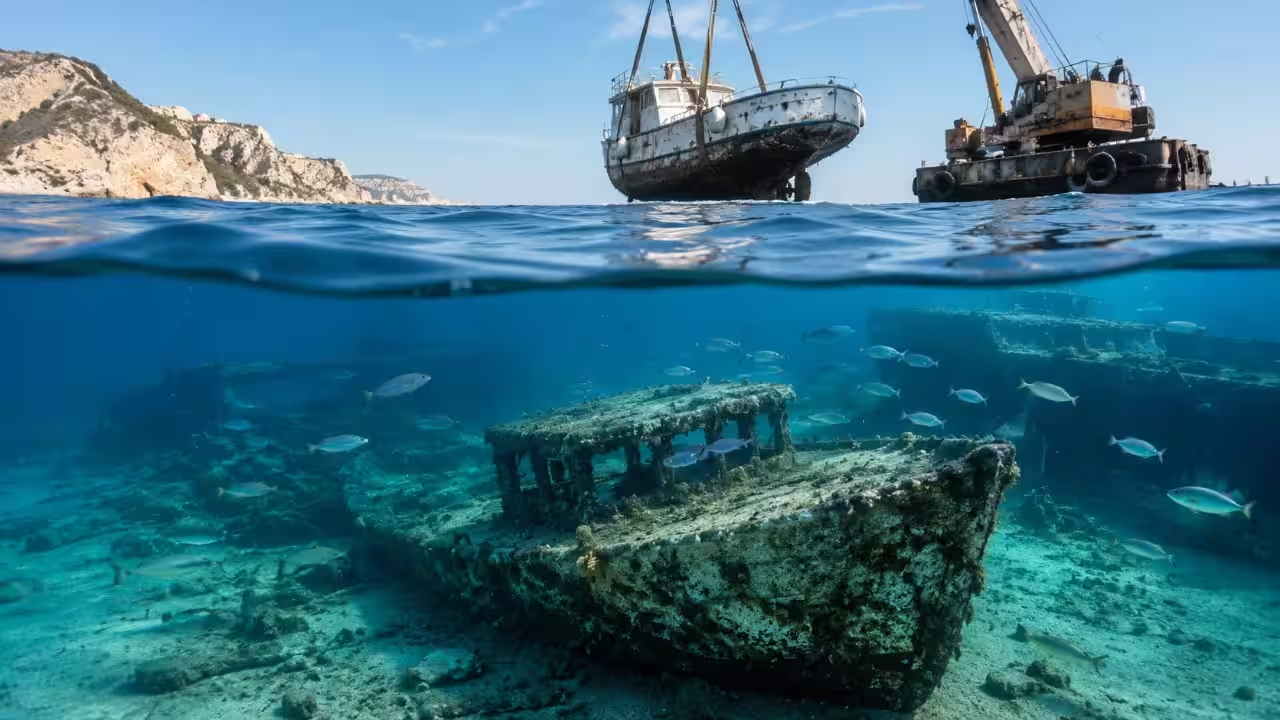
In 1973, former Army diver Eric Shaw looked at Gibraltar’s largely sandy seabed and saw an opportunity to give marine life somewhere to settle, hide and breed. His solution was unusual: use unwanted boats to build an artificial reef. What began as an experiment eventually developed into a major underwater habitat, with more than 30 vessels intentionally sunk around Gibraltar. The project is now regarded as one of Europe’s earliest artificial reef programmes.From empty seabed to artificial reefShaw’s idea was based on a straightforward ecological challenge. A largely sandy seabed offers fewer hard surfaces, crevices and sheltered spaces than a rocky reef, limiting the range of habitats available to marine organisms. According to Shaw, quoted by The Guardian, the area had been mostly sand with little visible life, prompting him to create an “oasis” where marine species could breed and colonise. Old boats provided a practical way to introduce solid structures to the seabed, creating surfaces and shelter that could gradually be occupied by marine life.The first vessels were donated locally, allowing the reef to expand gradually over the following decades. Rather than treating 1973 as the start of the formal government programme, it is more accurate to describe it as the year Shaw began developing the idea. The Government of Gibraltar dates the construction of its Artificial Reef Project to 1975 and says that more than 30 vessels have since been intentionally sunk and strategically positioned to enhance marine biodiversity and provide shelter for marine life. Before a vessel is submerged, it is carefully prepared to minimise environmental risks, with potentially polluting or detachable materials, including fuels, lubricants and loose equipment, removed beforehand.The structures provide something the original seabed lacked: hard surfaces. Organisms can attach themselves to the hulls, while holes, shaded spaces and gaps offer shelter for smaller animals. As these organisms become established, they can provide food and habitat for other species, allowing a more complex marine community to develop. Research published in Estuarine and Coastal Marine Science similarly found that artificial structures can help organisms colonise otherwise barren areas by providing solid surfaces, shelter and food. The study examined artificial substrates rather than Gibraltar specifically, but its findings illustrate the ecological principle behind Shaw’s project.A new home for marine lifeOver the decades, the vessels became established as artificial reef structures that supported a growing range of marine life. HM Government of Gibraltar reports that the artificial reef programme, which began in the 1970s, was associated with a dramatic increase in mid-water and bottom-dwelling species, as well as a rise in sessile organisms living on the reef structures themselves. One assessment recorded 12 vertebrate and 22 invertebrate species in the area before the reef was established, compared with 54 vertebrate and 55 invertebrate species after it was in place.The ecological significance of the project lies in this gradual accumulation of life. A bare or relatively simple seabed is transformed as the artificial structures provide places for organisms to settle. Those organisms then become part of the food web, while the physical complexity of the reef provides shelter for juvenile and adult animals. Therefore, the project also demonstrates why artificial reefs are increasingly considered in marine habitat management. They can introduce structure into environments where natural hard habitat is limited. However, they are not automatically equivalent to natural reefs, and their success depends on location, materials, water movement and how the structures are managed.When conservation became controversialGibraltar reef ended up getting entangled in a bigger conflict altogether. In 2013, there was controversy regarding the setting of other concrete blocks in the waters off Gibraltar by Spain. The Spanish fishermen complained that this was hindering their ability to fish, and the argument between Gibraltar and Spain grew bigger. This particular conflict shows us the importance of artificial reefs. While they do provide habitats for aquatic organisms and attract more life in general, they also affect how the animals interact in the area. The fish that tend to form around these structures may end up changing the patterns of fishing in the region.However, the basic premise of Shaw’s reef-building idea was relatively simple. Instead of trying to engineer an entire ecosystem, he introduced solid structures that gave marine organisms surfaces on which to settle and spaces in which to shelter. Over time, the approach became part of Gibraltar’s broader efforts to enhance marine habitat and biodiversity. The project later became the centre of a diplomatic dispute in 2013, when the Gibraltar government placed dozens of concrete blocks on the seabed to create another artificial reef. Spanish fishermen protested, arguing that the blocks restricted access to fishing grounds they had traditionally used, while Gibraltar said the structures were intended to protect fish stocks and marine life. What began with Shaw’s attempt to provide structure on a largely barren seabed had therefore developed into a much larger conservation effort, while also becoming entangled in the long-running political tensions surrounding Gibraltar.Catch the latest World News and Live updates. Download the TOI app.
Topics in this story
Gathered from external sources. Rights to this text belong to whoever originally published it.