Two blue whale bones kept in London’s Natural History Museum reveal a 100-year-old link to South Georgia’s whaling industry and early efforts to regulate whale hunting
Two blue whale vertebrae kept at London’s Natural History Museum have helped uncover a century-old story linking the South Atlantic, a colonial exhibition
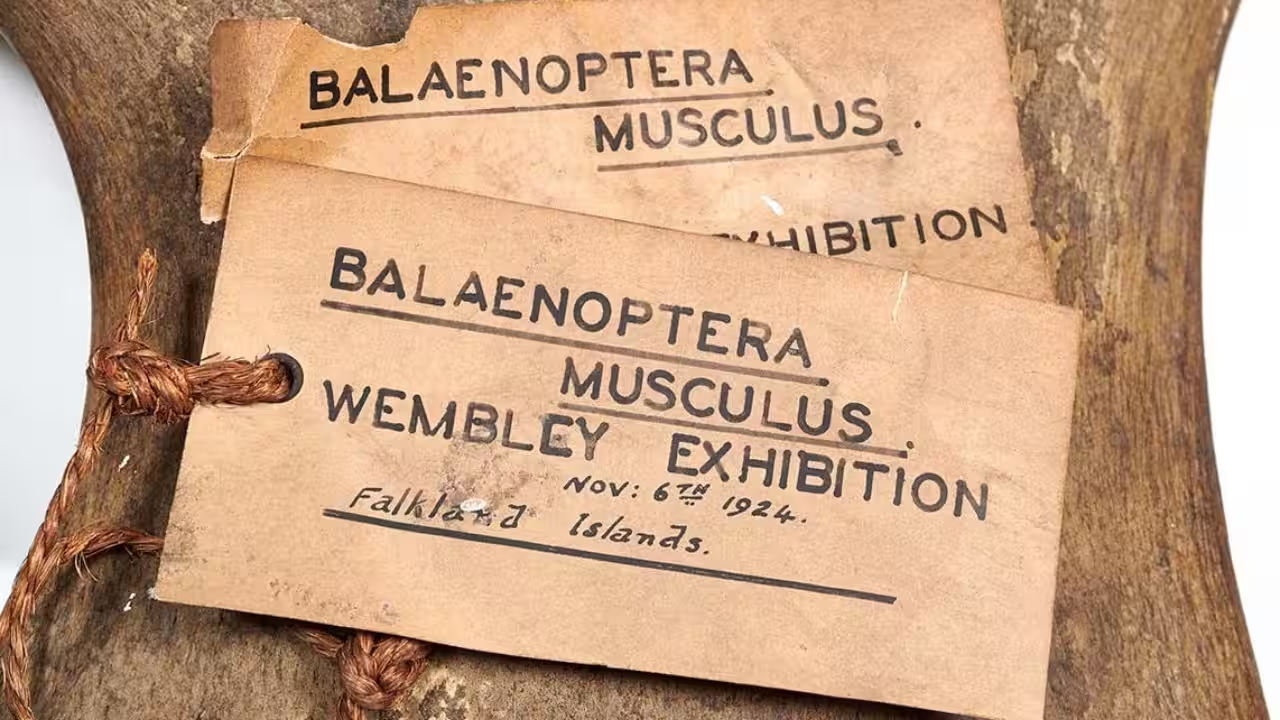
Two blue whale vertebrae kept at London’s Natural History Museum have helped uncover a century-old story linking the South Atlantic, a colonial exhibition and efforts to regulate whaling. The bones were collected from the Falkland Islands Pavilion at the British Empire Exhibition in Wembley in November 1924. Their origins remained unclear for more than 100 years, until museum researcher Dr Sophia Nicolov traced their history through museum archive records.According to the Natural History Museum, the vertebrae came from one or two whales killed off South Georgia and were taken ashore for processing. The discovery also links the specimens to Sir Sidney Harmer, a former museum director who called for regulations as whale populations around South Georgia declined sharply.How did researchers connect the vertebrae to the 1924 British Empire ExhibitionThe investigation began when Dr Sophia Nicolov noticed discoloured labels attached to two large blue whale vertebrae in the museum’s cetacean collection. The handwritten notes identified the species as Balaenoptera musculus and recorded the date as 6 November 1924, with the Falkland Islands listed as the location.They also referred to the ‘Wembley Exhibition’, a name unfamiliar to Nicolov and Richard Sabin, the museum’s Principal Mammals Curator.Further research established that the reference meant the British Empire Exhibition, held at Wembley Park in 1924 and 1925. More than 27 million people visited the event, which presented the resources and industries of 56 dominions, colonies and protectorates represented across the British Empire.The Falkland Islands Pavilion showcased the whaling industryThe exhibition’s regional pavilions presented different aspects of the territories they represented. The Falkland Islands Pavilion also covered the Falkland Island Dependencies, including South Georgia and the South Shetlands.Whaling was the region’s largest industry, and the display included equipment used by the Southern Whaling and Sealing Company, owned by Lever Bros. Visitors could see harpoon guns, knives and hooks, alongside photographs showing how the tools were used.Whale products were then widely used in oils for machinery, soaps, margarine and other goods. The pavilion also displayed wildlife from the Southern Oceans, including whale remains. However, the two vertebrae were not visible in the archival photographs identified by Nicolov during her research.A century-old paper trail solved the whale bone mysteryNicolov found records in the museum’s archives confirming that the vertebrae had been displayed at Wembley. Letters showed that museum taxidermist Percy Stammwitz collected the bones from the Falkland Islands Pavilion on 5 November 1924. A separate letter from Sir Sidney Harmer to A. Radcliffe, manager of the Southern Whaling and Sealing Company, thanked him for the specimens.It stated that they came from either one or two whales killed off South Georgia and taken back to the island for processing. A memo from Harmer added that the vertebrae had remained on a beach in South Georgia for more than a year before they were collected and shipped to London for the exhibition.Why were the blue whale vertebrae important to Sir Sidney HarmerThe vertebrae were particularly relevant to Harmer, who had investigated the effects of whaling around South Georgia for more than a decade. Whale populations in the region had declined dramatically, and he was an early voice calling for regulations on the industry.Harmer later used the bones in a talk at the Zoological Society of London, although their role in research over the following century remains unclear. Nicolov and Sabin hope the improved information about the specimens' origins will make them more useful to scientists studying the effects of whaling.You use AI every day. Now get your AI Quotient. Take the AIQ test.
Topics in this story
Gathered from external sources. Rights to this text belong to whoever originally published it.