After years of selling used clothes, Rose Blumkin saved $500 and opened a furniture store in Omaha in 1937; it grew into a retail business acquired by Berkshire Hathaway in 1983
Discover the remarkable journey of Rose Blumkin, who turned $500 into Nebraska Furniture Mart, one of the largest furniture stores in the US, transforming the retail landscape during the Great Depression.
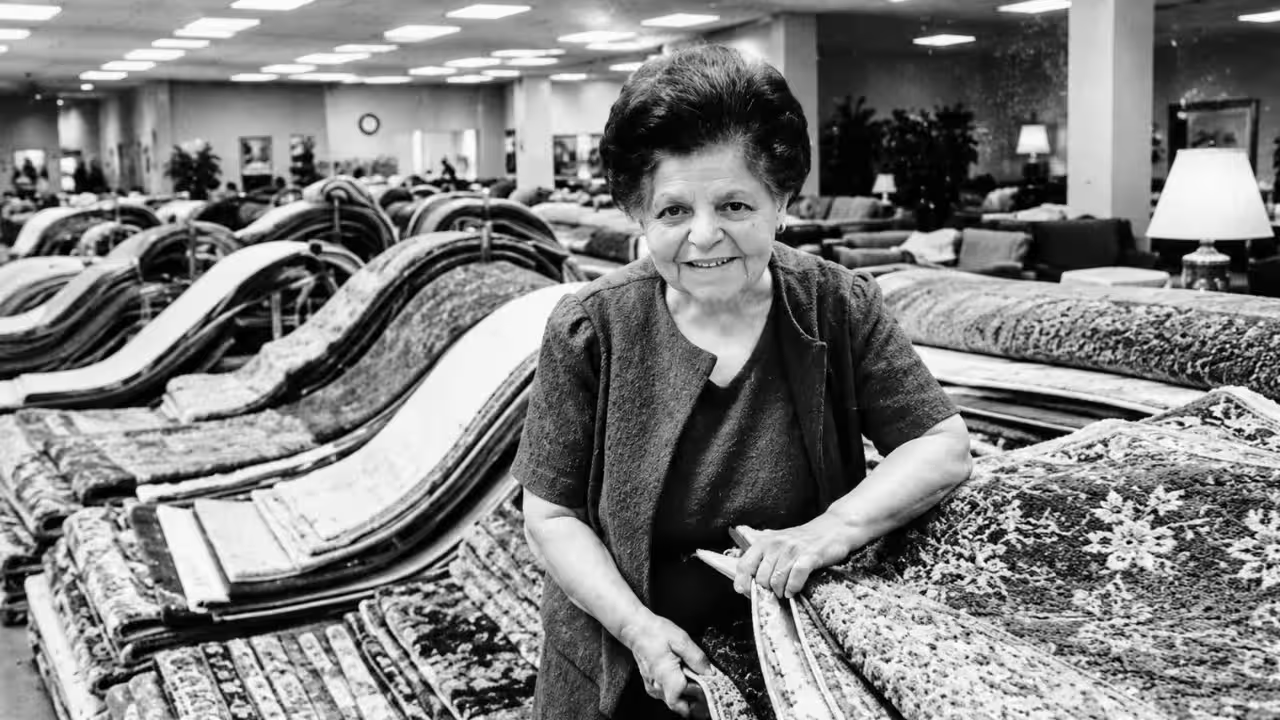
A former second-hand clothing seller, Rose Blumkin turned a profit when American firms were feeling the pressures of the Great Depression. The Russian emigrant used her modest savings of $500 and experience in trade to launch Nebraska Furniture Mart in Omaha, Nebraska and eight years later began the approach that would make her company one of the largest furniture outlets in the US.According to Berkshire Hathaway's 1983 shareholder letter, Rose Blumkin’s story caught the attention of billionaire Warren Buffett. It showed how perseverance, aggressive pricing, and customer trust can turn a small operation into a retail giant. Known to many customers as Mrs B. Blumkin, she lacked formal business education and financial training, but she benefited from years of direct selling experience, an eye for customers' needs, and competing against big-name retailers. As it turned out, her story was an important part of Berkshire Hathaway's history after Buffett bought a majority stake in Nebraska Furniture Mart in 1983.From selling used clothes to opening a furniture storeBorn Rose Gorelick in 1893 in a small village near Minsk, Russia, Blumkin grew up in a modest family. She started working early and gained retail experience in the family business. She came to the United States in 1919 to be with her husband, Isadore Blumkin, and ultimately settled in Omaha. The family business focused on the sale of second-hand clothing. Their experience in the business made her realise that it was difficult to attract customers when the economy was poor. She realised that people needed affordable prices rather than high markups to tempt them to buy when the family's budget was tight.Her technique proved especially effective during the great depression. She tried promotional deals and direct mail and ran a promotion: promising to outfit a man from head to toe for $5. The promotion garnered a lot of interest and showed the capacity for gaining customers. By 1937, she had accumulated $ 500 and launched her foray into the furniture business. Opening her first store in a basement in Omaha that she called Nebraska Furniture Mart. It was only a small store to start, but her plan was not limited to a small local operation.A low-price strategy that challenged established retailers Blumkin based her firm’s business plan on a simple philosophy: to sell customers high-quality merchandise at a reasonable price without being disconnected. It is reported that she marked up prices below those of the local furniture stores so that customers could buy furniture and appliances at an affordable rate. This strategy, however, was not without problems. The big furniture retailers did not like the low prices she set on her furniture, and some of the manufacturers pressured her to stop selling their products to their stores. Blumkin replaced these manufacturers and used other routes to buy her products. Her pricing also led to fair-trade violations, which she successfully challenged in court.Her perseverance especially came in the tough times with her business. In the 1983 Buffett shareholder letter, she remembers telling her creditors that she would sell them furniture and appliances from her house if needed. She was more concerned with hering her commitment rather than having a business supported by financial difficulties. The principle can be seen in academic papers and research studies published in the Journal of Retailing and Consumer Services, which analyses how customer and entrepreneurial orientation affect the performance of small retailers.Warren Buffett's 1983 acquisition and the business's legacyBy the early 1980s, Nebraska Furniture Mart had become a retail powerhouse. Warren Buffett, who had long admired Blumkin and her family's capabilities as businesspeople and managers, identified the acquisition as one of the year's highlights in Berkshire Hathaway's 1983 letter to shareholders. Berkshire Hathaway purchased a 90% interest in the company for $55.3 million, while family members retained the remaining 10%. The agreement allowed the Blumkin family to remain involved in the business and maintain its connection with the original owners.Face stated that it was an incredible business. It did more than $100 million in annual sales from a single-store, 2,000-square-foot showroom. It had good buying habits, terrific operations, and passed on savings to customers. She became a widow at age 94 but continued with the business until retiring at the age of 103. In 1998, she died, having built the business into far more than the small basement store she first opened in 1937. Today, Nebraska Furniture Mart operates in Omaha, Des Moines, Kansas City and the Dallas-Fort Worth metro area.You use AI every day. Now get your AI Quotient. Take the AIQ test.
Topics in this story
Gathered from external sources. Rights to this text belong to whoever originally published it.