Hawaii put 195,000 plastic bottles’ worth of recycled plastic into Fort Weaver Road in 2022, but the experiment came with a hidden environmental question
Rest of World News: A road in western Oahu looks much like any other stretch of asphalt. Cars pass over it, tyres wear against its surface and, from the driver's seat, th.
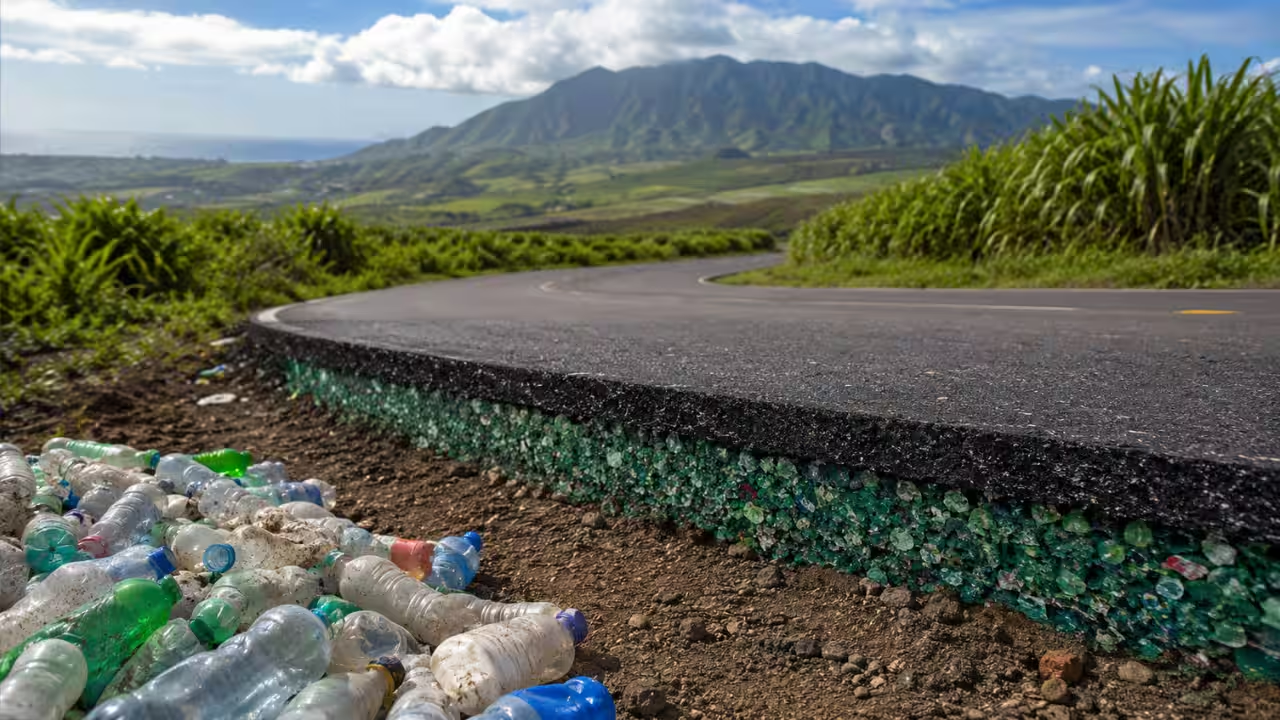
A road in western Oahu looks much like any other stretch of asphalt. Cars pass over it, tyres wear against its surface and, from the driver's seat, there is little to suggest that recycled plastic is part of the pavement underneath. Yet in 2022, the Hawaii Department of Transportation (HDOT) began testing exactly that idea on Fort Weaver Road in Ewa Beach.Reportedly, the project used 1,950 tons of plastic-modified asphalt, containing recycled plastic equivalent to about 195,000 bottles. The aim was not to build a road out of plastic, but to add a small quantity of recycled polymer to a conventional asphalt mixture and see how it behaved.There was a second question hanging over the experiment, though. If plastic could be kept out of a landfill by putting it into roads, what happened to that material afterwards?Hawaii’s 195,000-bottle plastic road was built as a pavement testAccording to Hawaii News, The Fort Weaver project was designed as a pavement experiment rather than a wholesale change to road construction. The recycled plastic polymer was incorporated into hot-mix asphalt, with the resulting material containing only around 0.1% plastic. Three sections were laid so researchers could compare different mixes, including a conventional control section.The figure of 195,000 bottles can make it sound as though an enormous quantity of plastic was physically packed into the road. In reality, the bottles are an equivalent measure of the recycled material used in the asphalt. The plastic forms only a small part of the much larger paving mixture.HDOT's interest was partly practical. If the modified asphalt could withstand Hawaii's conditions without sacrificing pavement performance, recycled plastic might become another material available for road construction. The department was also examining whether the approach could help produce stronger or longer-lasting pavement.Hawaii compared recycled plastic asphalt with conventional pavementPlastic waste presents a particularly awkward problem for places that have limited land and complex waste-management needs. Turning some of that material into an ingredient for infrastructure offers a possible route away from disposal, while also reducing the amount of new material needed for certain applications.But roads are not forgiving testing grounds. They have to withstand traffic, heat, rain and repeated loading for years. A material that looks promising in a laboratory still has to perform when thousands of vehicles travel across it.That is why HDOT did not simply replace an existing road with the new mixture and declare the experiment a success. A section using polymer-modified asphalt was placed alongside the plastic pavement, giving researchers a reference point for comparison.The hidden environmental test behind Hawaii’s plastic roadThe most interesting part of the experiment was not necessarily visible from the road. The University of Hawaiʻi at Mānoa and Hawaiʻi Pacific University were brought in to examine what happened around the new pavement. Part of the work involved investigating whether plastic particles or chemical additives could leave the asphalt and enter the surrounding environment.By 2023, researchers at Hawaii Pacific University's Center for Marine Debris Research were collecting simulated stormwater runoff from the pavement. The samples were being examined for microplastics and synthetic chemicals that might have been released from the road.They were also looking at tyre-wear particles. That was important because not every tiny plastic particle found around a road would necessarily have originated in the pavement itself. Vehicles can generate their own mixture of rubber and polymer particles as tyres gradually wear down.So the catch was fairly straightforward: putting waste plastic into asphalt may prevent some plastic from reaching a landfill, but researchers still have to establish what happens to that plastic while the road is being used.Hawaii spent 18 months testing what recycled asphalt could doThe plastic experiment was also tied to a separate effort to increase the amount of reclaimed asphalt pavement, or RAP, used in Hawaii.According to HDOT, asphalt mixtures contain 50% RAP. If those mixtures performed adequately, the resulting data could support a substantial increase in the amount of recycled asphalt used in future road projects.That makes the Fort Weaver project slightly different from a simple plastic-recycling exercise. Engineers were testing several approaches to reducing the demand for virgin road-building materials at the same time.Plastic was one part of the experiment. Reclaimed asphalt was another. The evaluation was planned to run for about 18 months. Rather than judging the pavement immediately after construction, researchers intended to watch its performance over time and examine environmental samples from the site.That longer observation period was necessary because a road can look perfectly sound shortly after it has been laid and still develop problems later. Cracking, rutting, surface wear and changes caused by weather are among the things that matter when judging a pavement mixture.Environmental monitoring adds another layer. A recycled material can solve one waste problem while creating a different concern if components migrate into soil or water. That is why the researchers were specifically looking for evidence of microplastics and other substances in runoff.The plastic road was a test for Hawaii’s future paving plansThe department had already acknowledged that plastic-containing asphalt had been used elsewhere in the United States, while stressing that the mixture still needed to be evaluated for Hawaii's particular conditions. That caution is important. A material working on one road in one climate does not automatically make it suitable everywhere.The project also involved local institutions and industry partners, turning the stretch of Fort Weaver Road into something of a live laboratory. Cars continued to use the road while researchers collected information that could eventually influence future paving decisions.There was no guarantee that the plastic mixture would become standard practice. And that was precisely the point of the pilot.What happened to the 195,000 bottlesThey did not become 195,000 recognisable bottles buried beneath the surface. The recycled material was processed and incorporated into the asphalt mixture. The quantity of plastic used was calculated as being equivalent to about 195,000 plastic bottles. HDOT said this represented material that otherwise could have gone to landfill.If the modified asphalt proved durable and did not create unacceptable environmental impacts, roads could provide one additional outlet for certain recycled plastics. If the material degraded, leached unwanted substances or failed to improve pavement performance, the apparent recycling benefit would be harder to justify.That uncertainty is why the project attracted scientific scrutiny rather than being treated simply as a recycling success story.Hawaii’s plastic road experiment moved into a second phaseThe initial phase was completed in 2022, but the idea did not end there. Hawaii later moved into a second phase of its plastic-road work, including material from consumer recycling and discarded fishing nets.That development points to a larger issue surrounding recycled materials: where the feedstock comes from matters almost as much as where it eventually goes.For Hawaii, finding uses for locally generated waste could potentially reduce disposal while creating a supply of recycled material for infrastructure. But each new material source brings its own composition and processing questions.Catch the latest World News and Live updates. Download the TOI app.
Topics in this story
Gathered from external sources. Rights to this text belong to whoever originally published it.