In 2009, Terry Herbert found the Staffordshire Hoard in a farm field; its £3.285 million reward was later divided between the finder and the landowner
UK News: Discover the remarkable story of the Staffordshire Hoard, a significant find of Anglo-Saxon gold and silver artifacts, and the rewards shared by the finder and landowner totaling £3.3 million.
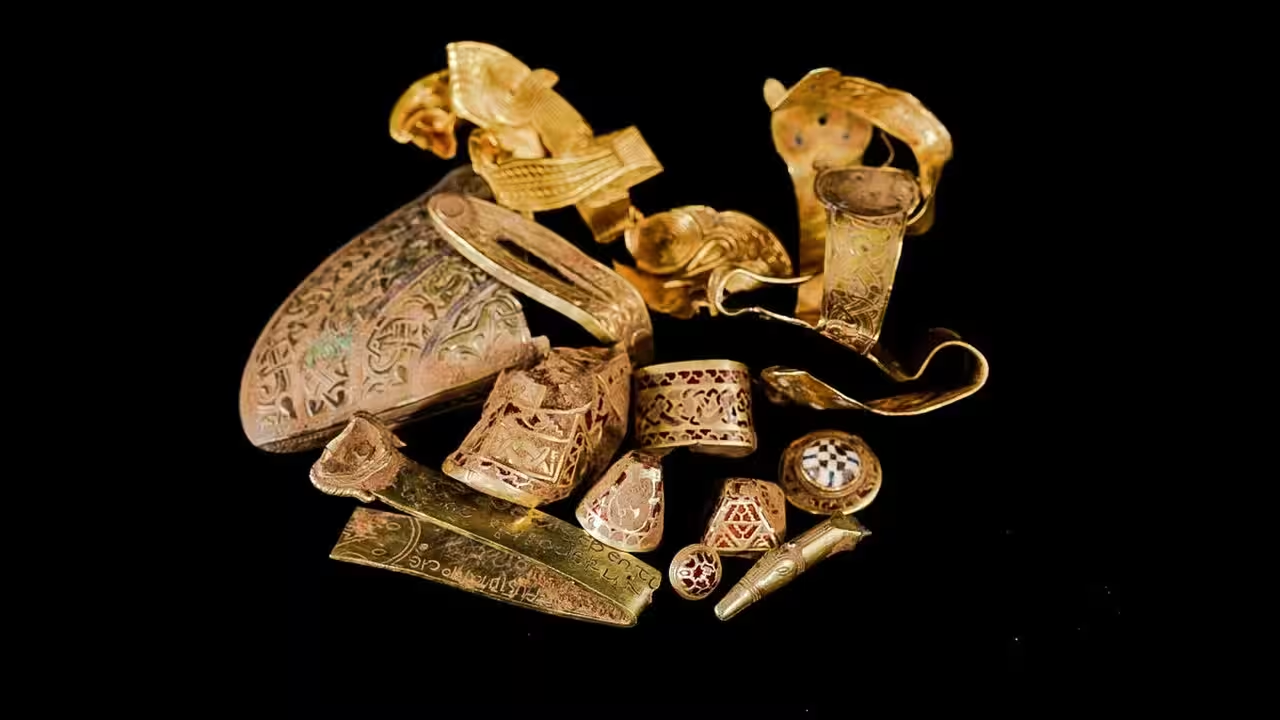
In July 2009, a man swinging a metal detector over a farm field in south Staffordshire began pulling gold out of the ground. Before long, people had already begun calling this find one of the most significant hoards of Anglo-Saxon artefacts to ever be discovered. It also set off a valuation, a national fundraising drive and an equal payout to the finder and the farmer who owned the land.Terry Herbert recovered 244 bags of finds between 5 and 10 July 2009The study The Staffordshire (Ogley Hay) hoard: recovery of a treasure, published in Antiquity in 2011 by Leahy, Bland, Hooke, Jones and Okasha, records the first days of the find. The hoard was discovered by Terry Herbert between 5th and 10th July 2009 using metal detectors in the arable lands of south Staffordshire. He contacted Duncan Slarke, Finds Liaison Officer of Staffordshire and the West Midlands in the Portable Antiquities Scheme. Slarke met Terry Herbert at his house and made a provisional inventory of 244 bags of items.The hoard holds about 3,900 fragments, mostly sword fittings.The study Secrets of the Anglo-Saxon goldsmiths: Analysis of gold objects from the Staffordshire Hoard, published in the Journal of Archaeological Science in 2016 by Blakelock, La Niece and Fern, calls the hoard the largest ever find of Anglo-Saxon gold and silver metalwork. It contains many hundreds of items in around 3,900 fragments. Most of these consist of parts from swords. The others are made up of parts of at least one helmet, as well as a few Christian items.Purity of over 222 gold components could not be used to order them by ageIn the same 2016 study, Blakelock, La Niece, and Fern state that they started by studying 16 gold artefacts that were used to deplete gilding in order to remove silver and copper from the surface. The researchers also studied 114 other items, totalling more than 222 parts. The analysis showed no relationship between the purity of the alloy and the age of the objects, so purity alone cannot be used to arrange the pieces in date order. As mentioned earlier in the study, the findings also suggest that there was extensive surface treatment of gold in Anglo-Saxon workshops. According to the authors, the same method could be used for discovering workshop procedures in other civilisations.The Treasure Valuation Committee set the value at £3.285 million on 25 November 2009In November 2009, the Treasure Valuation Committee, meeting at the British Museum, valued the Staffordshire Hoard at £3.285 million, according to contemporary news reports. This money would then be divided equally between the finder, Terry Herbert, and the landowner, Fred Johnson, after it was obtained. Simple arithmetic tells us that each one gets about £1.64 million.Terry Herbert, Fred Johnson, and the two museums interested in acquiring the treasure agreed on this valuation. They were the Birmingham Museum & Art Gallery and the Potteries Museum & Art Gallery, Stoke-on-Trent. Thus, there was no need for the payment in the form of a cheque from a single buyer; a campaign would do.A £1,285,000 grant completed the purchase price on 23 March 2010In March 2010, on the 23rd of that month, it was reported that the National Heritage Memorial Fund (NHMF) had granted funding in the amount of £1,285,000 for the acquisition of the Staffordshire Hoard, bringing its purchase cost to £3.285 million. Art Fund said that its campaign, which was launched in January 2010, raised £2 million from the public, charitable trusts, and foundations.About 5 kilograms of gold and 1.3 kilograms of silver top the Sutton Hoo recordOn the website of the Staffordshire Hoard, the hoard consists of 5 kg of gold and 1.3 kg of silver, which is more than the weight of the Sutton Hoo burial (1.66 kg of precious metals). It belongs to the 7th century AD and is mainly martial in nature. The NHMF also points out that the experts say that the high level of craftsmanship may indicate royal property. In this way, the two papers and the NHMF information provide a complete account of the process. Within days of the discovery in July 2009, Terry Herbert, the person who found the items, told Fred Johnson, the landowner, and other authorities. The experts then studied these artefacts for many years, after which the value of the monetary prize, £3.285 million, was split evenly between Herbert and Johnson.Catch the latest World News and Live updates. Download the TOI app.
Topics in this story
Gathered from external sources. Rights to this text belong to whoever originally published it.