Across 20 Spanish wind farms, stopping turbines when birds neared coincided with a 92.8% drop in recorded griffon vulture deaths over 13 years, with estimated power losses below 0.51%
A groundbreaking study reveals that temporarily stopping wind turbines near vultures drastically reduced griffon vulture fatalities by 92.8% over 13 years, with minimal impact on energy production.
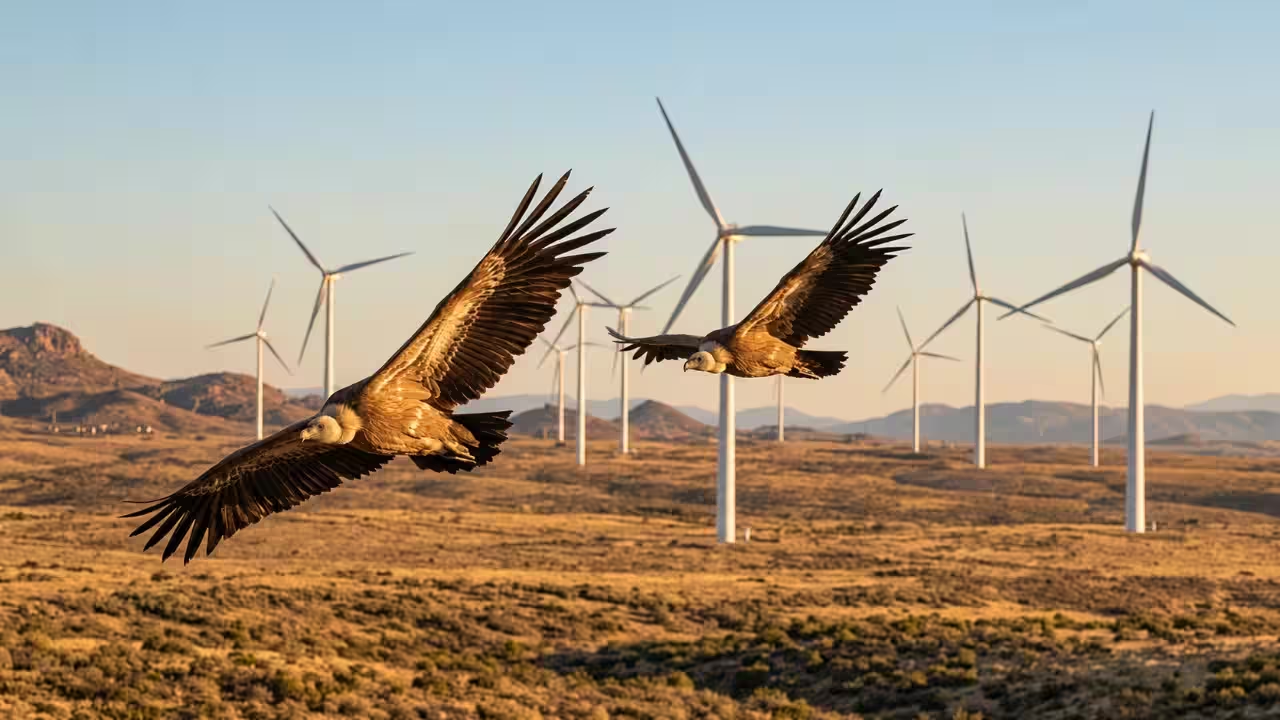
In southern Spain, researchers investigated a practical way to reduce these collisions: temporarily stopping selected turbines when birds were flying close enough to be at risk. Over 13 years, the approach was associated with a 92.8% reduction in recorded Griffon vulture fatalities, while estimated losses in electricity generation remained below 0.51%. According to a 2022 study published in Global Ecology and Conservation, a selective turbine shutdown protocol implemented across 20 wind farms in the Cádiz area of southern Spain was associated with a 92.8% reduction in recorded Griffon vulture fatalities over 13 years. The approach involved temporarily stopping individual turbines when birds approached at risk of collision, allowing the remaining turbines to continue operating.How the turbine shutdown system workedThis study involved monitoring 269 turbines located on 20 wind farms close to the Strait of Gibraltar, which is an important migration route for soaring birds migrating from Europe to Africa. The scientists looked at the rate of bird mortality during two years, namely 2006 and 2007, when there was no such shutdown protocol, and from 2008 until 2020, when the shutdown protocol was implemented.The observers monitored medium and large birds, especially birds of prey, approaching the turbines in situations likely to lead to a collision. When birds came too close, the observers contacted the control room to request a turbine shutdown. The approach relied on trained observers who could spot birds and recognise risky flight patterns. The turbines were restarted once the danger had passed, rather than being left off for long periods regardless of bird activity. This strategy mattered because bird strikes were not evenly distributed across turbines or throughout the year.What the 13-year study foundDuring the 13-year study, the researchers recorded 2,903 bird deaths and 354 bat deaths at the 20 wind farms. With the implementation of the turbine shut-off strategy, bird deaths among soaring birds such as raptors and storks decreased by 61.7%. The reduction was even greater for griffon vultures, whose recorded deaths fell from 12,627 in 2006 to 855 in 2020. These findings were notable because the vulture population increased during the study period. The griffon vulture population increased by more than seven times, and the number of shutdowns triggered by griffon vultures rose 2.5 times, from 3,517 in 2008 to 8,927 in 2020.The researchers estimated that shutdowns reduced annual electricity production by less than 0.51%. During the final three years of the study, turbines were stopped for an average of 108 minutes per intervention. Because Griffon vultures are active during daylight hours, the system could target periods of risk while allowing turbines to operate normally at night. Earlier research published in Biological Conservation also examined selective turbine shutdowns in southern Spain. That study reported a 50% reduction in Griffon vulture mortality during 2008 and 2009, with estimated annual energy losses of just 0.07%.Can selective shutdowns protect more birds?These results may help reduce the environmental impact of wind energy expansion. Rather than relying only on permanent restrictions or infrastructure changes, operators can respond to imminent danger by shutting down particular turbines if needed. Yet, there are some drawbacks associated with the method. It requires an observer to be present and able to identify danger in time to shut down the turbine. As the researchers pointed out, the procedure was mainly designed for large birds flying during the day.These findings come from a specific region where migration patterns, bird populations and turbine placement affect collision risk. Other regions may need different monitoring setups if birds are active at night or visibility is poor. Automated cameras and radar detection may help address these problems, but their efficiency and cost need to be assessed separately. Overall, the Spanish study suggests that selective shutdowns can help protect griffon vultures without major electricity losses.You use AI every day. Now get your AI Quotient. Take the AIQ test.
Topics in this story
Gathered from external sources. Rights to this text belong to whoever originally published it.