Belgium built a 700-metre circular bicycle path that rises 10 metres into a forest; cyclists can ride through the treetops on a double-loop bridge
A 700-metre circular bicycle path in the Pijnven nature reserve, part of Bosland National Park in the municipality of Hechtel-Eksel, lifts cyclists to 10
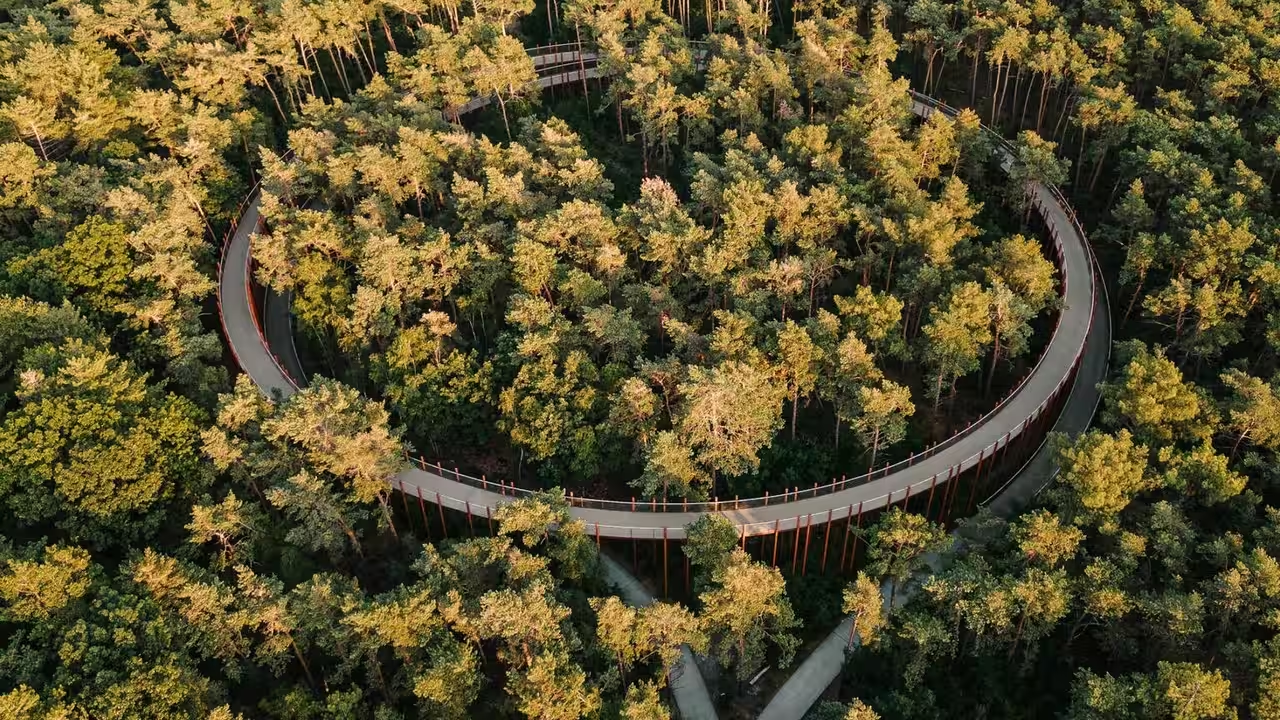
A 700-metre circular bicycle path in the Pijnven nature reserve, part of Bosland National Park in the municipality of Hechtel-Eksel, lifts cyclists to 10 metres into the treetops. Riders follow a double circle that climbs to its full height, levels out and descends. The path opened in June 2019 and is open to walkers and joggers. Its steel structure earned laureate status in the Steel Construction Contest 2020, in the bridges category. The Pijnven woods around it were planted largely with conifers at the beginning of the last century to supply the mining industry.Where to find the treetop cycle path at node 272 and how to reach it by car or hired bicycleAccording to Visit Limburg, Cycling through the Trees sits at node 272 of the cycle node network in the Pijnven nature reserve. Drivers can use a free car park at Kiefhoekstraat 16 in Hechtel-Eksel. Visitors without their own bicycle can rent one from De Lage Kempen, the nearest rental point, by reserving in advance and collecting it on the day of the visit.Infosteel reports that the route consists of a tight double circle 100 metres in diameter, connected to the cycle network. The path rises at a gradient of three to four per cent, stays level for nine metres once it reaches its full height, and then begins its descent.Its 450 unique columns, made of weather-resistant Corten steel, are spaced one, two and three metres apart in turn. They symbolise the straight trunks of the pine trees that were once used in the mine. The support piles sit on a point foundation of galvanised screw piles, which minimises the structure's impact on the natural environment.Who designed, engineered, checked and built the award-winning steel cycle bridge in Hechtel-EkselTourism Limburg of Hasselt was the client. Burolandschap and De Gregorio & Partners, both of Tongeren, acted as architect and designer, while BAS of Leuven handled the structural engineering. Socotec of Brussels was the control agency, and Smulders of Arendonk served as both general contractor and steel contractor.How the design respects a conifer forest planted for mining and now managed for native treesWhen the mines closed, the trees were never felled. A tailor-made woodland management plan is now giving smaller indigenous trees at the lower levels of the forest more space and light so they can grow. The aim is healthy, balanced forest resources with small, medium-sized and tall trees.Close to the entrance, a cycle pavilion serves as a rest and information point for cyclists and walkers. It is built from two Corten steel frames with logs stacked around them, and the logs come from the trees that were felled to make room for the cycle bridge.The partners behind the project and the other Limburg cycling experiences on the same networkThe project was delivered by Visit Limburg in conjunction with the Province of Limburg, LSM, Visit Flanders, the municipality of Hechtel-Eksel, the Flemish government's Nature and Woodland Agency and Bosland. Cycling through the Trees is not the only attraction on the cycle node network. Two other cycling experiences are Cycling through Water in Bokrijk and Cycling through the Heathland in Hoge Kempen National Park.You use AI every day. Now get your AI Quotient. Take the AIQ test.
Topics in this story
Gathered from external sources. Rights to this text belong to whoever originally published it.