In 1993, Bill Clinton proposed a Pacific Northwest forest plan after a bitter logging fight; the final 1994 framework covered about 24.5 million federal acres
In 1993, President Bill Clinton initiated a groundbreaking forest management strategy in the Pacific Northwest amid conflicts between timber industry and environmentalists, ultimately adopting the Northwest Forest Plan in 1994, protecting 24.5 million acres of federal forestland.
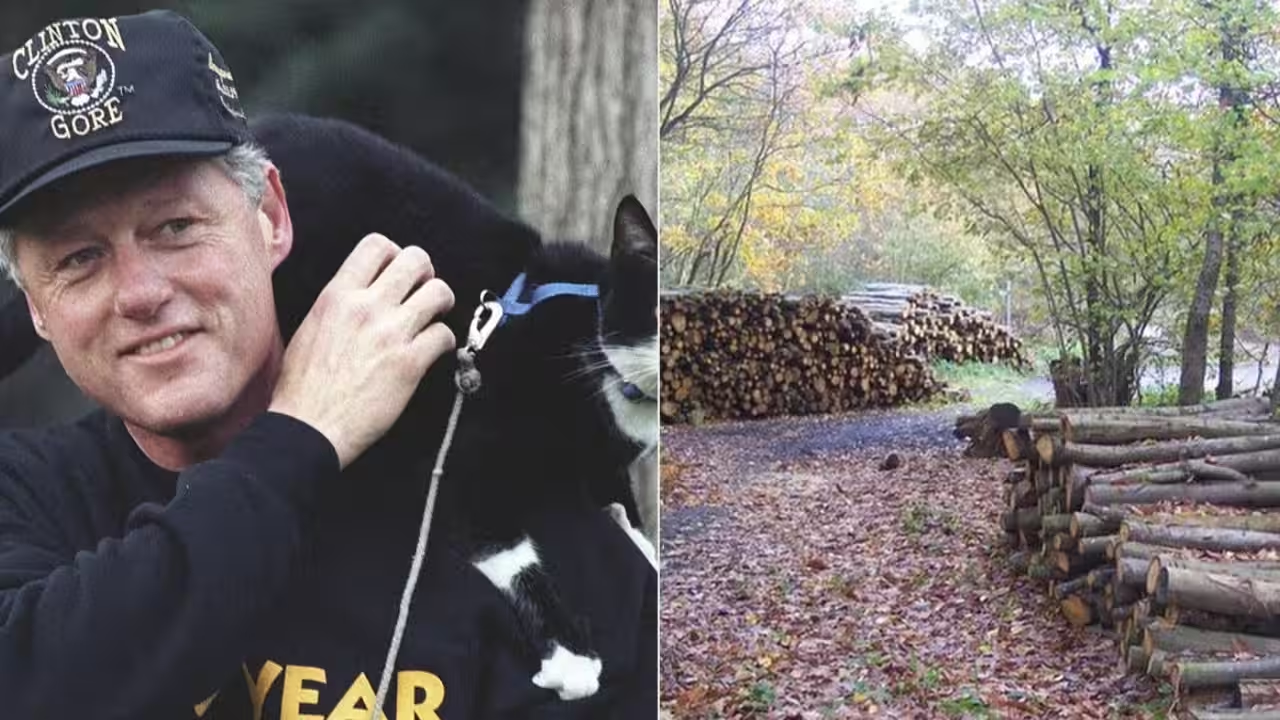
In 1993, US President Bill Clinton encountered a bitter conflict in the Pacific Northwest, where timber workers and logging companies clashed with environmentalists over the future of the region’s old-growth forests. Timber sales were disrupted because of the dispute. Additionally, it affected forest-dependent communities and eventually triggered legal battles over the protection of threatened wildlife.On July 1, 1993, Clinton announced a proposed forest-management strategy which intended to balance timber production, environmental safeguards and economic support for the affected communities. In 1994, the final Northwest Forest Plan was adopted. This established a management framework for approximately 24.5 million acres of federal forestland in western Washington, western Oregon and northwestern California.Why the Pacific Northwest turned into a battlegroundThe differences had developed over years of intensive timber harvesting and disagreements about how federal forests should be managed. Logging provided employment and supported local businesses; however, environmentalists and scientists cautioned that the loss of old-growth forests threatened wildlife habitats, waterways and broader forest ecosystems. The northern spotted owl became a central focus of the dispute as it depended heavily on mature forest habitat and was listed as threatened under the Endangered Species Act.The Clinton administration’s July 1993 background briefing described a region-wide dispute that involved the protection of old-growth forests, fish, wildlife and water, alongside workers’ economic needs, businesses and communities dependent on timber. The administration also identified the marbled murrelet and certain fish species as requiring protection.The then-president sought a response that would address both environmental concerns and economic uncertainty. In April 1993, Clinton brought representatives of different interest groups together at a Forest Conference in Portland, Oregon. After the conference, the administration assembled the Forest Ecosystem Management Assessment Team, a group of scientists and resource professionals tasked with evaluating management options for federal forests.The plan proposed protection across 24.5 million acresThe preferred approach announced by the administration was based on the team's watershed-oriented Option Nine. This proposal intended to create a better coordinated system for managing federal forests, with decisions informed by ecological conditions and the needs of individual watersheds. It aimed to establish a predictable, sustainable level of timber production while protecting important old-growth habitat and reducing conflicts between federal agencies over forest policy. This announcement was a proposal, not the date on which the final Northwest Forest Plan was adopted.The plan covered approximately 24.5 million acres of forest land under the federal government within the range of the northern spotted owl in the Pacific Northwest. However, different rules applied to different regions. These included late-successional reserves designed to conserve older forest habitat, riparian reserves intended to protect streams and surrounding areas, adaptive management areas for testing management approaches, and a matrix of lands where timber production could continue under the proposal’s guidelines. Therefore, the area was not put under one uniform protection regime; instead, management depended on the designation and its objectives.Though the northern spotted owl helped bring the conflict into the public eye, the proposed guidelines went further, considering the health of regional ecosystems more broadly. The framework for the proposal included protection for old-growth forest ecosystems, streams, watersheds, salmon, and other organisms. The overall philosophy behind the proposal was to manage the forests as systems.Following the development of the proposed approach, the administration prepared environmental impact statements and continued to work on implementation. On April 13, 1994, the secretaries of Agriculture and the Interior signed the Record of Decision for the plan, thus formalising the framework for federal forest management.Economic assistance and continuing disputesThe administration provided economic support as an important part of the response. Some of the measures that were undertaken include retraining workers for new industries, helping local businesses expand and diversify, and funding community-development initiatives. The purpose of this was to assist timber-dependent people to adapt to reduced timber harvest by the federal government.The proposal also faced legal and political challenges after its adoption. On December 21, 1994, a federal district court ruling upheld the administration’s approach, allowing implementation to continue. While the decision was a crucial legal milestone, it did not imply that disagreements regarding logging, conservation or the economic consequences of forest policy had disappeared.You use AI every day. Now get your AI Quotient. Take the AIQ test.
Topics in this story
Gathered from external sources. Rights to this text belong to whoever originally published it.