In 1962, Neil Armstrong’s X-15 bounced off the atmosphere, overshot Edwards on April 20, then flew over Pasadena: its 12:28 flight became the program’s longest
Discover Neil Armstrong's remarkable 1962 X-15 flight that became a record-breaking adventure. Learn how an unexpected atmospheric bounce led him to overshoot his landing zone near Pasadena and the challenges he faced during this extraordinary test of piloting skills.
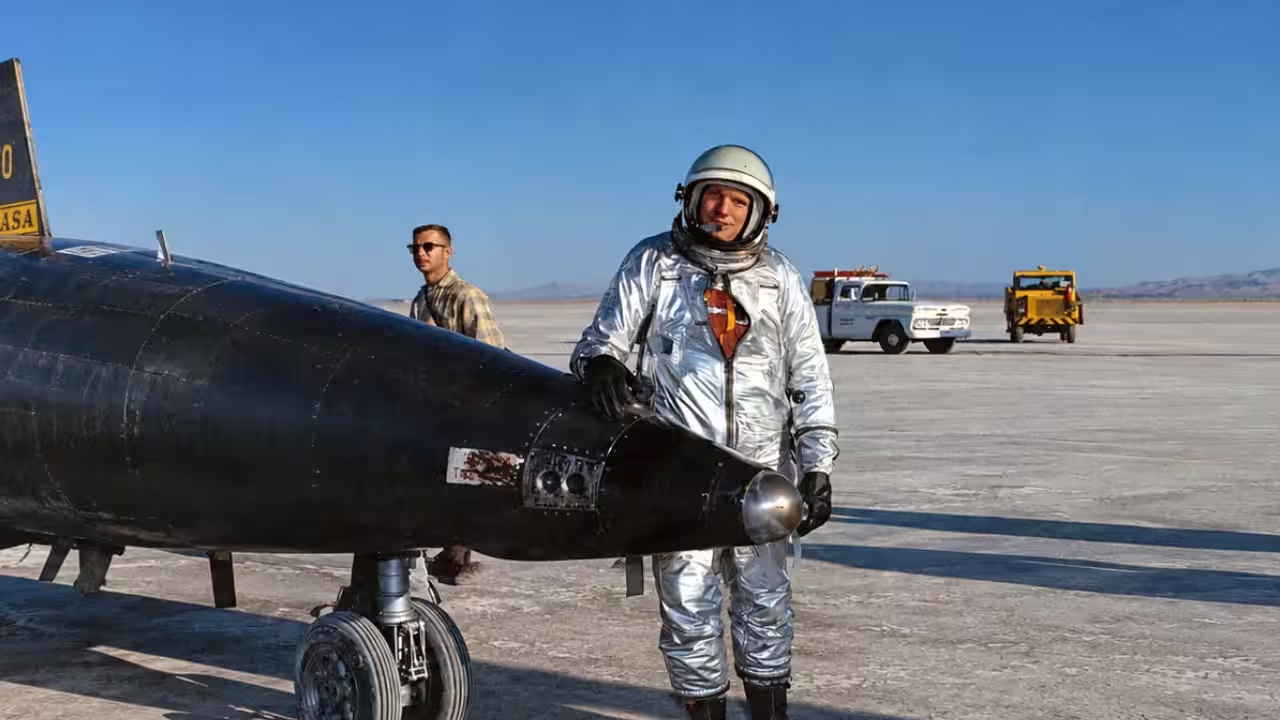
Neil Armstrong’s most extraordinary flights as a test pilot came in 1962, when he was flying the experimental X-15 rocket plane and encountered something strange as he neared Earth. Moving at approximately one-third the speed of sound, the aircraft passed that target zone at Edwards Air Force Base in California and kept heading out on the course toward Pasadena, ultimately bouncing off the atmosphere. What was intended to be an ordinary test of a new flight control system turned into a surprise test of Armstrong's piloting skills.An experimental aircraft designed to explore the edge of spaceAccording to NASA, the North American X-15 was a joint program with the agency, the US Air Force and the US Navy to investigate the nature of high-speed, high-altitude flight and to develop hypersonic flight vehicle technology, such as vehicle stability and control, and vehicle behaviour during and after hypersonic flight. The X-15 was powered by a rocket engine and lifted into flight from a modified B-52 aircraft flying at an altitude of 45,000 feet. Once at altitude, the rocket engine would be ignited to accelerate the aircraft to hypersonic speed, then shut off, and the aircraft would return to Earth as a glider.The programme was especially significant because traditional aerodynamic controls worked increasingly poorly in the thin air at near-space altitudes. It had reaction control jets, small rocket thrusters that helped pilots move the craft in the thinner atmosphere. Armstrong joined the NASA flight research program in 1955 and was one of the pilots who had tried out the plane. By the spring of 1962, he had already made several X-15 flights and was used to the rigours of sub-orbital high-speed experimental flight.An atmospheric bounce sends Armstrong beyond his intended landing zoneThe 20 April flight test was to determine the performance of the MH-96 adaptive flight control system that was installed in the third X-15 (X-15-3) to help the pilot better control the aerodynamic controls and reaction control thrusters, and to ease the control of the aircraft in varying atmospheric conditions. Armstrong was released from the B-52 mother ship and triggered the X-15 rocket engine. The aircraft climbed to about 207,000 feet (63,000 meters) before the rocket engine burned out.However, it didn't turn out as he had planned. During the pullout, Armstrong pitched the aircraft into a positive angle of attack, causing it to skip back into the upper atmosphere rather than follow the planned flight profile. The unexpected rotation altered the trajectory and left Armstrong significantly farther away from the landing area as the X-15 descended again. Its vehicle was travelling at a speed of around Mach 3 and at an altitude of 100,000 feet. Instead of heading toward Edwards, it continued south until it reached the Pasadena area.NASA recorded the event, stating that the Rose Bowl marked the location where Armstrong was finally able to level off and re-enter the craft back towards the base. The event illustrated the challenges of controlling a plane at high speed as it moved from thin to denser air. A 1965 study of Automatica discusses adaptive flight control design for a re-entry vehicle, with the example of the X-15 control system used as a challenge posed by significant changes in aircraft behaviour at various speeds and altitudes.A difficult return and a record-breaking flightAs noted by NASA, the flight eventually moved towards the Rogers Dry Lake, the actual landing site next to the Edwards Air Force Base. Armstrong landed it on the southern part of Rogers Dry Lake instead of its designated point. The 12-minute, 28.7-second flight was the longest to date and showed how critical pilot judgment was when experimental aircraft encountered conditions that the automatic flight-control system and flight-planning calculations could not foresee. A 2025 study published in Aerospace analysed the flight and suggested a technical explanation using more up-to-date calculations. The researchers reconstructed the flight to examine how aerodynamic instability and the aircraft's finite response time may have contributed to the unexpected path.You use AI every day. Now get your AI Quotient. Take the AIQ test.
Topics in this story
Gathered from external sources. Rights to this text belong to whoever originally published it.