A New Orleans couple found a 2,000-year-old Roman tombstone in their backyard; the FBI traced it to Italy and returned it 80 years later
US News: In early 2025, Daniella Santoro, an anthropologist at Tulane University, and her partner, Aaron Lorenz, were clearing weeds behind their home in New O.
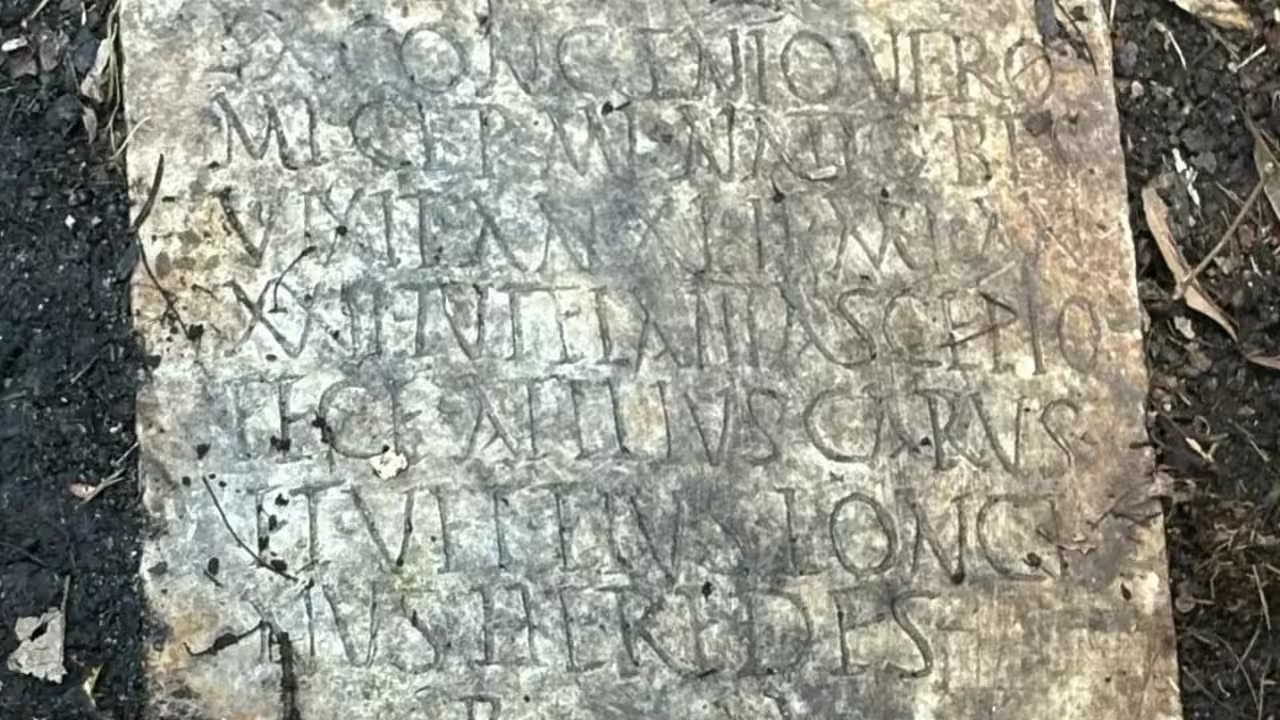
In early 2025, Daniella Santoro, an anthropologist at Tulane University, and her partner, Aaron Lorenz, were clearing weeds behind their home in New Orleans' historic Carrollton neighbourhood when they uncovered a marble slab covered in Latin writing. Santoro contacted D. Ryan Gray, an archaeologist at the University of New Orleans, who shared photographs of the stone with Harald Stadler, an archaeologist at the University of Innsbruck, and Susann Lusnia, a classical archaeologist at Tulane. Lusnia recognised the inscription as an ancient Roman funerary monument. The stone commemorated Sextus Congenius Verus, a 42-year-old sailor who had served for 22 years aboard a ship called the Asclepius. Further research established that the marble monument had once belonged to the collection of the National Archaeological Museum in Civitavecchia, Italy, where it had eventually been recorded as missing. Its discovery transformed an unremarkable garden stone into a nearly 2,000-year-old artefact with a traceable history.How researchers identified the missing Roman tombstoneAccording to the FBI's New Orleans field office, the inscription and physical characteristics of the marble allowed researchers to connect the New Orleans discovery with a funerary monument missing from the National Archaeological Museum in Civitavecchia. The museum is located in the Italian coastal city of Civitavecchia, northwest of Rome. Once the identification was established, Santoro and the researchers worked with authorities to return the artefact to Italy. The FBI's Art Crime Team became involved in the repatriation process. Researchers initially considered whether the monument might have disappeared during the upheaval surrounding World War II. Civitavecchia was heavily damaged by Allied bombing during the war, creating the possibility that objects from the museum's collection could have been displaced during the destruction. The circumstances of the stone's disappearance, however, remained uncertain, and the eventual discovery in Louisiana provided a much clearer trail than researchers had previously had.How a family connection revealed how the Roman stone reached New OrleansThe breakthrough came after news of the discovery became public. Erin Scott O'Brien, who had previously lived at the New Orleans property, learned about the Roman monument and immediately recognised the stone from her family's history. The artefact had belonged to her grandparents. Her grandfather, Charles Paddock, had served in Italy during World War II, and the stone eventually made its way into the family's possession. O'Brien did not know that it was an ancient Roman funerary monument. In 2004, she placed the stone in the garden of the New Orleans property. She later explained that the family had planted a tree and decided to put the unusual stone outside in the garden as part of the new home's landscaping. For years, the monument remained there without anyone realising what it was. It was only after Santoro and Lorenz uncovered it beneath the vegetation and archaeologists examined the inscription that its true age and history came to light. The family has not established exactly how Paddock acquired the monument in Italy. It remains possible that he purchased it, obtained it through another transaction or brought it home as a wartime souvenir, but there is no definitive family record explaining how it left Italy.What Sextus Congenius Verus's gravestone tells us about Roman lifeThe inscription provides a remarkably specific glimpse into the life of the man it commemorates. Sextus Congenius Verus was 42 when he died and had spent 22 years serving aboard the Asclepius. Rather than commemorating a famous emperor or military commander, the monument belonged to an individual whose name and occupation might otherwise have disappeared from the historical record. The inscription preserves details about his age and long career at sea, offering researchers a small but tangible window into the lives of ordinary people within the Roman world. The marble also demonstrates why inscriptions can be so valuable to archaeologists. Even when an artefact becomes separated from its original archaeological context, the information carved into its surface can provide enough evidence to identify both the person it commemorates and the institution that once held it. In this case, those words survived nearly 2,000 years and ultimately helped turn an anonymous garden stone into an identifiable Roman monument.How the Roman tombstone is being returned to ItalyAfter researchers established the stone's connection to the Italian museum, the artefact entered the process of repatriation through cooperation between American and Italian authorities. The FBI's Art Crime Team assisted with the return, with the monument ultimately intended to go back to the institution from which it had disappeared. The return is part of a broader effort by the United States and Italy to recover archaeological and cultural objects that have been removed from their countries of origin. For the Roman funerary monument, however, the journey is unusually personal. The stone travelled from the ancient Roman world to an Italian museum, disappeared from the collection and eventually crossed the Atlantic before spending years in an ordinary New Orleans garden.Where Sextus Congenius Verus's gravestone belongsThe monument is expected to return to the National Archaeological Museum in Civitavecchia, where it can once again be preserved and studied in the country from which it disappeared. For the researchers who identified it, the discovery demonstrates how easily an ancient artefact can become detached from its history. The stone spent years looking like an ordinary piece of marble in a New Orleans garden, while the inscription beneath the surface carried the name of a Roman sailor who lived almost 2,000 years ago. What began with a couple clearing vegetation behind their home ultimately connected archaeologists in Louisiana, Austria and Italy, a missing museum artefact, and a World War II family story. The stone's journey from ancient Rome to Louisiana and, eventually, back toward Italy is now part of the history preserved alongside the monument itself.Catch the latest World News and Live updates. Download the TOI app.
Topics in this story
Gathered from external sources. Rights to this text belong to whoever originally published it.