UN votes to adopt new world map to reflect Africa's true size
The Togo-sponsored resolution was backed by 164 nations - the US the only nation to vote against it.
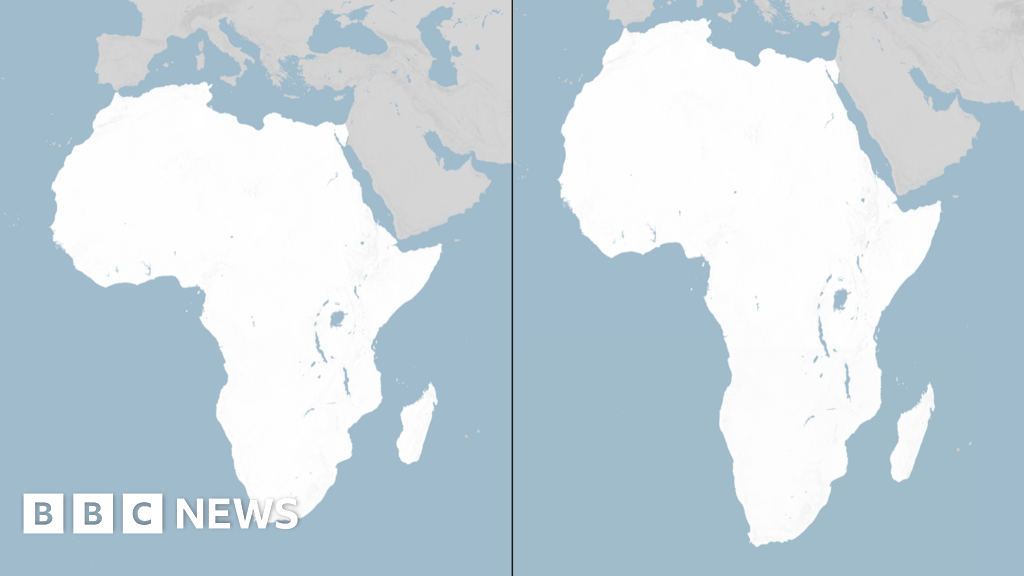
The UN General Assembly has voted to replace the traditional world map with one that more accurately reflects the size of Africa.
The "Correct the Map" resolution, sponsored by Togo and backed by African Union (AU) members, passed with the support of 164 nations, including France and the UK. The United States was the only nation to vote against it - and there were six abstentions.
The UN vote is non-binding but will see changes to the maps used by institutions around the world.
The Mercator map, which has been in common use since the 16th Century, has come in for criticism as it shows Africa as similar in size to Greenland, even though it is 14 times larger.
Critics say this leads to the development needs and potential for countries near the equator to be minimised.
US admits 'unfortunate error' after mislabelling countries on map of Africa
The Mercator map was designed in 1569 by the Flemish cartographer Gerardus Mercator to help European explorers navigate across the world.
The distortion of his map is a result of the fact that it is impossible to accurately represent the surface of a globe on a two-dimensional chart.
Whenever a map of the world is drawn, compromises need to be made.
The Mercator map shows the curvature of the Earth by making countries near the equator seem smaller than they are, with countries nearer the poles appearing bigger.
In an effort to correct this, a team of cartographers in 2018 created an equal area map they called the Equal Earth projection.
In February, the AU's 54 member states adopted it, and said it "more accurately represents the sizes of all continents, particularly Africa".
Online campaign group #CorrectTheMap said: "You could fit the United States, China, India, Japan, Mexico and much of Europe into Africa and still have land to spare."
Ahead of Friday's vote, Togolese Foreign Minister Robert Dussey told the Reuters news agency: "A fair world begins with a fair map."
Earlier he had told a UN briefing: "A map is never neutral. It shapes perceptions, influences how the place of peoples and continents in the world is understood."
He had the backing of the French Foreign Minister Jean-Noël Barrot, who said his ministry was going to stop using the Mercator map .
"Changing the map obviously doesn't change the world. But correcting a representation that distorts it is already an act of truth," he said.
But Yaryna Ferencevych, a US representative at the UN, said the resolution mocked the work and purpose of the UN General Assembly .
"Instead of focusing on genuine problems of international peace, prosperity, or good relations, this body is debating map projects from the 16th Century, and their role in promoting reparations and 'cognitive justice'," she said.
In March, the US was also critical when a resolution was adopted declaring the transatlantic slave trade "the gravest crime against humanity".
"Africa's misrepresentation on world maps is not just a cartographic error - it's a narrative issue," Lerato Mogoatlhe from Africa No Filter, one of the groups behind the campaign to ditch the Mercator map, told the BBC.
It was part of efforts to stop the "world's longest misinformation and disinformation" about Africa, she said.
For Kenyan geographer Kioko Muendo, the Mercator map has implicitly downplayed the African continent's vast resources, population and investment opportunities.
"Maps are more than just guides for travellers - they shape how regions are perceived politically and economically," he told the BBC.
'The crowd shouted that we'd stolen someone's genitals' - deadly rumours spread on social media
Did a goat herder's lucky $200 nugget spark a gold rush in western Kenya?
'This star is for Africa' - Angélique Kidjo on making Hollywood Walk of Fame history
'If you started running, they shot you' - inside Nigeria's growing kidnapping crisis
What is Ebola and why is stopping the latest outbreak so difficult?
Go to BBCAfrica.com for more news from the African continent.
Topics in this story
Gathered from external sources. Rights to this text belong to whoever originally published it.