Her 6-year-old brought home an AI-generated photo from school. This mom isn’t having it
Nikki Anderson's 6-year-old daughter brought home from school an AI-generated photo of herself at age 25. Anderson was furious.
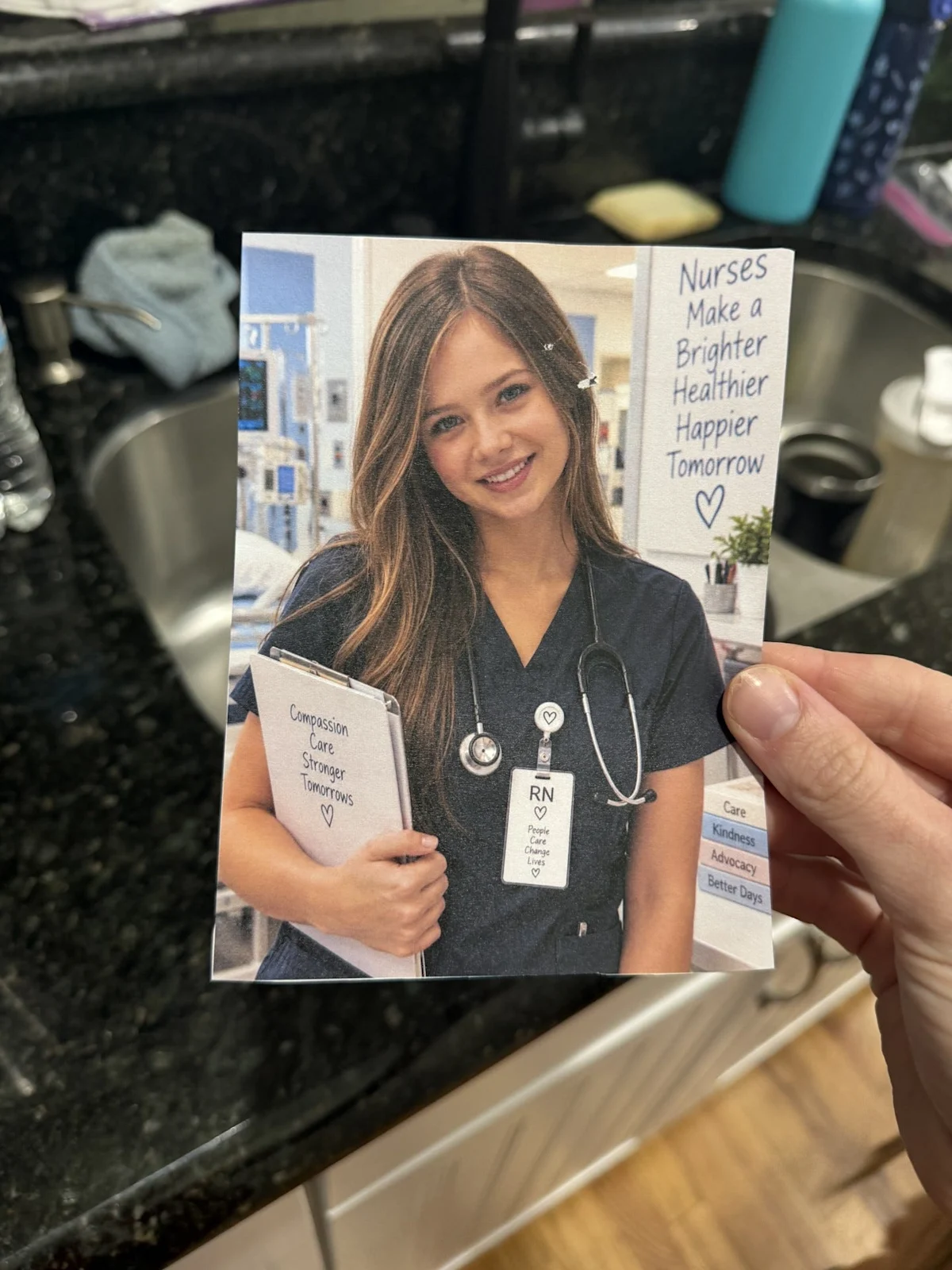
When Nikki Anderson, 32, opened up her 6-year-old's Friday folder on Oct. 16, she was excited to see what her daughter , Harper, had been working on at school that week.
The folder contained spelling tests and artwork from Harper's first grade classroom. But among the construction paper and lined sheets where her daughter wrote what she wanted to be when she grows up − a nurse − was a peculiar photo that stopped Anderson in her tracks.
The image, generated by artificial intelligence, showed what her daughter would look like as a 25-year-old. The image was of a young woman with a "baby face," Anderson said, with sleek, wavy hair, wearing a nurse's uniform and holding a clipboard. Anderson's daughter proudly told her mother how her specials teacher had made the photo with AI. She especially loved the wavy hair she'd have when she's a grownup, Harper said.
Another image of her daughter as a nurse − the one her daughter dreamed up with her own imagination and crafted with her own two hands out of construction paper and penciled-in eyes, nose and mouth − didn't feature wavy hair.
"My child's interpretation of the world has been replaced with an algorithm's interpretation of what a successful adult woman should look like," Anderson, of Charleston, South Carolina, wrote in an Instagram post about the AI image, which has more than 600,000 likes. "She had already imagined the future. Made something incredible to represent it. What part of that needed to be finished by a computer?"
AI is infiltrating everyday life, and the classroom is no exception. Many teachers are adapting to AI use , urged by some education leaders to not get left behind. Even in places prohibiting AI use in some classrooms – like New York City, where Mayor Zohran Mamdani mandated it as such for preschool through eighth grade students in September – teachers are pushing back by saying students need to learn how to use AI in safe and smart ways. But is AI use in schools getting in the way of children's creativity? And shouldn't parents have to give permission before images of their kids are uploaded onto AI platforms? These are the questions Anderson and thousands of other parents are asking in the wake of the AI boom.
There's a lack of legislation and guidance around AI use in schools and what teachers should or shouldn't put into AI models, said Tina Mulqueen, a professor at Washington State University Vancouver and senior vice president of digital transformation at Burson, a communications company.
"I don't want to put that on the teacher," she said. "I just have so much respect for teachers. It's a really difficult job and I think that most of them are really well-intentioned in how they're trying to navigate this with AI."
Teachers shouldn't be inserting personally identifiable information about students into AI models, Mulqueen said. But if AI is going to be useful and expected in the workforce, she said, "then we probably want to teach our kids to be able to interface."
"But we don't want to take learning away from them," she said.
Conversations around AI in classrooms are typically centered around AI literacy and how to use AI to improve learning, said Jason Yeh, cofounder of Patron, an early stage venture firm investing in the next generation of consumer technology. One of his investments is in a company that specializes in personalized education through AI. But Anderson's situation doesn't sound related to either of those purposes, he said. Because parents are growing increasingly wary of AI, Yeh said more and more schools are becoming cautious about using it at all.
"Schools need to figure out the best way to incorporate relevant technology to help people learn better," Yeh said.
Anderson told USA TODAY she signed a consent form at the start of the school year that allowed the school to use Harper's photos and artwork in the media; it didn't say anything about AI.
"Charleston County School District recognizes both the opportunities and responsibilities that come with the use of artificial intelligence in education, particularly when it involves student images and personal information," Harper's school district provided in an emailed statement to USA TODAY, adding that the district has established policies and guidance surrounding responsible use of technology and partnered with AI for Education, a national consulting organization, beginning in 2025 to develop an AI framework . "Once concerns were brought to the school's attention, the principal directed that similar assignments be discontinued, and the district followed its established procedures to address the matter."
The district is preparing to launch comprehensive, districtwide AI literacy training for educators in the coming weeks to reinforce expectations about student privacy, approved AI tools, ethical use and appropriate instructional practices, the district said.
Anderson said she is "pretty against AI" as it pertains to child development, and she's worried about privacy concerns. She's read about increased child sex abuse materials being made available with AI, and said "all parents are just kind of on high alert right now because we're trying to protect our kids' imagination and privacy."
Yeh uses AI with his children at home sometimes, with parent supervision, and sees many ways AI can be useful in educational situations. He, too, said he'd be concerned if either of his elementary-aged children came home with a similar image to the one Harper's teacher made.
"It's hard to imagine how that ties into something that they would be learning," he said.
Anderson said she doesn't think Harper's teacher did anything malicious, and that the idea of the assignment was sweet in some ways. She's also aware teachers "are overworked, underpaid, just absolutely fighting to do their best with kids and I absolutely want them to have access to material that makes them feel like they can better manage their schedules," including AI tools.
But she doesn't want her daughter interfacing with AI at 6 years old. She said she struggled to have that conversation with her daughter when it came up. "I want her to think that science and advancement is fascinating and it's necessary and it's useful," she said. For now, though, Anderson is focusing on the art Harper makes herself.
"How your hair looks whenever you're 25, I promise you, is going to be the least important thing about you," she told her daughter.
Madeline Mitchell's role covering women and the caregiving economy at USA TODAY is supported by a partnership with Pivotal and Journalism Funding Partners . Funders do not provide editorial input.
Reach Madeline at memitchell@usatoday.com and @maddiemitch_ on X.
Topics in this story
Gathered from external sources. Rights to this text belong to whoever originally published it.