How Lula beat Bolsonaro, broke records and halted the right-wing wave aligning Latin America with Trump in 20 days
Luiz Inácio Lula da Silva made history on Sunday, setting a record for Brazil and the rest of Latin America by becoming the first president to win a fourth term – and he did so days before turning 81, an age when many other leaders decide to leave politics behind.
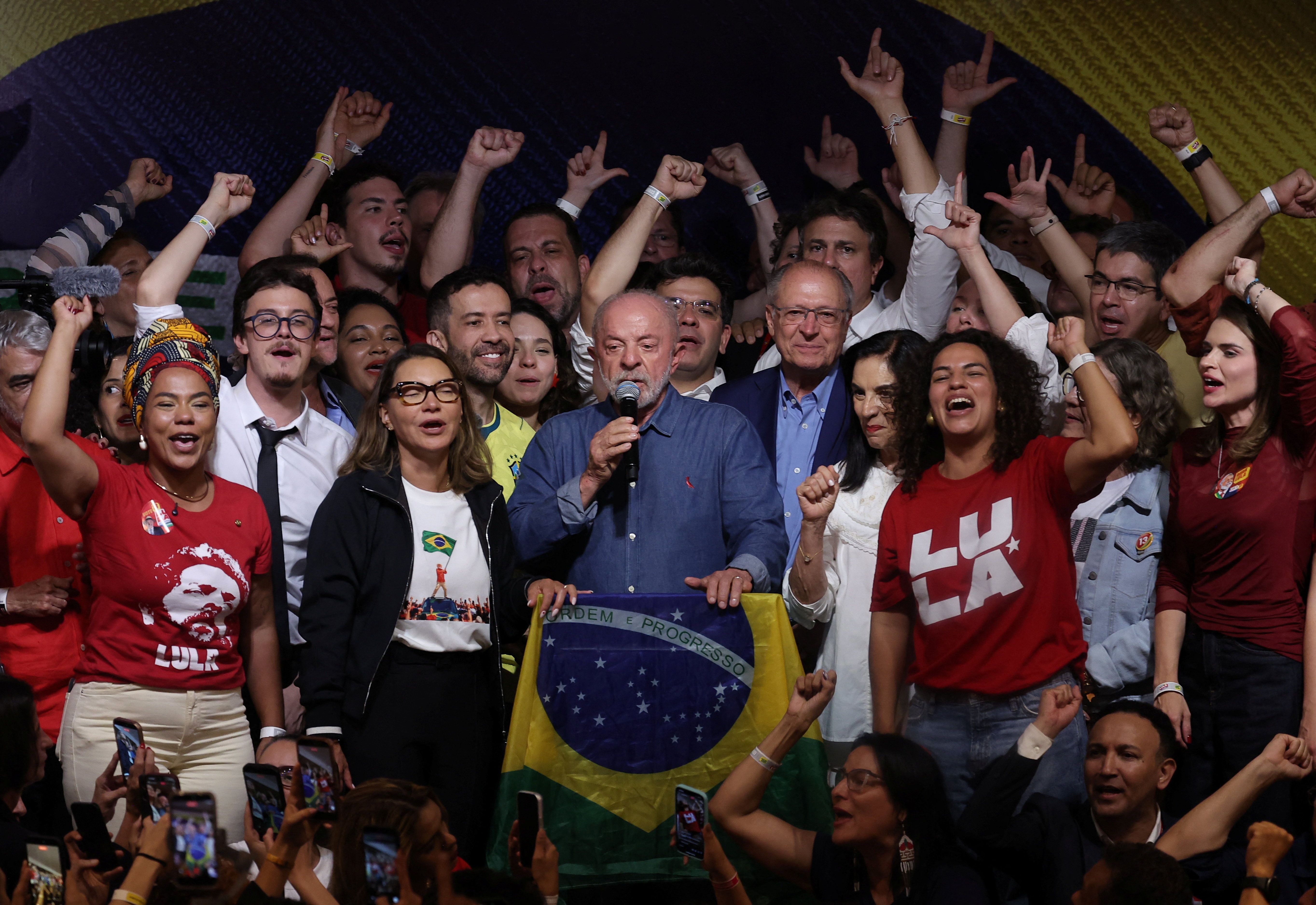
Luiz Inácio Lula da Silva made history on Sunday, setting a record for Brazil and the rest of Latin America by becoming the first president to win a fourth term – and he did so days before turning 81, an age when many other leaders decide to leave politics behind. The Brazilian president’s remarkable comeback against his right-wing rival, Flávio Bolsonaro, also set another record. Since Brazil’s return to democracy in 1985, no president has managed to overturn a first-round defeat. The Workers’ Party candidate added more than 10 million votes in the three weeks between the two rounds of voting, while his rival gained just 3.6 million. The margin was decisive enough for Lula to secure a larger lead than he did in 2022, when he defeated Jair Bolsonaro, Flávio’s father and the incumbent president at the time. The comeback also allows Lula to remain the leading figure of the regional left as the right advances in other countries across Latin America, many of whose governments are now aligned with Donald Trump’s White House. As his father did four years ago, Flávio Bolsonaro refused to recognize the result and announced that he would seek to have the election annulled through the courts. The senator challenged Supreme Federal Court Justice Cristiano Zanin’s decision to extend voting by two hours, arguing that the uneven application of the measure had undermined equal voting conditions. “It is impossible to recognize the election results given the circumstances in which these events unfolded,” he said. Bolsonaro’s statement did not dampen celebrations over Lula’s historic achievement. But the right’s political strength could hinder the smooth functioning of his new administration. The victory confirms Lula’s political staying power. Yet Bolsonaro’s defeat does not weaken the right’s grip on Congress and state governments. That is the paradox of Lula’s next term: a historic electoral triumph and limited room to govern. What explains Lula’s unexpected victory? Geography helps explain how Lula overturned his first-round deficit. In Minas Gerais, the state with Brazil’s second-largest electorate, he went from losing by nearly 590,000 votes to winning by about 99,000 — a swing of roughly 690,000 votes in the margin between the two candidates. The state, which has backed the winner of every direct presidential election since 1989, once again voted in line with the national result. Although Flávio retained his lead in the states of São Paulo and Rio de Janeiro, Lula won their capitals, Brazil’s two largest cities, and reversed the first-round result in the city of Rio. His gains were reinforced by victories in all nine northeastern states and higher voter turnout. Abstention fell from 21.08% in the first round to approximately 19.2% in the runoff, bringing nearly three million more Brazilians to the polls. That additional participation cannot be attributed entirely to Lula, but it underscores the importance of mobilizing those who had not voted: in the first round, the gap between the candidates was just over 2.2 million votes. The battle was also fought on Brazilians’ phones. After finishing second in the first round, Lula stepped up his digital mobilization efforts to expand his reach and turn support into votes. The challenge was not simply to persuade undecided voters, but to get those who already preferred him to show up at the polls. The push was accompanied by last-minute measures and proposals aimed at voters’ concrete concerns. Lula signed into law a measure raising the revenue threshold for individual microentrepreneurs, proposed new initiatives to renegotiate consumer debt and advocated ending online betting, whose expansion has contributed to household indebtedness. On security, he even embraced a traditional right-wing position: he backed lowering the age of criminal responsibility for particularly serious offenses. The move was intended to respond to demands for a tougher approach to crime, another major issue in the election. The victory allows Lula to remain in power, but it also obliges him to meet the expectations he raised to secure it. More than one challenge ahead Lula’s first challenge after celebrating his victory will be legislative. Right-wing parties will hold 303 of the 513 seats in the Chamber of Deputies, compared with 124 for the left and 86 for the center. In the Senate, the right will control nearly two-thirds of the seats. That does not make every one of those lawmakers an automatic opponent, but it means Lula will have to build alliances beyond his own base both to advance his proposals and to defend his government’s priorities. The map of state governments also shows the strength the conservative camp retains. Across the two rounds of voting, Bolsonaro’s Liberal Party (PL) won five governorships, while the Republicans and the Progressive Party (PP) secured four each. The Workers’ Party (PT) won four. The Social Democratic Party (PSD), which brings together politicians with different political alliances, secured another five. Negotiations with those governors will be another challenge for Lula, who will need cooperation at the state level to implement his policies. “Once we win the election, we no longer have opponents. I have to govern for 215 million people,” Lula said in his victory speech. He also addressed the challenge of negotiating with a more conservative legislature: “I didn’t choose Congress. The people did. And that is the Congress with which I will vote, work and get things done.” The most immediate challenge will be to turn economic gains into relief that Brazilians can feel in their daily lives. Perceptions of the economy were among the main sources of erosion in Lula’s support during the campaign. Lower inflation does not bring prices back to their previous levels, and improvements in employment do not necessarily offset the burden of debt and household expenses. Dissatisfaction with the cost of living will remain after the election. Addressing that discontent will be harder because of fiscal constraints. Debt, the deficit and high interest rates limit the government’s ability to increase spending and foreshadow disputes over how to fund campaign promises without jeopardizing social programs. With an unfriendly Congress, decisions about who pays and where cuts are made will also test Lula’s ability to negotiate. Security will be another source of pressure. Lula will have to respond to demands for tougher measures against crime, as the right has made a hard-line approach one of its main political platforms. In the final stretch of the campaign, he signaled a tougher stance by expressing his willingness to lower the age of criminal responsibility to 16 for serious offenses, a measure championed by the right and backed by broad public support. It remains to be seen whether he will turn that campaign signal into a concrete proposal. He will also face the challenge of preparing a successor for a left whose ability to win presidential elections remains closely tied to his own political stature. Regional autonomy and isolation The challenges extend beyond Brazil’s borders. The progressive leader’s comeback prevented Trump from securing the crown jewel of a wave of victories by right-wing candidates aligned with the White House. As head of Latin America’s largest economy, with China as its top trading partner, Lula’s government has used Brazil’s economic weight to push back against Washington’s trade and political demands — a degree of autonomy few of its neighbors can attempt. A Bolsonaro victory, by contrast, would have marked a major shift in Washington’s efforts to secure its dominance in the hemisphere and curb Beijing’s reach. Yet Lula faces a highly challenging regional landscape and risks being largely isolated. “Lula faces a very different political environment from the one that existed when he first took office, during the pink tide. Back then, he had several regional allies and could play both sides to Brazil’s advantage,” Michael Paarlberg, an associate professor of political science at Virginia Commonwealth University and a researcher at the Center for International Policy (CIP), a Washington-based think tank, told CNN. The region’s political landscape is also different from the one Lula faced when he began his third term in 2023, when allies such as Alberto Fernández in Argentina, Gabriel Boric in Chile and Gustavo Petro in Colombia were in power. “Lula is unlikely to spend his political capital pushing regional integration initiatives such as Unasur (Union of South American Nations), as he did during his first terms. Lacking ideological allies, he will exercise that leadership through Brazil’s economic weight — its investments, trade and Mercosur,” Paarlberg added, referring to the South American trading bloc. Looking toward Trump and the US midterm elections As he prepares for his fourth term, Lula will have to decide how to approach relations with the United States. “Brazil does not belong in anyone’s backyard,” Lula said at the United Nations in September, in a message directed at Washington. Yet he has also acted cautiously. When the United States imposed a new round of tariffs on Brazilian goods in the middle of the year, he left open the possibility of retaliatory measures. “Lula has shown an ability to adapt to Trump. He has balanced occasional harsh criticism with conciliatory gestures,” the analyst said. “For Lula, sovereignty does not necessarily mean confrontation; in fact, he believes confrontation does not necessarily strengthen sovereignty. (…) Lula is not ideologically anti-American, nor does he have difficulty working with right-wing governments,” he added. Paarlberg also said the reelected president would closely follow the US midterm elections, in which “his position could improve” if Trump’s Republican Party loses control of one or both chambers of Congress, potentially bringing greater scrutiny of the president’s agenda. In addition to halting the run of victories by the right and candidates backed by Trump, Lula interrupted another trend: a succession of defeats for incumbent governments, a phenomenon common over the past decade. That raises a broader question about whether the rightward shift is a lasting wave or part of a political pendulum. “Lula’s victory shows that the far right, particularly Bolsonaro’s movement, has a ceiling of support, because many voters consider it too radical,” Paarlberg said. He added that the result also suggests that backing from the White House and its battery of economic measures “are not decisive factors” in an election. In a Latin America increasingly defined by emerging leaders, Lula remains a statesman with international reach and one of the region’s key figures on the global stage. After another political feat, the record-breaking president has two months before beginning his fourth term to decide what course he will seek to chart for South America’s largest country over the next four years.
Topics in this story
Gathered from external sources. Rights to this text belong to whoever originally published it.