Woman divorced after father's death can get his family pension, Tripura HC rules
News News: NEW DELHI: The Tripura high court has directed the Agartala Municipal Corporation to pay family pension to a divorced daughter from the date she obtai.
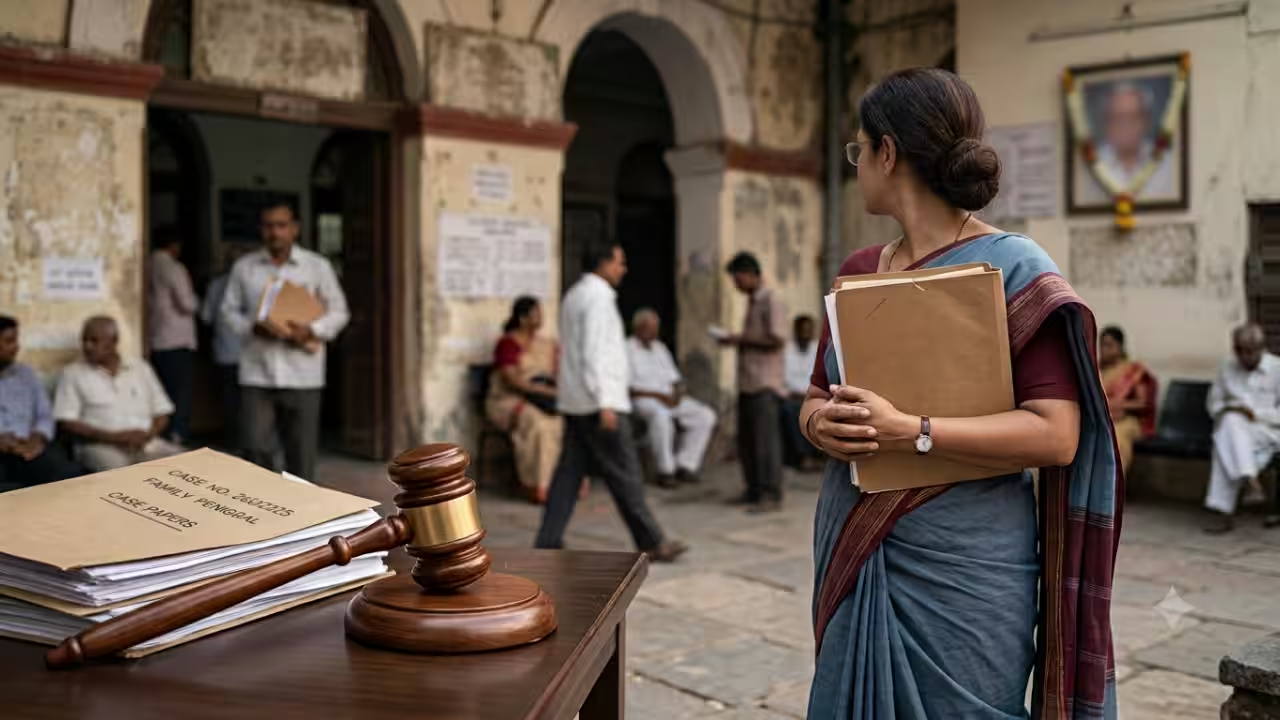
NEW DELHI: The Tripura high court has directed the Agartala Municipal Corporation to pay family pension to a divorced daughter from the date she obtained her divorce, ruling that she could not be denied the benefit merely because she was still married when her pensioner father died. The court directed the corporation to pay her pension from October 4, 2021, with arrears and 6 percent interest.Why was the woman's family pension claim rejected?According to the August 18 order, Ujjwala Rani Paul was the daughter of an Agartala Municipal Corporation employee who retired in 2004 and died on December 2, 2018. However, his wife had already died.Paul had been married to Pradip Saha when her father died. She later obtained a mutual-consent divorce from him on October 4, 2021. She applied for family pension on February 23, 2022, under the Tripura State Civil Services (Revised Pension) Rules, 2017.The corporation rejected her claim in October 2024, saying a 2018 memorandum extending family pension benefits to divorced daughters of pensioners had not been adopted and ratified by it.Paul challenged the decision before the high court. The single judge agreed that the pension rules covered divorced daughters but rejected her claim on the ground that she was not divorced when her father died.What did the high court find about her eligibility?A division bench comprising Chief Justice M.S. Ramachandra Rao and Justice Biswajit Palit found that the corporation's position was contrary to its own records. The corporation had itself stated that a legally divorced daughter was entitled to family pension under Rule 8, subject to the income condition.The bench also noted that Paul had been living with and dependent on her father for years. Her divorce petition stated that her husband had left shortly after their marriage in 1982 and that she had taken shelter in her father's home.The court said the rules did not specifically require a daughter to be divorced on the date her father died.“Neither Rule 8 quoted above nor the amendment to the CCS (Pension) Rules, 1972 states explicitly that to claim the benefit of Family Pension, the daughter of the pensioner should be a divorcee at the time of his death,” the court said.The bench held that the single judge had therefore added a condition that was not present in the rules. It said the right to family pension arises on the death of the pensioner or the pensioner's spouse receiving the pension.“When such a requirement is not provided in the applicable rule, in our opinion, the learned Single Judge erred in reading such a requirement into Rule 8,” the court held.The high court also referred to a 2017 Government of India memorandum which allowed family pension to a divorced daughter even where divorce proceedings had been filed during the pensioner's lifetime but the divorce took place after his death.The bench said this showed that a daughter did not necessarily have to be divorced when her father died to qualify for the benefit. It also noted that the pension rules were intended to provide financial support to dependent family members.The court rejected the corporation's attempt to cast doubt on Paul's claim that her husband had left her shortly after their marriage. It said there was no reason to doubt the statement because her former husband had also agreed to it.“It is unfortunate that such an unfair stand has been taken by the Agartala Municipal Corporation,” the court observed.The bench then allowed Paul's appeal and set aside the April 1, 2026 judgment of the single judge.It directed the Agartala Municipal Corporation to pay her family pension from October 4, 2021, the date she obtained the divorce decree, and continue paying it during her lifetime.The corporation was also directed to pay all arrears within three months, along with 6 percent annual interest calculated from the respective dates on which the pension amounts became due until payment.
Topics in this story
Gathered from external sources. Rights to this text belong to whoever originally published it.