In the mid-1990s, a New Mexico business owner bought 50 eroded acres; she planted more than 5,000 trees and shrubs to help restore its wetlands
Discover how Kimberly de Castro revitalized a barren 50-acre ranch in New Mexico by planting over 5,000 trees and shrubs, creating wetlands, and inspiring community conservation efforts.
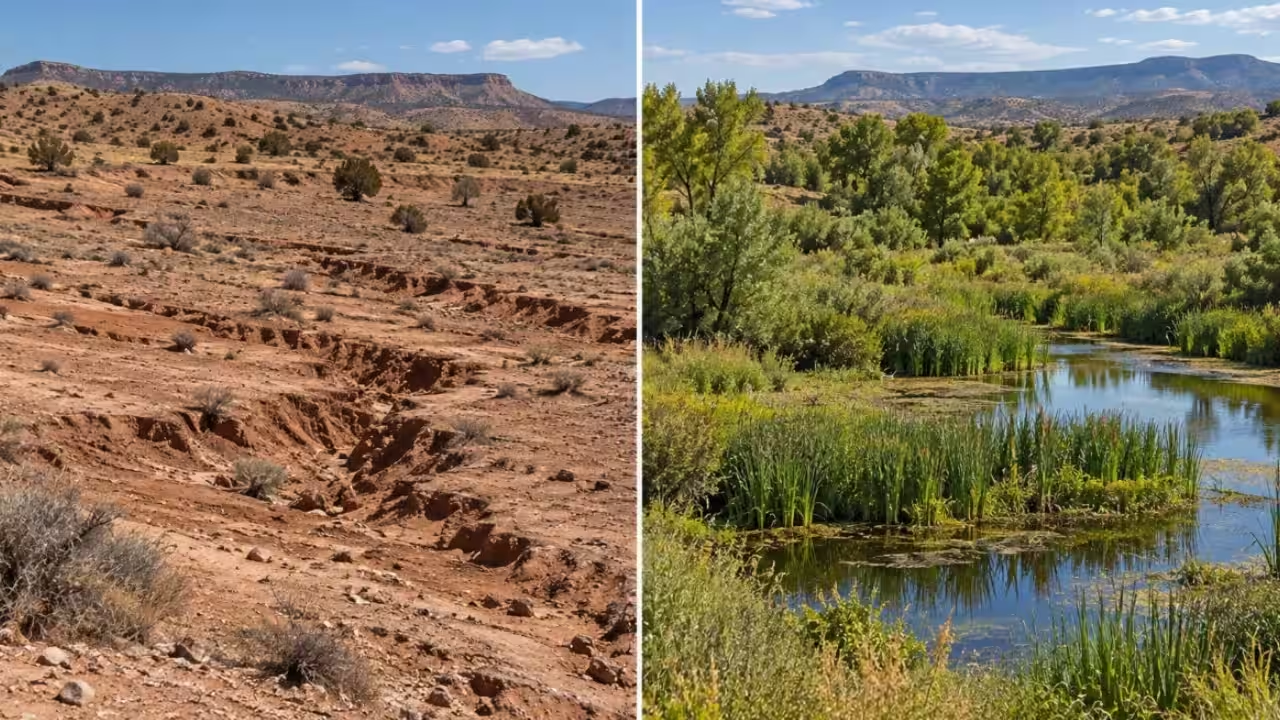
In the mid-1990s, Kimberly de Castro bought a 50-acre ranch outside San Jose, New Mexico. At the time, the land she purchased was overgrazed, eroded, and largely barren. Rather than abandoning the property, she began rehabilitating the land with help from a small grant through the US Fish and Wildlife Service’s Partners for Fish and Wildlife Program. The US Department of Interior’s 2002 annual report noted that de Castro planted more than 5,000 trees and shrubs, sowed grass seed, and placed straw bales containing seed and fertiliser in areas where erosion was most severe.Additionally, she developed and installed a five-mile drip-irrigation system to supply water to the new plants. Eventually, the project helped the ranch regain vegetation by dividing the property into distinct ecological zones: fragile riparian areas were fenced off to restore its wetlands, while the upland pastures were reclaimed to support separate, sustainable rotational grazing. This work also encouraged neighbouring landowners to undertake conservation works of their own. Decades later, looking back from 2026, this multi-layered rehabilitation serves as a historical case study in long-term private land management.How degraded land became a restoration projectWhen de Castro bought the ranch, the land’s condition showed the effects of intensive grazing and erosion. This was because the land was said to be windswept, overgrazed, and bare according to the government report. This kind of soil is not only difficult for plants to grow in, but the absence of vegetation on this soil means that it becomes susceptible to erosion. The response to this by de Castro was a combination of planting and soil-stabilisation measures instead of relying on a single intervention. Grass seed was drilled into the ground; straw bales containing seed and fertiliser were placed in badly eroded areas.The US Fish and Wildlife Service’s Partners for Fish and Wildlife Program, which works with private landowners to improve wildlife habitat on their property, provided a small grant for this project. The grant was one part of the restoration effort, alongside planting grass seedlings, erosion-control measures and irrigation.Planting thousands of trees and shrubsPlanting more than 5,000 trees and shrubs was a crucial part of de Castro’s work. However, the restoration involved more than just introducing new plants. The federal agency reported that the ranch eventually bloomed again, successfully supporting sustainable grazing on its reclaimed uplands while entirely preserving the adjacent wetlands. As the report does not provide a survival rate for the plantings or quantify changes in erosion, soil conditions or wildlife populations, it can best be described as the recovery of vegetation and the return of the property to productive grazing, instead of a measured ecological transformation.As noted in the historical records of the Department of the Interior, the project provided an impetus for the wider watershed community. The business owner's efforts encouraged dozens of neighbouring landowners to form a regional conservation collective, ultimately pooling their contiguous properties to extend similar resource-management work across a combined 5,000 acres of the shared valley. The extra lands were part of the wider community project. Moreover, de Castro involved teachers and pupils from the surrounding schools in the partnership.Wetland, wildlife and environmental educationAn account published by the US Environmental Protection Agency provides further context about the property’s conservation role. It reported that the 50-acre property included two restored wetlands and more than 5,000 plants. The wetland restoration formed part of the broader rehabilitation of the property, alongside planting and other land-management works.The wetland area can create habitats to sustain wildlife such as birds, fish and amphibians, as well as store and purify water. According to the guidelines provided by the EPA on the management of wetland and riparian areas, some of the roles played include habitat creation. Therefore, de Castro’s project began with the rehabilitation of a degraded 50-acre ranch and developed into a wider conservation effort involving neighbouring landowners and local schools.You use AI every day. Now get your AI Quotient. Take the AIQ test.
Topics in this story
Gathered from external sources. Rights to this text belong to whoever originally published it.