In 2001, a British-Brazilian family began reclaiming abandoned cattle pasture; 840,000 trees later, 1,500 acres of Atlantic Forest have returned
Rest of World News: Discover how the Locke family has restored 1,500 acres of Brazil's Atlantic Forest by planting 840,000 trees, transforming degraded pasture into vibrant ecosystems over two decades.
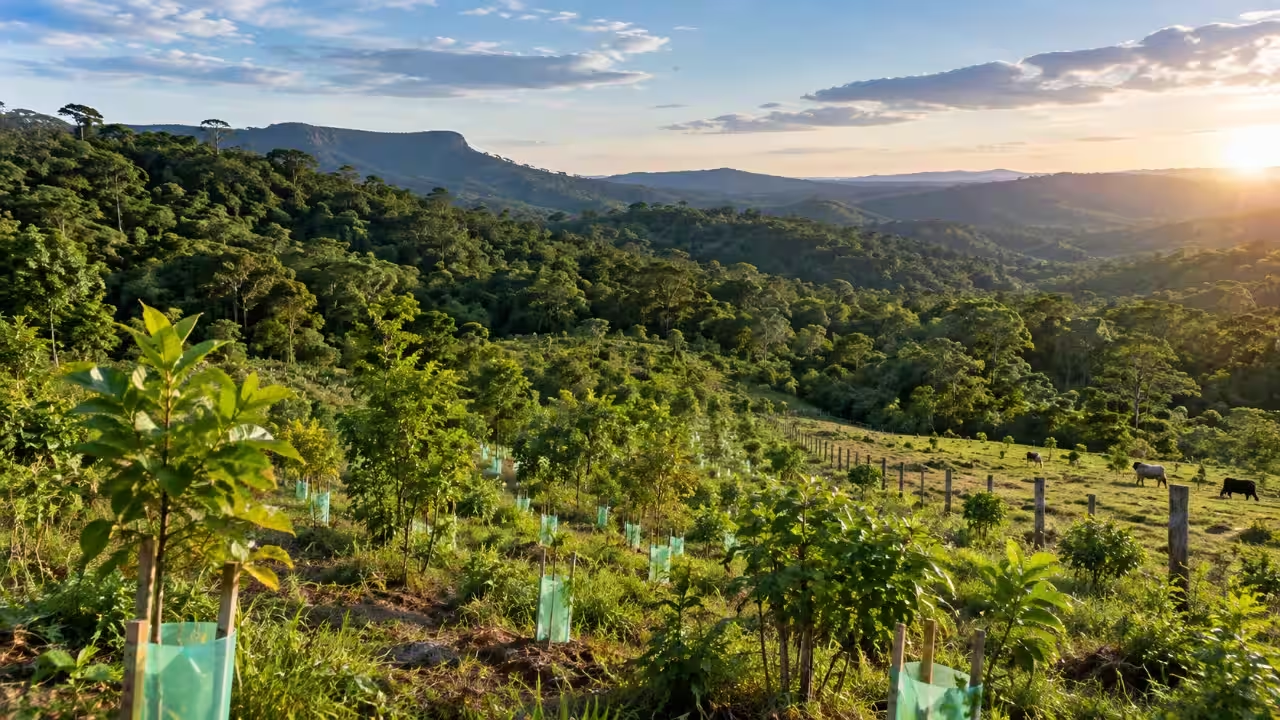
In a landscape once used for cattle pasture, young native trees are growing into a very different habitat. In the hills of Rio de Janeiro state, the Locke family has spent more than two decades restoring parts of the Atlantic Forest through the creation and expansion of the Guapiaçu Ecological Reserve, known as REGUA. What began as an effort to protect the forest on the family's land has grown into a long-running restoration effort across degraded pasture, wetlands and fragmented forest. The scale of the change is striking. According to the World Land Trust, REGUA has planted about 840,000 trees on degraded land, mostly former pasture, restoring about 607 hectares, or 1,500 acres, to forest. The restored areas also help reconnect isolated forest fragments.From family land to a growing forestAccording to REGUA, the organisation was formally established as an environmental organisation in 2001, although the idea behind it had developed several years earlier. Nicholas Locke, who was born and raised in the UK, returned to Brazil as a young man and became involved with the family property in Guapiaçu. He and his wife, Raquel, gradually shifted the focus of the property away from traditional agriculture and towards conservation.The family’s connection to the land dates back much further. Nicholas Locke’s great-grandfather acquired the former Fazenda do Carmo in 1907. Over the following decades, parts of the property were used for agriculture and livestock, while sections of the original forest remained. By the 1990s, the family had become increasingly concerned about protecting these remaining forest areas and restoring the surrounding landscape. When REGUA was established, its work went beyond protecting the forest that remained. The organisation also began acquiring degraded land and restoring it, with reforestation becoming one of its central activities, particularly in lowland areas where forests had been cleared for pasture.Wildlife returns as the forest growsThe transformation has taken years. Trees planted in former pasture first had to survive the difficult early stages of establishment, while natural regeneration gradually added to the developing vegetation. REGUA’s restoration programme aims to rebuild ecological connections between isolated forest fragments. As restored areas mature, they can fill gaps between existing forest patches and create a more connected landscape. The organisation has also restored wetlands and other degraded habitats, extending the work beyond tree planting.The results are becoming increasingly visible. The World Land Trust states that more than 220 bird species have been recorded at the preserve, while capybaras, caimans and wetland birds have returned to restored areas. The reserve has also carried out species reintroduction programmes, including the return of lowland tapirs to Rio de Janeiro state after an absence of roughly 100 years. Research published in Environmental and Sustainability Indicators has also found that areas of the Brazilian Atlantic Forest undergoing active reforestation showed patterns of tree and mammal diversity that could approach those found in naturally regenerating secondary forests. The researchers also found that greater tree diversity was associated with greater mammal diversity, highlighting the importance of diverse native plantings in forest restoration. This does not mean newly planted forest immediately becomes equivalent to mature forest. Recovery takes time, and restored areas can still differ from older forests in structure and biodiversity. But the findings show how carefully managed restoration can help degraded landscapes develop more complex ecological communities.Where restoration takes rootToday, REGUA extends far beyond the original family property. The organisation manages many thousands of hectares through land acquisition and partnerships, while its restoration work brings together local staff, scientists, volunteers, conservation organisations and international supporters. Its nursery remains central to this effort, producing a steady supply of native seedlings from seeds collected in surrounding forests and helping ensure that restoration remains rooted in the region’s native flora.For the Locke family, restoring the land is not simply about replacing trees that were lost. It is about recovering parts of a landscape shaped by generations of farming, grazing and forest clearance. The former pasture will take many years to develop the structure of mature Atlantic Forest, but the planted trees are already changing the landscape, creating vegetation and habitat where open pasture once dominated. Over time, those young plantings can become part of a larger forest system reconnecting areas of habitat across the region.Catch the latest World News and Live updates. Download the TOI app.
Topics in this story
Gathered from external sources. Rights to this text belong to whoever originally published it.