The lost Corsair: The search for a Korean War legend and its missing pilot
US Navy and Marine Corps pilots called the F4U Corsair the “The Widowmaker.”
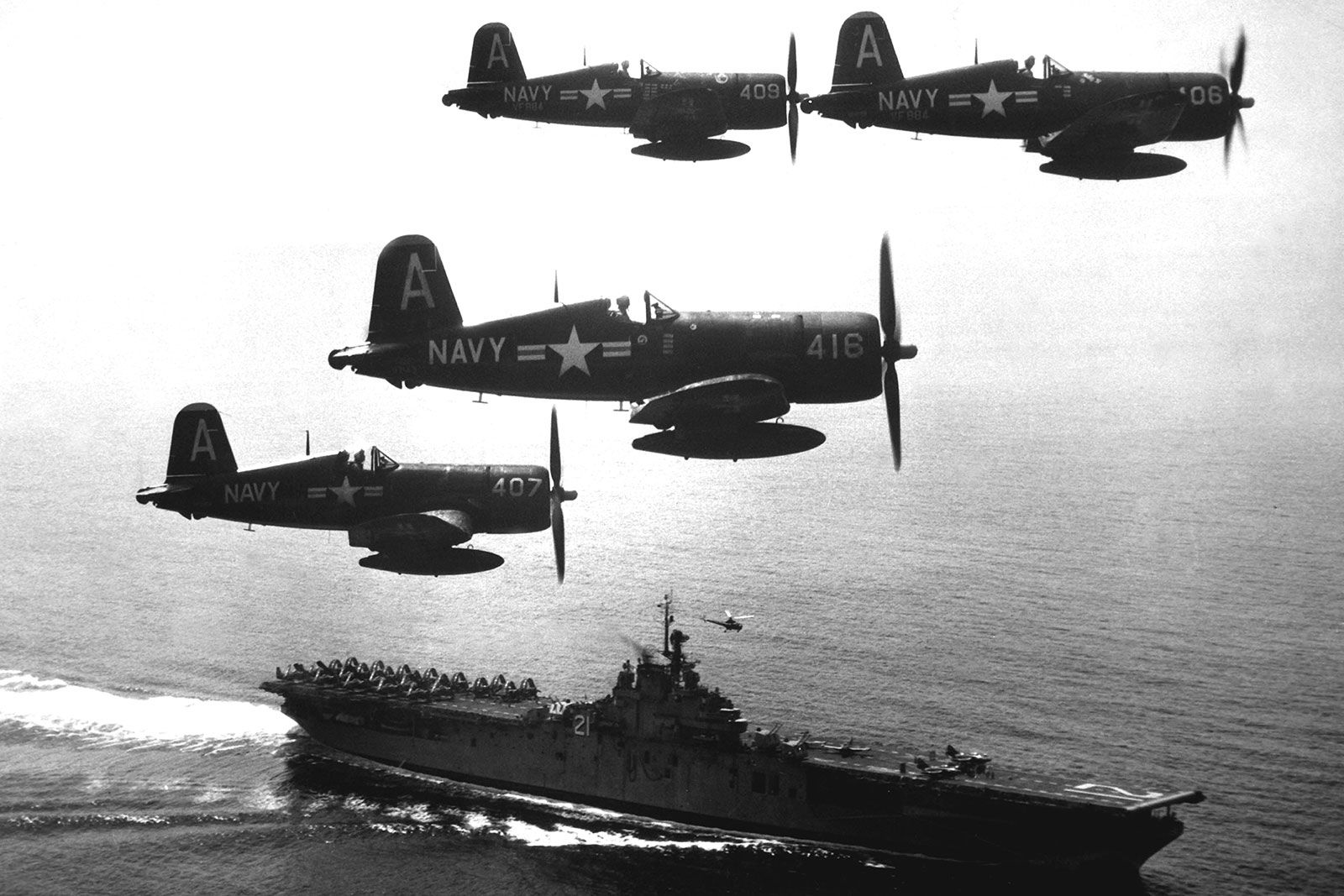
US Navy and Marine Corps pilots called the F4U Corsair the “The Widowmaker.” Not because it was responsible for shooting down more than 2,100 Japanese planes in World War II, but because it was tricky to handle; so powerful that if its pilot adjusted the throttle too quickly the torque from its 18-cylinder engine could flip it over and send it crashing, upside down, into the sea. Japanese ground troops called it “Whistling Death,” for the sound it made during bombing and strafing runs, a role that would become even more important during the 1950-53 Korean War. In Korea, 494 Corsairs would be lost, including one flying off the aircraft carrier USS Essex on February 21, 1952. It was never seen again. Until, maybe, now. Mystery find Scuba diver Kim Kyung-soo has 25 years’ experience in the waters off Korea and elsewhere. But what he saw one day in May 2025 was a mystery to him. Leading a group of divers into the waters off Yangyang, South Korea, Kim dropped anchor at a well-explored diving spot. But a strong tidal current pushed the anchor into even deeper waters, he told CNN. “When we reached 45 meters (148 feet) depth, I couldn’t see the seafloor. I was swimming around in that depth when I saw a dark object on the floor,” Kim recalled. “I couldn’t see the exact shape, but it had a long cylindrical form like a submarine. Not too big though… I thought it could be a small submarine from North Korea.” Kim was curious. But the object was at least another seven meters (23 feet) below him, and a deeper descent was too much of a risk for his inexperienced students. So, he left his curiosity behind with the unknown object in the water. A gray, frigid Thursday Carrier Air Group Five was operating off the east coast of Korea that Thursday in February ’52, flying off four aircraft carriers – USS Valley Forge, USS Antietam, USS Philippine Sea and the Essex. The air group had been on station just a few days when combat orders came in for February 21. It would launch 85 combat sorties, flying close-air support for ground troops and photo reconnaissance, as well as strikes against enemy supply lines and installations. It was cold and snowy, but combat reports show the planes of Carrier Air Group Five made an impact that day: “The Air Group cut railroad tracks in 33 places, 6 trucks were destroyed, 11 buildings destroyed, 1 barracks burned, 25 railroad cars destroyed and 25 were damaged.” The price to the US Pacific Fleet was two aircraft lost. That afternoon, an AD-4 sustained battle damage. The Essex sent out help, a Corsair to escort the Skyraider back to the carrier. But the weather was as much an enemy as the North Koreans or the Chinese. An “F4U crashed into the sea shortly after entering a snow storm while escorting a battle-damaged AD,” Pacific Fleet records state. “Probable cause, pilot … disoriented in snowstorm. Not recovered; listed as killed in the line of duty,” a report from the Essex’s commanding officer states. A new clue “Usually when you tell people you saw something (underwater) they don’t believe you. They say, ‘Don’t lie! You must be mistaken,’” Kim, the scuba diver, said. But one of Kim’s students, An Hyun-jin, listened, believed and searched. And searched. And searched. An, who owns a dive shop and has been diving for more than five years, would go back under the waves looking for what Kim saw more than 10 times until … “When I found the propeller, I was really surprised that Kim was not wrong about seeing something; like wow, there really is a plane, and my heart started beating fast,” An told CNN. But it took a while longer to find that mysterious cylinder, which would turn out to be the forward fuselage of a plane. They got close and, without touching the aircraft, moved the sediment to reveal the distinctive inverted gull-shaped wings, leading them to believe it was a Corsair. Kim knew the significance of preserving and documenting such findings, having participated in several recovery works with nonprofit organization Global Underwater Explorers in Europe, and the South Korean government at Chosei Coal Mine in Japan’s Yamaguchi prefecture, where more than 130 Koreans were killed in 1942, during the Japanese colonial period. He led an 11-person crew diving to the site, armed with devices for measuring the wreckage and rendering it into a three-dimensional model. Photographic evidence In photos and videos captured by the divers and seen by CNN, the plane appears embedded in the seafloor, rusted and covered in barnacles, as could be expected after decades under water. The tail had been torn away and is nowhere to be seen. There’s no propeller or cockpit canopy. But it has the profile of a Corsair, its distinctive wings and long nose that covered that powerful engine offering clear indicators of the model, according to a CNN comparison of the pictures alongside historical photos and blueprints. As they made those photos last year, the divers knew they were on to something. They shared their findings with South Korea’s defense agency for recovery and identification, one of only two government agencies in the world dedicated to identifying those killed in action. Impressed with the divers’ find, the South Koreans shared the detailed documentation of the plane with their American counterparts at the Hawaii-based Defense POW/MIA Accounting Agency (DPAA), who were aware of a Corsair that crashed into the water after returning from combat action in 1952, and the pilot never heard from again. In short order, the Yangyang mission became a priority for the Americans. Underwater archaeology The sun beat down on the rigid-hulled rubber boat as Meghan Mumford stood tall over the other five people aboard. An underwater forensic archaeologist, she scanned the sea, trying to pinpoint the best spot to drop an underwater drone, whose sensors could help confirm Kim’s find. Mumford felt the weight and responsibility of her job. “I think it’s truly an honor to bring answers and repatriate our servicemembers and our heroes not only to our nation but specifically to their families,” she said. The DPAA says 7,354 Americans are still missing from the Korean War, among more than 80,000 from all actions since World War II. Multiple thousands of descendants and relatives are still waiting for answers. DPAA goes wherever it has credible evidence and a chance of providing relatives with closure, juggling searches in 46 countries to try to put resources where they’ll have the best chance of finding identifiable remains. The Yangyang site fits the bill. Locating and recovering remains require a long process, starting with interviewing local residents or witnesses, digging through historical records, and carefully excavating bones and artifacts for DNA analysis at the agency’s Hawaii lab before returning them to the remaining relatives. DPAA team leader Spencer Jefferson, a US Army captain, told CNN that the agency wouldn’t notify families that remains have been found until bone tissue has been found and tested at its own lab. “From there, we can positively identify who exactly this is,” he said. Mission in Yangyang The weather was “oddly calm,” noted Commanding Officer Choi Seong-woo when CNN joined DPAA and its South Korean counterpart in August on their mission to verify the Yangyang wreckage. After sailing about half an hour, Choi’s navy yard utility boat slowed and hovered – never fully stopping as the water was far deeper than the length of the anchor. Fishing nets were obstacles for Mumford’s team as they tried to scan the ocean floor with two underwater drones. Once the drones were safely in the water, the team spent five hours scanning the sea floor – and confirmed there was indeed an aircraft below them. Black sheep and angels Team leader Spencer agreed that, based on the photos taken by the divers, the wreckage has all the signs of being a Corsair. “This has the potential of being something we’re looking for … the shape, and the different engine compartments and things like that,” he said. Corsairs entered service in 1942, and more than 12,500 were delivered to the US military by 1952. While the F4U was designed to be operated off carriers, in its early years the US military had trouble figuring out how to do that in practice, according to the National World War II Museum in New Orleans. So, it made its mark flying off airstrips on Pacific islands, in air-to-air combat but also as a fighter-bomber in battles over Guadalcanal and the Solomons, the museum says. It also notes the most heralded operators of the Corsair, Marine Fighting Squadron 214, also known as the “Black Sheep Squadron.” The unit – cobbled together from pilots without units – shot down or destroyed more than 200 Japanese planes from August 1943 to January 1944. Its exploits inspired the 1970s TV series “Black Sheep Squadron,” bringing new fame to the Corsair. Those victories flying off island airstrips might have been the final legacy of the Corsair, but British Royal Navy pilots figured out how to fly it off carriers, according to the museum. It would be incorporated into the US carrier fleet by 1944, and in the 1945 Battle of Okinawa, Corsair pilots were instrumental in blunting Japanese kamikaze attacks on American warships, earning the nickname “Angels of Okinawa,” the museum says. One of the “Sseksseki” Koreans didn’t have a specific name for the Corsair. US fighter planes were called “Sseksseki” for the sound they made zooming by. But the Corsair was still a force on the war. In the first 10 months of combat, 82% of ground-support missions were flown by Corsairs, according to the Vought Heritage Foundation. The pilot on one of those missions, flown during the frigid Battle of the Chosin Reservoir in late 1950, recalled the action in a 2000 essay for the US Naval Institute’s Naval History magazine. Marine pilot Lyle Bradley and a wingman were tasked with supporting the 15,000 men of the First Marine Division, who were surrounded by several Chinese divisions. Checking in by radio with a Marine air controller on the ground, codenamed Dunkirk 1-4, the Corsair pilots heard their importance. “We are happy to see you Corsairs. Please circle us as long as possible. You’re our link to the outside world,” Bradley quotes the controller as saying. He would go on to give the American pilot instructions on where to hit the Chinese, and Bradley released 2,000 pounds of bombs on the target. “Looks like a perfect hit,” Dunkirk 1-4 said. “We love you Corsair people.” Attending a history conference in Wyoming almost 40 years later, Bradley writes, he came across the Marine air controller who was Dunkirk 1-4. “He hugged me and exclaimed, ‘You guys saved our fannies!’” Once in the family It’s said that once you’re in the military, you gain a whole new family. And the family you leave behind when you deploy is part of that greater new family. That’s why the aircraft wreckage at the bottom of the sea off the coast of Korea still matters. Families are key to the DPAA’s mission. DPAA personnel expect to be back off Yangyang in the near future. If there’s a chance the remains of that pilot are there, DPAA will keep looking. “Somewhere beneath a modern city, on a mountain, in the middle of a minefield, or in the deep seas may lie the last trace of a life cut short by war,” says Chris Jo, the Korea liaison officer of DPAA. “Fulfilling our nation’s promise is to leave no one behind and bring long-awaited closure to the families.”
Topics in this story
Gathered from external sources. Rights to this text belong to whoever originally published it.