In 1419, a Portuguese settler reportedly released a mother rabbit and her litter on Porto Santo; centuries later, Darwin found rabbits about half the weight of mainland ones
Rest of World News: Explore how the introduction of rabbits by Portuguese navigator Bartolomeu Perestrelo in 1419 transformed Porto Santo’s ecology and shaped the understanding of evolution, as observed by Charles Darwin over 400 years later.
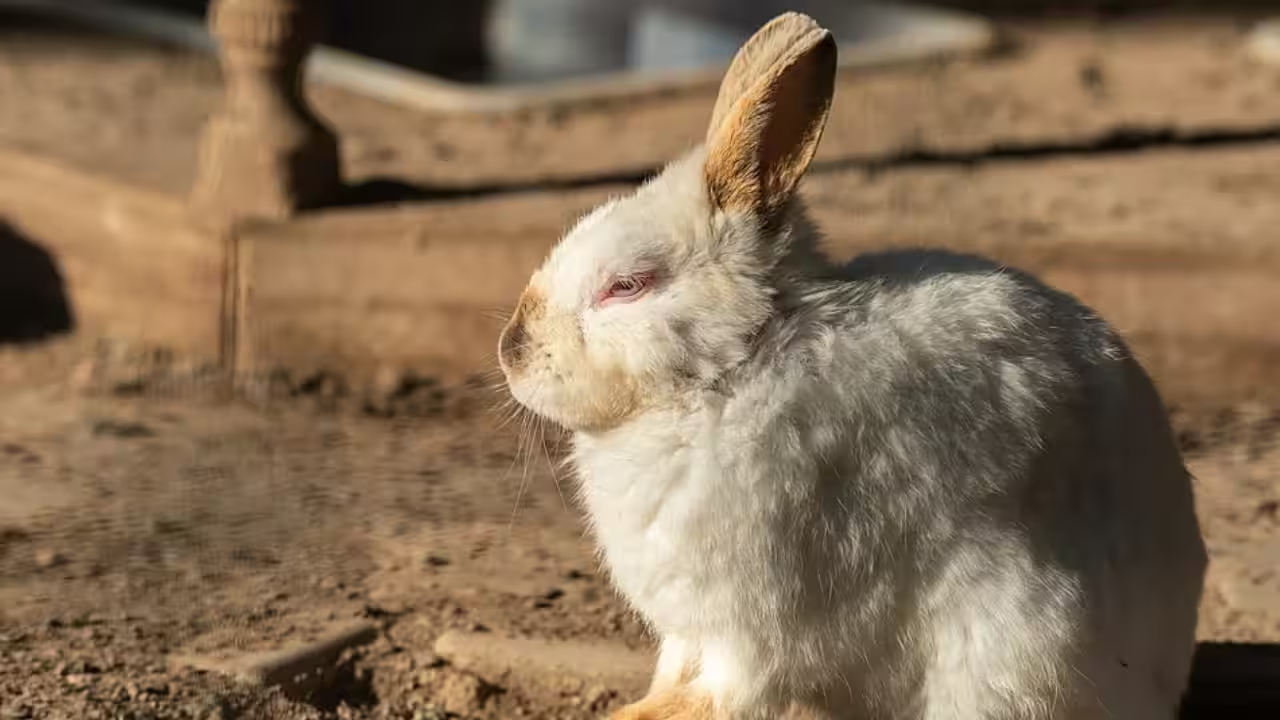
A storm carried a Portuguese fleet off course in 1418 to an uninhabited island in the eastern Atlantic Ocean. The commanders of this expedition, João Gonçalves Zarco, Tristão Vaz Teixeira and Bartolomeu Perestrelo, named this island Porto Santo because they appreciated the safe landing on the island, according to the Portuguese National Archive’s virtual exhibit of Discovering Madeira and Porto Santo Islands. According to tradition, when Bartolomeu Perestrelo returned in 1419 to lead the settlement of the island, he released a doe rabbit and her newborns upon landing. The act is said to have seemed harmless at the time, but within decades it transformed the island's ecology, and the rabbits it produced were later cited by Darwin as one of his best-known examples of evolutionary change.An island with no predators becomes a rabbit warrenPorto Santo had no native land mammals or natural predators to limit rabbit reproduction. Without either one of these factors, the rabbits quickly multiplied in such large numbers as the settlers had never expected. According to mid-15th-century Portuguese chronicles and the narrative of the Venetian navigator Alvise Cadamosto, who was on Porto Santo Island in 1455, the rabbits multiplied very fast, such that their proliferation ruined the farmland much quicker than it could be tilled by the settlers. According to the same chronicles, the first settlements nearly collapsed because of the rabbit infestation.In one study called ‘Long-Term Forest Dynamics on Porto Santo Island (Madeira Archipelago) after Human Colonization: A Paleoecological Approach’ concerning the history of the island's forest, a lengthy series of vegetation degradation on Porto Santo is found to be connected with this initial action; one such significant reason for the deterioration of native forests is attributed to the grazing activity of rabbits. The same study describes long-term forest monitoring plots at four sites on Porto Santo, each about 0.5 hectares, spanning a range of elevations and exposures. The study suggests the impact of rabbit introduction may have been comparable to that of human activity, since intense grazing limited the regeneration of native forest and its replacement by less browsing-resistant plants.Later zoologists reinterpreted the rabbits as a known small wild subspecies By the 1860s, more than 400 years had passed since Perestrelo supposedly released the rabbits on Porto Santo. Some of the specimens collected by Darwin included animals that appeared to be entirely different from any he had come across before; they were diminutive, brownish-red in color above and gray underneath, and had small ears and tails that did not have black tufts like those of the European rabbits, as indicated in his 1868 book on The Variation of Animals and Plants under Domestication. According to Darwin's own account in that 1868 book, they were, most notably, only about half as heavy as the average mainland rabbit. This, Darwin regarded, as one of the clearest demonstrations of evolutionary change in his lifetime.A later paper challenged Darwin's interpretationAn article written many years after Darwin's death revisited the question, with a conclusion that reframed his findings. A naturally diminutive rabbit subspecies, found in Iberia and parts of North Africa and known to zoologists for some time, carries the scientific name Oryctolagus cuniculus algirus. The article argued that the rabbits Darwin observed on Porto Santo were not an evolutionarily new form after all, but examples of this existing south European subspecies, typical of Iberia and North Africa; their small size and other distinctive traits were later interpreted as features of that naturally occurring race rather than evidence of island-driven evolutionary change. On this reading, the rabbits Darwin studied most likely descended from the same subspecies Perestrelo originally released.Regardless of whether the rabbits' small size arose through genetics or through four centuries of island life, the ecological impact of their early-15th-century introduction was substantial and long-lasting. The LIFE4BEST project's ecosystem profile of the Macaronesia region describes this as one of the earliest known cases of what happens when a mammal is introduced to an environment with no native grazing mammals.Catch the latest World News and Live updates. Download the TOI app.
Topics in this story
Gathered from external sources. Rights to this text belong to whoever originally published it.