454-million-year-old supervolcano found beneath England may explain a vast ash layer across northern Europe
Rest of World News: More than 454 million years ago, a huge volcanic system erupted beneath what is now eastern England. Scientists have now found evidence of the long-ex.
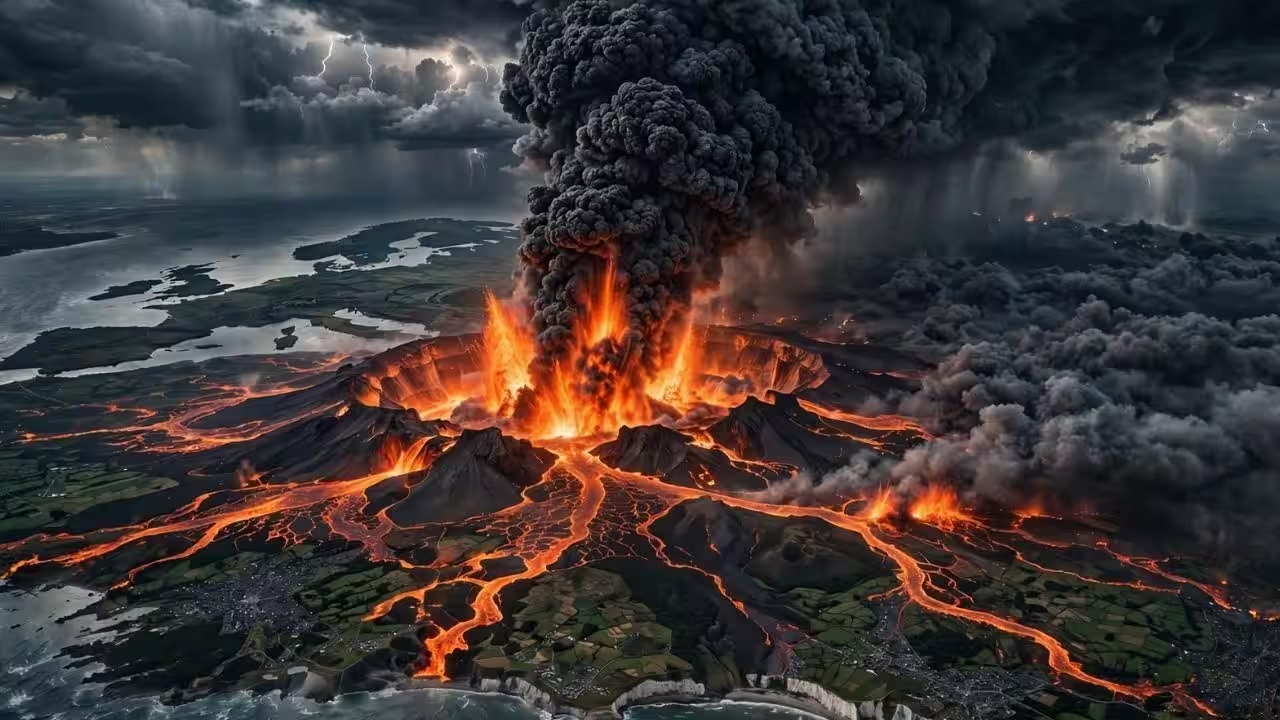
More than 454 million years ago, a huge volcanic system erupted beneath what is now eastern England. Scientists have now found evidence of the long-extinct volcano buried beneath The Wash, offering new clues about the region’s ancient past. Researchers from the British Geological Survey and the University of Oslo studied tiny crystals preserved in rock samples from boreholes in Norfolk and Lincolnshire. The crystals helped them date the eruption to about 454.4 million years ago. The findings also suggest that this ancient volcano may have produced the Kinnekulle ash layer, which is found across parts of Norway, Sweden, the Baltic region, Belarus and Poland. At the time, the land that would become England was separated from Scandinavia by the Tornquist Sea. Though the volcano disappeared millions of years ago, evidence of the eruption remained buried beneath the landscape.Ancient supervolcano beneath The Wash was once a vast volcanic complexThe ancient supervolcano was centred beneath The Wash, with its remains stretching into parts of Norfolk and Lincolnshire. Scientists identified evidence of the volcanic system in rock samples recovered from two boreholes about 65 kilometres apart. It was active during the Late Ordovician period, more than 450 million years ago, when the landscape and position of the continents were very different from today. The area that would later become England was then part of Avalonia and lay near an active zone of volcanic activity. Over millions of years, the volcano was buried beneath younger layers of rock and sediment. Scientists believe one of its eruptions sent several hundred cubic kilometres of material high into the atmosphere.Tiny zircon crystals revealed when the ancient eruption occurredThe evidence came from zircon crystals found in samples taken from boreholes at North Creake in Norfolk and Claxby in Lincolnshire. Zircon forms inside molten magma and can preserve a timestamp for the crystal because uranium within the mineral decays into lead. By analysing these isotopes, researchers dated crystals from both locations to 454.4 million years ago. That age closely matches dating obtained for the Kinnekulle tephra in the Oslo region. The researchers compared the chemistry of apatite crystals in the English samples with material from the ash layer. The similarities strengthen the proposed link between the buried volcanic complex and the tephra.Ancient eruption may explain the mysterious Kinnekulle ash layerThe eruption may explain the origin of the Kinnekulle tephra, a layer of altered volcanic ash preserved across Europe. The deposit occurs in parts of Norway, Sweden, the Baltic region, Belarus and Poland. The Tornquist Sea separated the land that became England from Scandinavia. Researchers propose that an eruption in eastern England sent ash high into the atmosphere, allowing the plume to cross the sea before material settled on the seafloor in Scandinavia. Chemical similarities between apatite crystals provide further evidence.Why the extinct supervolcano beneath England poses no modern threatIts remains are not visible as a volcanic mountain because geological processes have transformed and covered the landscape. The research reconstructs the volcano from minerals preserved in rocks recovered from boreholes. The findings show the value of geological archives, since the samples used in the analysis were collected decades ago and examined with modern techniques. Researchers say the work provides evidence linking the Kinnekulle tephra to eastern England. It offers a picture of volcanic activity that shaped the region during the Ordovician period.Catch the latest World News and Live updates. Download the TOI app.
Topics in this story
Gathered from external sources. Rights to this text belong to whoever originally published it.