The woman who remembers everything: What it’s like to live with memories of your best days — and worst nightmares
FIRST PERSON: Rebecca Sharrock tells Rachel Dobkin what it’s like living with Highly Superior Autobiographical Memory and how she deals with disturbing flash...
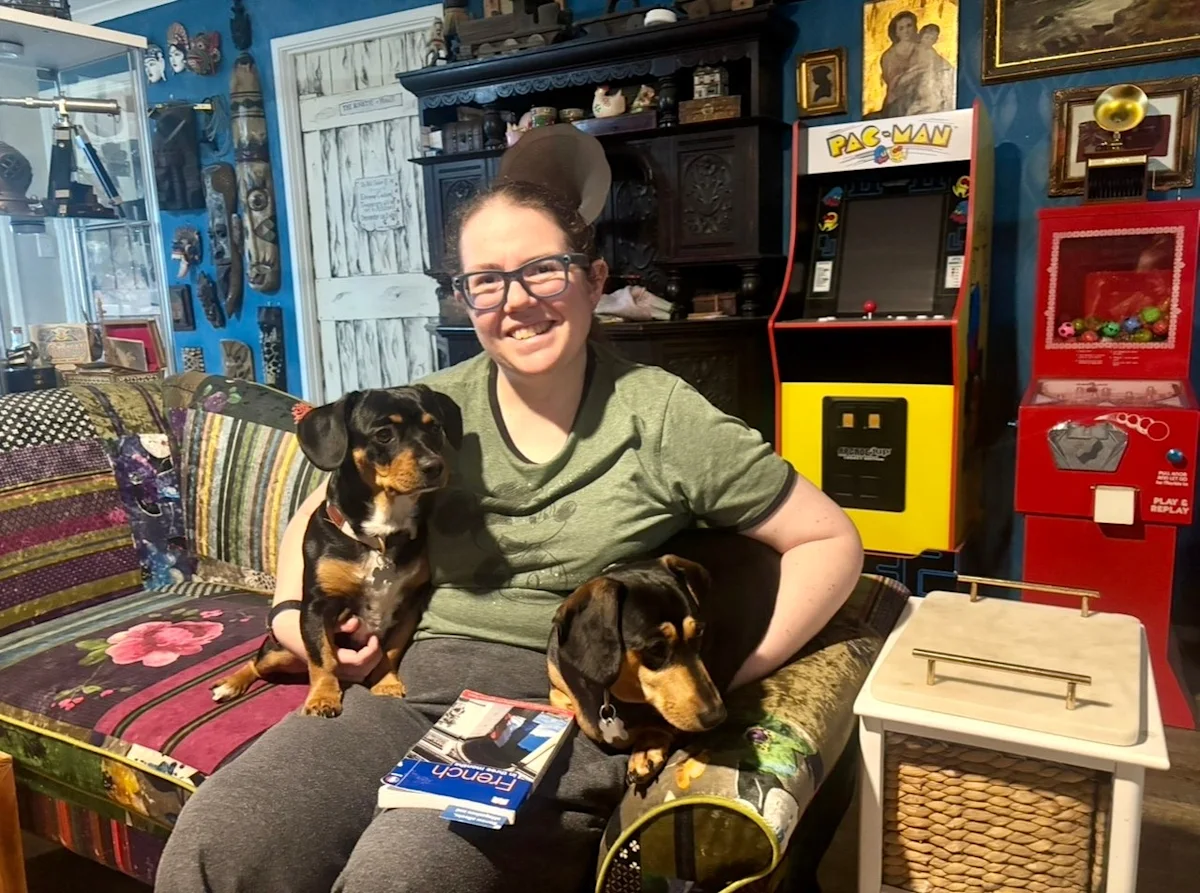
Rebecca Sharrock remembers almost every day of her life.
The 36-year-old has a rare condition called Highly Superior Autobiographical Memory, or HSAM, which means she can remember vivid details from her past — even back to when she was a young child.
"I live with constant random flashbacks of a clutter of experiences — negative, positive, mundane — and they just flash through my head all the time from random ages, such as they can jump from three years old to 20 years old to seven years old to 16 years old, and it's very difficult for me to get to sleep at night," Rebecca told The Independent from her home in Brisbane, Australia .
For Rebecca, who also has autism, anxiety and obsessive-compulsive disorder , it can be hard to let go of disturbing memories. She said HSAM and OCD "get along like a house on fire" and that the two conditions feed off each other.
"I find it hard to just let go of emotions, let go of thoughts, and with HSAM, it then extends to more and more memories that I can't let go of," Rebecca said.
While many people might retain a hazy memory of a day when a global event occurred, Rebecca can recount it with extraordinary precision.
When asked about August 31, 1997, the day when Princess Diana died, Rebecca remembered in detail how her family reacted to the tragic news.
"I was seven. I wasn't allowed to watch the news until I was 11 because mum said that it may be a bit scary for me, but I did catch a news story because my mum and my auntie were over, and me and my sister were having a bath, and mum was washing our hair, and then my auntie just called out, and she said, 'Oh, the Princess of Wales has died,'" Rebecca said.
Dr. Craig Stark is professor of neurobiology and behavior and principal investigator of Stark Lab at the University of California , Irvine. His team study HSAM and diagnosed Rebecca with the condition in 2013 when she was 23, after two years of testing.
Stark says that he and his team have validated memories of people with HSAM by asking about both public and private events.
"For a number of these folks...we can verify against actual public kinds of things," he told The Independent . "Some of them have had diaries, and it's like, 'Oh yeah, they could go back and study their diary.' Yep, they could, and then they show up with multiple boxes of diaries, and you're like, 'Oh.'"
HSAM is a rare condition where people have an exceptional ability to remember autobiographical memories. While Stark says that it's impossible to truly answer how many people have HSAM, researchers have identified about 100 people worldwide with the condition.
One famous example is the actress Marilu Henner, best known for the sitcom Taxi that ran from 1978 to 1983.
Henner offered a positive outlook on HSAM for students at the University of California, Davis, during a visit to one of psychology professor Charan Ranganath's classes last February.
"Developing a better autobiographical memory is the strongest defense against meaninglessness that we have. Because then our lives count for something," she said, according to the college's magazine .
Stark said that he and his team found that people with HSAM score high on obsessive-compulsive tendencies. The professor explained the process that people he's studied with HSAM go through to remember the days of their lives.
"They turn the day into basically the diary or the social media post version of the day," Stark said. "And that's what they remember very, very well. They think about it multiple times — repetition over time, repeated practice. They have a structure and everything to it. They link it to other events."
"We've known for thousands of years that these things improve your memory. And Marilu Henner is kind of right that the rest of us just don't do this. [People with HSAM] do, which then makes their memory for autobiographical events better," Stark explained.
Rebecca said that she loves to organize her memories, which she attributes to her OCD.
"It's as if in my head, hypothetically, I've got a filing cabinet, and I like to organize them into months, years and days," she said. "I had a fear as a child with my obsessive-compulsive disorder about forgetting things. So, when mum would say, 'You need to just put your memories into a box,' I'd say, 'But I'm scared that I'll forget them, and then a part of my life will be missing.'"
Rebecca is a lover of classical music and foreign languages, using her passions as a distraction from unwanted memories that constantly pop into her head.
She said that when she struggles to go to sleep at night, she listens to classical music. "I anchor my mind into relaxation by just imagining that my thoughts and feelings are the notes of the music, and that helps me a lot," she said.
Rebecca has taken medication to manage her OCD since she was 16 but stress can make some days harder than others.
Rebecca can't drive or have a traditional career because of her conditions.
"If I was to just have to be in one place all day and do what I have to do, I'm constantly having to ground my mind due to flashbacks," Rebecca said. "I've had to pick a job which is writing and doing creative work that relaxes my mind. So it still occupies me, but relaxes me. And learning languages distracts my mind from flashbacks because I have to focus on either learning the instrument or learning the language."
She has been taking classical guitar lessons for three years and will start violin lessons next year. She's also learned how to speak Spanish and French and is almost finished with her courses in Italian.
Rebecca released her first book, My Life is a Puzzle , in 2024, which gives a chronological account of her experiences from birth to age 30. She is working on her next book titled My Life in Sketches .
"For many years, I did wish that I was like most other people. I did wish that I didn't have OCD, didn't have these experiences of HSAM, didn't have my issues with autism, and that causes my anxiety primarily," Rebecca said. "I have thought over the past five years that because I've never known life to be any different…it would be unsettling to just have to suddenly adapt to a different life."
Rebecca hopes more research into HSAM can help better understand the brain. "We need to learn a lot more about what's in our world rather than what's outside of our world," she said.
Topics in this story
Gathered from external sources. Rights to this text belong to whoever originally published it.