In 2015, US engineers added blade deflectors to help turbines capture more wind; a wind-tunnel model’s power coefficient rose 10%, while a separate prototype test measured a 7.7% gain
Discover how Rutgers University engineers are enhancing wind turbine performance with innovative blade deflectors, achieving up to 10% increases in energy capture without needing larger turbines.
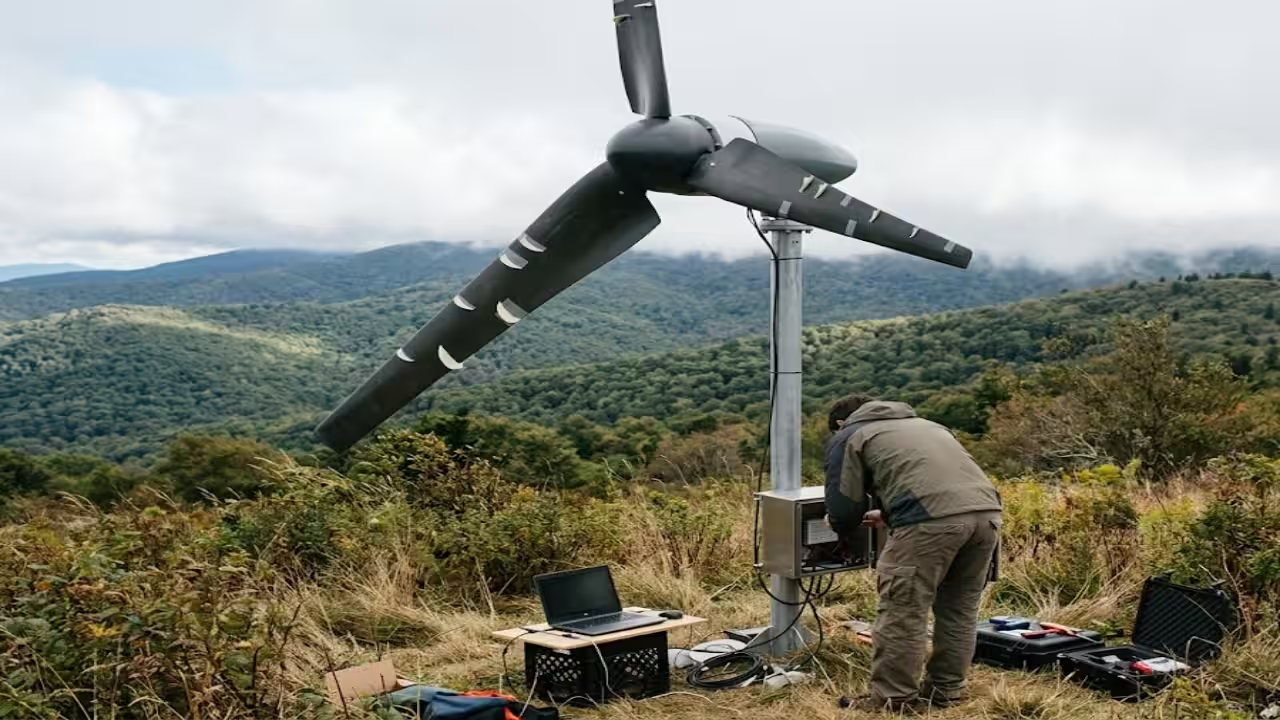
The wind business has pursued size for most of the past few decades. Wider rotors, longer blades and taller towers have increased output, but they also bring heavier parts, more difficult transportation and costs that wind farm operators would rather avoid. A quieter question remains in the background as a result. Can turbines already spinning on farmland and hills capture a little more wind without getting bigger?Rutgers University engineers in New Jersey took up that question in a project whose final report was published in 2015. Arturo Villegas oversaw the project, which Rutgers CAIT, the university’s transportation and infrastructure research division, ran with funding through the US Department of Transportation’s University Transportation Centres program. His group created aerodynamic flow deflectors, small, slightly curved fins attached to turbine blades. According to the project summary, the team’s target was a 10% gain in power when the deflectors were added to new or existing turbines. Rutgers said a 1 MW turbine could rise from about $90,000 a year to $126,000, and early water-channel tests showed power increases of 8% to 12%.The power coefficient measures how much of the wind’s available power a turbine extracts. The theoretical ceiling, known as the Betz limit, is roughly 59%, and real machines fall well short of it. If a turbine converts a quarter of the energy in the wind, a 10% relative improvement will increase it to about 27.5%, which sounds small until you scale it up throughout a wind farm.How do deflectors work?Air doesn’t slide smoothly on a rotating blade. It also drifts sideways along it, from the root towards the tip. Conventional design views such drift as a loss. But the Rutgers team didn’t see it that way. They fastened fine silk threads to the blades of a miniature turbine, recorded them with a high-speed camera and saw that the airflow tilts by about 5 to 20 degrees. Their idea was to capture that sideways flow with a narrow, winglike deflector and convert it into more torque, the twisting force that drives the generator.Initially there were glimpses of hope. With trials in a tiny water channel showing roughly 8 to 12% power increases, the team turned to practical questions. The deflectors for the following tests were 3D printed and adhered with double-sided tape from 3M and Nitto, and in spin tests none of the tested tapes let loose. That out of the way, two proper trials ensued.Wind tunnel and field resultsThe first took place in the wind tunnel at Rutgers. Two identical 3D-printed turbines, each about 0.4 meters across, were tested at wind speeds from 3 to 6 meters per second, one with deflectors and one without. The second test was harder because it took place in real weather. The team transported a Whisper 100 turbine to the Wind Application Centre at Appalachian State University on Beech Mountain, North Carolina, at an altitude of around 1,556 meters, where typical winds at 30 meters are approximately 7 meters per second. It ran as is for two weeks. Then the team lowered the turbine tower and added the deflectors, and it ran for another two weeks. The final report, published by the US Department of Transportation, shows a 7.7% improvement in the average power coefficient over the entire curve. The best single point was at 8 metres per second, where the coefficient rose from 0.25 to 0.30, a 20% relative gain at that wind speed.One caveat is needed for a fair reading. The weather differed between the two fortnights: average wind speed at the main sensor was 4.48 meters per second before the deflectors and 5.38 after. The researchers normalized the measurements for air density and used an international testing standard for small turbines, but because the two runs were not simultaneous, the comparison is less controlled than a side-by-side test.What this could mean for wind farmsWhy would a few percent matter? The authors said a 2% increase in annual output can boost a wind farm’s profit by roughly 8%. They also noted that vortex generators, a retrofit currently on the market, often add 2% to 3%. The report included return-on-investment scenarios for a 1.5-megawatt turbine. Those figures were projections, not measurements, and should be read as such.The limitations matter too. So far, only two experiments have been carried out, one on a small model and one on a small turbine. The team itself proposes computer simulations and longer testing, first on turbines more than 10 meters across and then on full-scale machines over 100 meters, before anyone talks about commercial application. And it advises that a poorly formed or badly located deflector can actually decrease power rather than increase it.So the takeaway is a cautious one. Rutgers has shown that redirecting the sideways flow along a blade can contribute about 10% in a wind tunnel and 7.7% outdoors, enough to pique the interest of wind farm owners. The question is whether the same approach will work on a big turbine in real weather.You use AI every day. Now get your AI Quotient. Take the AIQ test.
Topics in this story
Gathered from external sources. Rights to this text belong to whoever originally published it.