At Fort Campbell, Tennessee, researchers mixed processed household trash into soil; the highest dose helped native prairie grasses establish better than on control plots
Discover how researchers at Fort Campbell, Tennessee, found that incorporating processed household waste into soil significantly improved native prairie grass establishment, with implications for land restoration efforts.
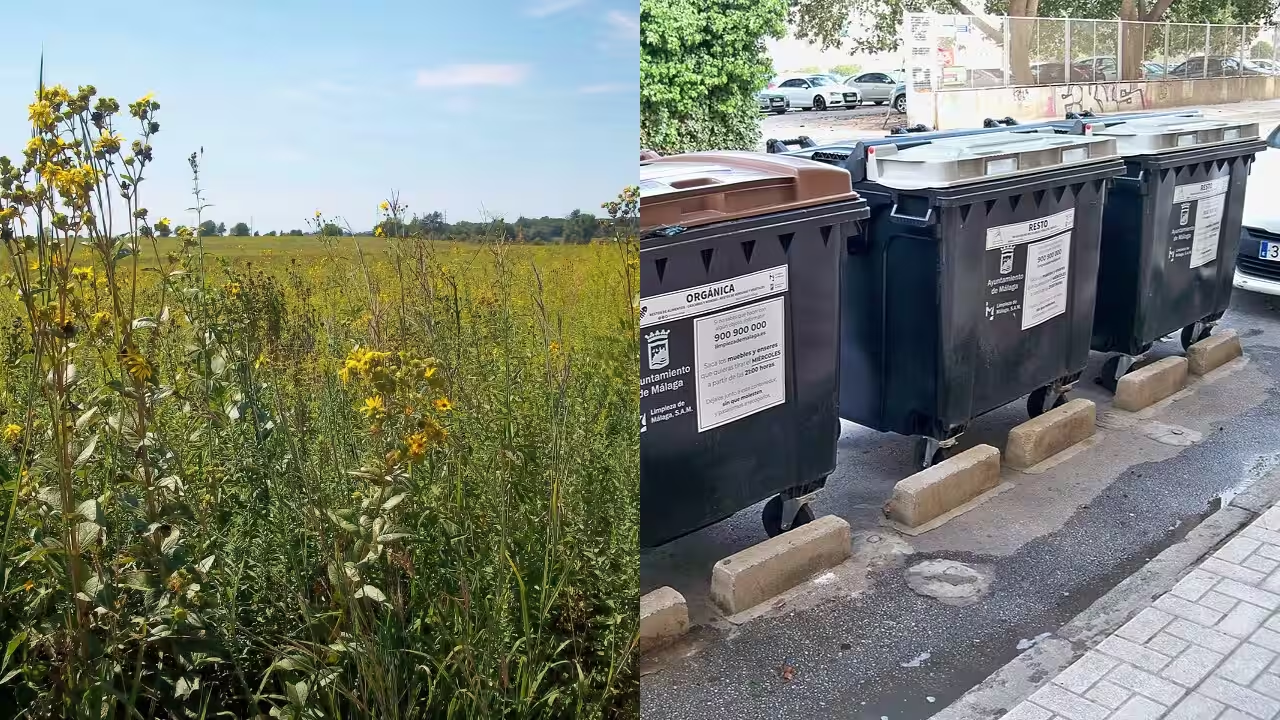
Fort Campbell is a military installation in Tennessee, where it was found that native prairie grasses grew more successfully in plots that were treated with high doses of a processed household-waste by-product. Researchers recorded significantly greater native-grass cover in the highest-dose plots than in untreated controls, during a two-growing-season study.Can organic material help in restoring disturbed land? The project tried to answer this by sterilising household waste and separating its organic and inorganic components, with researchers incorporating the uncomposted organic by-product into silt loam soil before sowing native prairie grasses.Researchers tested five application ratesThe team applied the material at rates of zero, 4.5, 9, 18 and 36 metric tonnes per hectare, and the plots were seeded with native prairie grasses and were monitored over two growing seasons. The researchers were able to compare the treatments with natural vegetation recovery with the help of an additional unseeded control. The highest application rate produced a lot more native-grass basal cover and a greater share of native grasses in the plant community than the controls. Basal cover measures the area that has been occupied by plants at the soil surface, while percentage composition is an indicator of how much of the vegetation consists of the target grasses.Accumulation of plant phosphorus also increased as the application rate rose; phosphorus is an important plant nutrient, and the measurements suggested that the processed material supplied nutrients that the grasses could use. The experiment showed that the greatest improvement in native-grass establishment occurred at the highest rate tested, 36 metric tonnes per hectare.The material changed soil nutrient levelsWhen it came to soil chemistry, phosphorus and lead concentrations increased in the upper 10 centimetres of soil at the highest application rates where the material had been mixed in. The authors reported few environmental effects during the trial and concluded that the material improved the establishment of perennial grass and plant nutrition at the highest rate. It is important to note that the study does not infer that every processed household-waste product would be suitable for every restoration site, or that the same application rate would be safe under all soil conditions. The research was published in Communications in Soil Science and Plant Analysis in 2010, and its authors included researchers from the US Army Engineer Research and Development Center, the US Department of Agriculture’s Agricultural Research Service and the University of Illinois.A related study tested the material on degraded landThe same type of waste-processing by-product was examined in a separate study at Fort Benning in Georgia, which was published in the Journal of Plant Nutrition in 2007. It tested the material on moderately and highly degraded sandy loam soils over two growing seasons, where material at rates of zero, 18, 36, 72, and 143 metric tonnes per hectare were applied. They found improvements in available nutrients and soil pH at both sites, and the treatment also reduced soil bulk density and increased soil carbon and nitrogen concentrations. The study’s results provide related evidence for using processed organic waste in land restoration, but the sites, soil conditions, and application rates were different from those at Fort Campbell.The results depend on the site and doseThe Fort Campbell trial found that processed household waste could help native grasses establish on disturbed land, particularly at the highest rate tested, but also cautioned that the results could not be universally applied. The increase in soil lead and phosphorus also means that any wider use would require testing of the material and the receiving soil, as researchers would need to consider nutrient needs, soil chemistry, and the possibility of contaminants accumulating before applying the approach at other sites. The study supports further investigation of processed organic waste as a soil amendment, and its findings are specific to the product, site, and conditions tested over two growing seasons.You use AI every day. Now get your AI Quotient. Take the AIQ test.
Topics in this story
Gathered from external sources. Rights to this text belong to whoever originally published it.