After cats and rats were wiped out on Raoul Island, a parakeet missing for generations returned; researchers found its first nests there since 1836
The Kermadec red-crowned parakeet, absent for 172 years, has returned to Raoul Island after the eradication of cats, rats, and goats. This historic discovery of nesting and population growth offers hope for parrot conservation efforts.
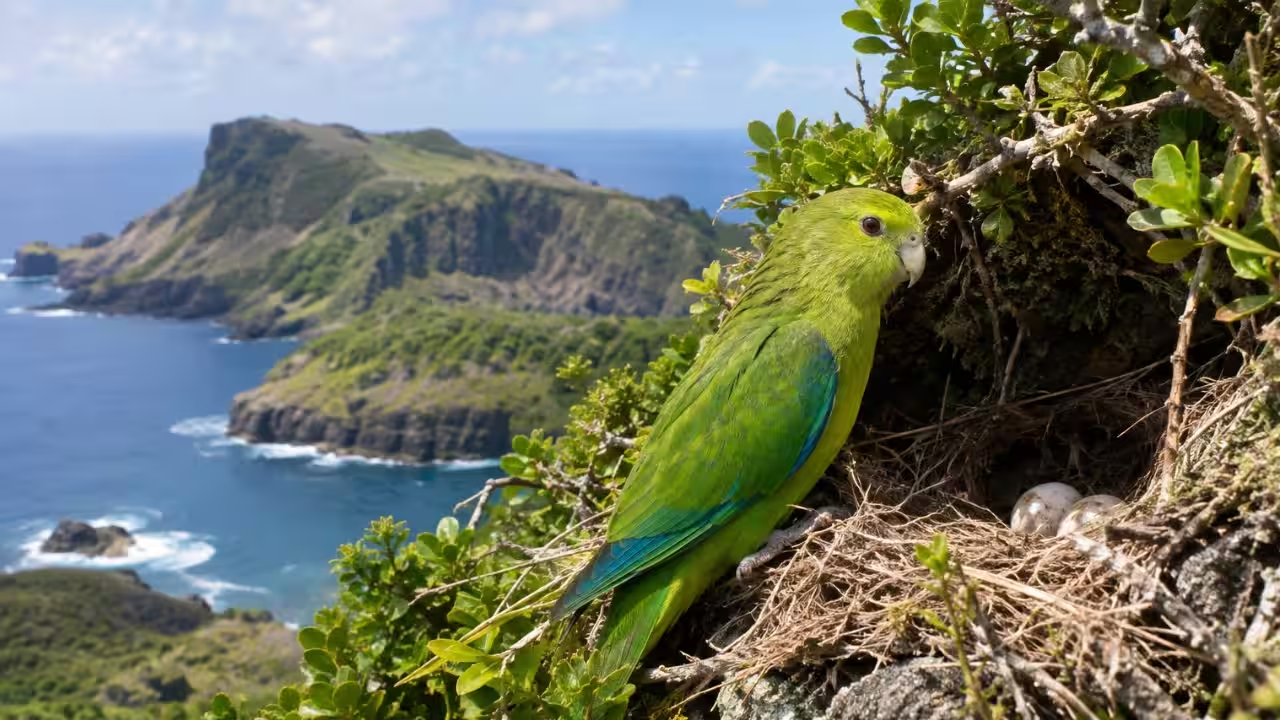
Raoul Island, the largest of New Zealand’s Kermadec Islands, lies about 1,000 km northeast of the mainland. No breeding by the green-bodied, red-crowned Kermadec parakeet had been recorded on Raoul for roughly 170 years, until birds began returning after predator removal. Soon after cats and rats were removed, birds began arriving from a nearby island group, and a 2008 research team documented breeding there again. The 1836 date now appears in the opening line, so it isn't lost.Parrots abundant in 1836, feral cats established by 1872, and Norway rats from 1921A 1991 study in the New Zealand Journal of Ecology on the diet of feral cats on Raoul Island reconstructs the decline. In 1836 when Captain Rhodes made his visit, there were plenty of parrots, pigeons, and other birds on the island. The dietary data presented by the authors were based on the examination of gut contents of 61 cats, along with pooled scats that had been collected from August to October 1972, 12 cats examined in the field between May and July 1973, and 26 cats between September and November 1974. According to the authors, most rats consumed by the cats were kiore, despite the fact that more Norway rats had been trapped. By the time of the study, the island's parakeets were represented only by stragglers from the nearby Herald Islets. The authors examined 101 cats killed between 1972 and 1974 and found that rats were the main food, with land birds second.2002 to 2004 eradication of cats, rats and goats, the world's largest multi-species projectCats, rats and goats were culled on the island between 2002 and 2004 in what is considered the largest-ever multi-species eradication effort, according to researchers from Massey University. The goats had been removed previously, in 1984, based on the 1991 study. In 1991, the study's authors were cautious about removing cats alone. They argued that culling cats without also removing the Norway rats would do little to help the island's birds, and that the money could be spent more wisely. They did, however, predict that if the cats were removed, parakeets from the neighbouring Herald Islets would colonise Raoul.2008 survey captured 100 parakeets, and 44% had hatched that yearIn 2008, scientists from Massey University and the University of Auckland, along with the Department of Conservation, made a trip to Raoul via the Royal New Zealand Navy ship Canterbury. They discovered an abundant parakeet population there. The scientists captured parakeets using mist nets near the airstrip and Boat Cove gullies, then fitted each bird with a numbered band and collected breast feathers for DNA sexing. They captured 100 parakeets and determined that 44% had hatched in 2008. Ortiz-Catedral and colleagues reported the findings in Conservation Evidence. These parakeets likely originated from the Herald Islets, a 51-hectare island group about 4 kilometers away from Raoul, where some parakeets were still alive.A first for parrot conservation, and what it means for costly translocationsThe researchers say that, as far as they know, this was the first recorded population expansion and recolonization of an island by a parrot species following predator eradication. Massey University conservationist Luis Ortiz-Catedral said the finding is encouraging because birds can find safe breeding areas once predators are eradicated. The paper recommends prioritising eradication sites near remnant populations rather than relying on translocation alone.What food supply could mean for Raoul's parakeets nextA 2013 study in the New Zealand Journal of Ecology offers a clue about what may come after predator removal. Working on Tiritiri Matangi Island, an offshore sanctuary free of introduced mammalian nest predators, researchers tracked red-crowned parakeets through two breeding seasons. Starvation, not predation, was the main cause of nestling deaths, and every dead nestling examined had an empty crop. Early clutches produced larger broods of healthy nestlings, which led the researchers to conclude that food availability becomes the critical resource once cats and rats are gone. Whether the same holds on Raoul is still unknown. The 2008 survey was a single snapshot that did not track birds between islands or report later counts, so Raoul's current parakeet population has not been measured.Early clutches gave rise to larger broods of healthy nestlings. They suggested that, in the absence of introduced nest predators, clutch order and starvation-related brood reduction determine nestling survival. The experiment suggests that food availability, not predation, becomes the critical resource for a parakeet colony when cats and rats are removed. The recolonisation paper reports a single 2008 survey. It says the birds presumably came from the Herald Islets and does not track individuals between islands. It also does not report later counts, so it does not establish the size of Raoul's parakeet population today.You use AI every day. Now get your AI Quotient. Take the AIQ test.
Topics in this story
Gathered from external sources. Rights to this text belong to whoever originally published it.