In 2022, a Norwegian man cycled toward India for nine months, then kept riding until 55,000 km across 46 countries brought him home nearly four years later
Andreas Graf embarked on a bicycle journey from Norway to India, but ended up circumnavigating the globe over three and a half years covering 55,000 km across five continents and facing extreme weather conditions.
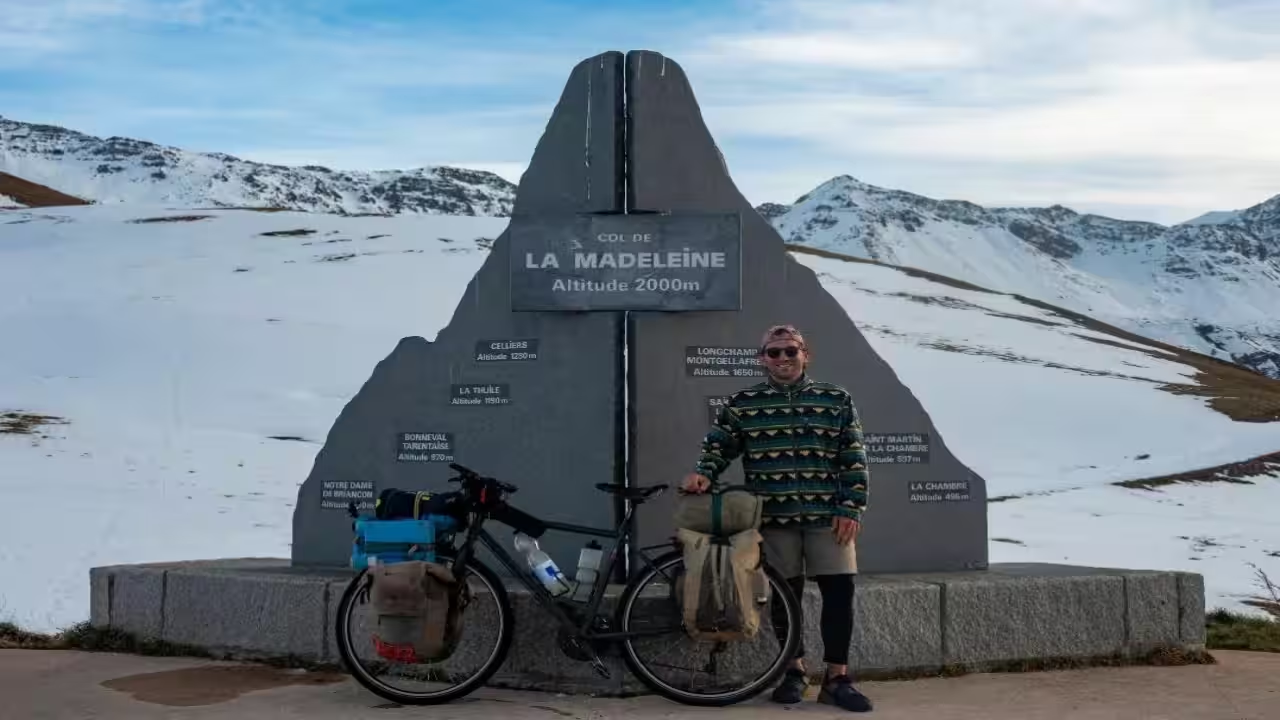
In April 2022, Andreas Graf set out from his home in Norway on a bicycle, expecting to reach India in about nine months. Instead, the journey led him to travel 55,000 kilometres across five continents and 46 countries, according to the Guardian. What started as a trip towards a single destination turned out to be a circumnavigation that lasted three years and eight months. Graf chose to leave his routine behind to travel mostly under his own power, meet people and spend more time outdoors. A week after leaving home, he was in Sweden, lying in a half-wet sleeping bag while rain poured onto his tent, but he continued through Denmark, Germany and Poland, then south through central Europe, Greece and Turkey. The reason Graf chose cycling was that it allowed him to cover more ground than walking while retaining a slower pace. By the time he reached India, he no longer intended to stop, and the idea of cycling around the world had replaced his original goal.From India through Asia and Oceania to South AmericaAfter India, Graf travelled through Nepal, where he took a break for a month and volunteered on a coffee farm. He then flew over Myanmar, which was closed, before cycling through south-east Asia to Singapore. From that point, he took a ferry to Indonesia and continued by bicycle through Indonesia, Timor-Leste, Australia and New Zealand.His next major leg took him through Chile and Argentina, before he cycled through Bolivia, Peru, Ecuador and Colombia. At the end of this South American section, he took a final flight to Senegal and cycled north towards Norway, completing the journey on 23 December 2025.Graf met the most brutal conditions in Australia, where he spent two months cycling across the outback during summer, with the exception of one day when the temperature fell below 40°C, he told the Guardian. His loaded bicycle weighed between 52 and 85kg. In addition, he also crossed the Sahara during summer, recording a temperature of 51°C in central Mauritania, Graf said. Strong winds and blowing sand made the crossing particularly difficult and extended it by a month beyond his expectations.Extreme conditions and unexpected kindness during the journeyWhile facing dangers on the road, Graf camped near the Ak-Baital Pass in Tajikistan, at 4,655 metres above sea level, during a storm and woke to clear skies and snow-covered mountains. In northern Chile, he experienced a 7.4-magnitude earthquake; while in Peru, his bicycle along with his tent, mattress and stove broke down and forced him to wait for replacement equipment.After he had cycled almost 10,000 kilometres along the Andes, he crashed while descending a mountain in Colombia after encountering a pothole and an oil spill. The accident broke his wrist, and surgery left him with a titanium plate and eight screws. Along with these hardships, Graf encountered generosity from strangers in rural India, where he was invited for breakfast after a brief, tense encounter. Recalling his experience, Graf told the Guardian: “There was a bunch of guys in front of the tent with knives and machetes and a big flashlight. They were scared; they don’t get a lot of visitors.” In southern Australia, a couple who had seen his photograph on Facebook left him the keys to their house while they had gone away for the weekend.The experience also changed his relationship with work and time. In Australia and New Zealand, he travelled without a phone, often waking with the sun and going to bed with it. His career-focused outlook faded, while his experiences of pollution and extreme temperatures prompted concerns about the future of places he had visited.You use AI every day. Now get your AI Quotient. Take the AIQ test.
Topics in this story
Gathered from external sources. Rights to this text belong to whoever originally published it.