A New York family kept building a winter ice rink in its front yard despite $100 weekly HOA fines; a judge ruled the ban invalid and cancelled nearly $2,000 in penalties
A family in Clarence, New York, can keep building an ice rink in its front yard.
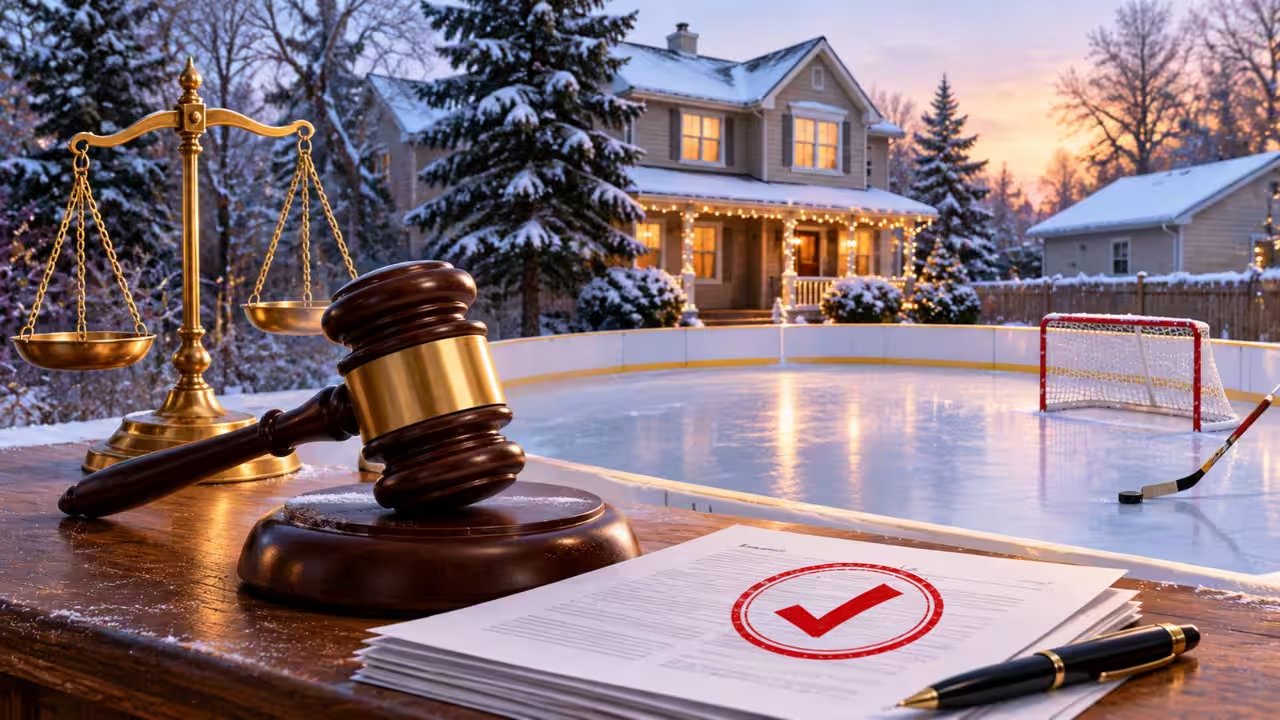
A family in Clarence, New York, can keep building an ice rink in its front yard. The Zinnos skated for a year before their homeowners' association prohibited ice rinks in all front yards. They continued to erect one in each of the next two years, and the association began levying weekly fines of $100, reaching approximately $2,000. On 6 January 2026, Justice Peter Allen Weinmann of the Supreme Court, Erie County, declared the ban invalid and ruled the fines null and void, finding the board had skipped the 67% homeowner vote its Declaration required.New York family’s front-yard ice rink sparks a $2,000 HOA fine disputeAccording to the ruling in Zinno v. Waterford Village Association, Inc., the Zinnos enjoyed a carefree year of ice skating before their HOA decided to prohibit ice rinks in all front yards. The family continued to erect a rink in each of the next two years. The HOA then began levying weekly fines of $100, and the balance had reached approximately $2,000 by the time of the decision.The ruling states that the Zinnos sued the association, alleging violations of the HOA's governing rules. The HOA countersued, also alleging violations of those rules, and sought to collect the outstanding fines. According to the court, both sides' counsel agreed at oral argument that no facts were in dispute, and that the issue was a question of law, so both sought summary judgment.HOA rules did not originally prohibit front-yard ice rinksThe decision describes the central issue as a conflict between two documents: the Declaration of Protective Covenants, Conditions, Restrictions, Easements, Charges and Liens, and the Architectural and Maintenance Standards and Guidelines. The Declaration was created in 2004 by the developer. It runs to 15 articles, schedules and exhibits across almost 60 pages. The judge wrote that it "functions as a constitution" and forms part of the deed to every property in the association, which counsel put at approximately 100.According to the ruling, Article X of the Declaration sets rules on almost 20 topics, including signs, animals, fences and walls, garbage, hunting, above-ground swimming pools, exterior storage, open fires, trees, and snowmobiles, motorcycles and ATVs; it contains no reference to ice rinks. The Architectural Guidelines were issued in 2014 by the Architectural Committee, which the board of directors was empowered to create under Article VIII. They span 14 pages and cover approximately 15 topics, such as fences, exterior storage sheds, play sets, pools, fire pits and solar panels, and they also do not mention ice rinks. The decision records that in 2022, after the Zinnos erected a rink in their front yard, the committee issued revised guidelines that addressed ice rinks and required them to be placed only in backyards, among other restrictions.Judge says HOA needed homeowners’ approval to ban ice rinksThe court framed the question as whether the board had to follow the Declaration's amendment procedure, or could restrict ice rinks by amending the Architectural Guidelines by a majority vote of the board. According to the ruling, Article XI allows an amendment to be proposed by the board or by a petition of not less than 25% of lot owners. After notice and a hearing, it must be approved by 67% or more of lot owners.The judge pointed to two Appellate Division cases. In Turon v. Meadowbrook Pointe HOA, Inc., a board rule barred dogs over 25 lbs although the governing documents were silent on dog size, and the court sided with the homeowner. In Board of Managers of Village View Condominium v. Forman, a board rule banned all pets where the governing documents did not address the issue, and the court invalidated it for breaching the required 80% owner approval. The decision also cites case law holding that ambiguity in a restrictive covenant is construed against the drafter, and that where language supports two equally plausible readings, the less restrictive reading is adopted. According to the ruling, the party seeking to enforce a covenant carries the burden of proof.Judge voids ice rink ban and nearly $2,000 in HOA finesAccording to the court, there was no ambiguity: altering the restrictions listed in Article X required approval by 67% of all homeowners at a duly noticed meeting, and that did not happen. The judge described the Architectural Guidelines as a subsidiary set of regulations whose authority was created by the Declaration, and wrote that the board's action amended the Declaration without the required vote. The court also held that the business judgment rule, which limits judicial review of authorised board decisions, did not protect the rule because the board's action was authorised by the Declaration.The decision declares the HOA's prohibition on front-yard ice rinks invalid and rules the accumulated fines against the Zinnos null and void. It states that if the HOA wishes to regulate ice rinks, it must schedule a duly noticed vote of all homeowners, which would require 67% approval to pass. The judge directed the plaintiffs' counsel to submit an order on notice within 30 days. The opinion carries a note that it is uncorrected and will not be published in the printed Official Reports.Disclaimer: This article is based on the publicly available decision in Zinno v Waterford Village Association, Inc. (2026 NY Slip Op 50137(U)), published by the New York State Law Reporting Bureau. The Times of India has not independently verified the details of the dispute, the fines levied, the association's rules or the circumstances mentioned. The decision is marked as uncorrected and will not be published in the printed Official Reports. The information should not be interpreted as confirmation from the Zinno family, Waterford Village Association, Inc. or their representatives, and it is not legal advice.You use AI every day. Now get your AI Quotient. Take the AIQ test.
Topics in this story
Gathered from external sources. Rights to this text belong to whoever originally published it.