She wanted a lunar habitat that could understand astronauts’ emotions; how Aparna Jha and her IIT Madras team won an ISRO-IIT Roorkee hackathon
For Aparna Jha, the idea of building a habitat for the Moon did not begin with a plan to design a futuristic space station.
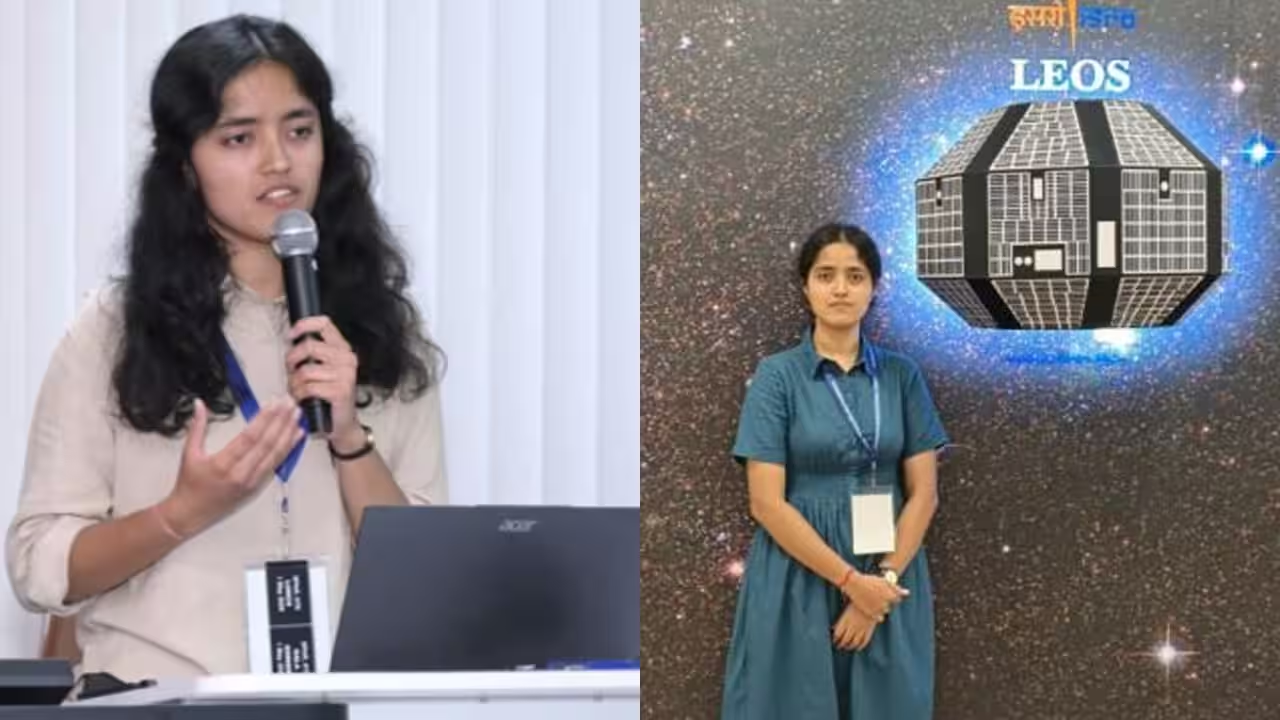
For Aparna Jha, the idea of building a habitat for the Moon did not begin with a plan to design a futuristic space station. It grew out of her interest in Artificial Intelligence, Data Science and the problems that humans could face when they eventually spend long periods away from Earth.That idea became SYNAPSE-1, a proposed lunar habitat that uses AI to respond to the cognitive and emotional state of astronauts. Along with IIT Madras BS students Abhishek Chopra and Pratham Amritkar and teammate Neetika Jain, Aparna developed the project for the Space Architecture (SpAr) Conclave 2026, a national lunar habitation hackathon organised by ISRO, ANRF, IIT Roorkee and TIDES.The team, led by Aparna, eventually secured first place.She wanted to design more than a shelterThe starting point for SYNAPSE-1 was a question that goes beyond the basic engineering of a lunar base.Astronauts on long-duration missions will have to deal with isolation, confinement and extreme environments. So the team explored whether the habitat itself could respond to those challenges.Their concept is a closed-loop cognitive cyber-physical habitat powered by an edge-computing AI digital twin. It is designed to interpret biometric feedback from astronauts and adjust the surrounding environment according to their cognitive and emotional state.“We wanted to design a habitat that responds to human emotions and cognitive well-being, not just physical survival. That vision became the core of SYNAPSE-1,” Aparna said.The project brought together areas that are not usually treated as a single problem: Artificial Intelligence, Data Science, neuroscience, architecture and systems engineering.From a student idea to a technical evaluationWinning the competition required more than presenting an interesting concept.During the evaluation, the team had to defend its approach on areas including structural mechanics, acoustic physics and power-budget considerations before ISRO scientists and IIT Roorkee faculty.The experience gave Aparna an opportunity to see how a multidisciplinary idea would hold up when examined from different technical perspectives.She credits her IIT Madras BS Degree programme with helping her develop that way of thinking.“The IIT Madras BS Degree Program played a significant role in helping me think across disciplines, communicate complex ideas, and confidently lead a project of this scale,” she said.The win took her to an ISRO national meetThe victory also brought another opportunity.Aparna was able to attend the ISRO National Meet on Scientific Exploration of the Moon, where she spent three days interacting with researchers and scientists involved in India's lunar exploration programme.Writing about the experience on LinkedIn, she said discussions covered Chandrayaan-4's sample-return mission, LUPEX (Chandrayaan-5) payloads and the challenges of human spaceflight under the Vision 2040 roadmap.For someone working in Data Science and AI, the conversations also opened up another line of thought: how could technologies being developed today work in the difficult conditions of space?Aparna said she was particularly interested in the possible use of low-power Machine Learning, Deep Learning, edge computing and robust data pipelines, from robotic scientific payloads to future human habitats.What comes after the hackathon?For Aparna, the three days at the ISRO meet were not simply a chance to celebrate the team's win. They gave her a closer look at the problems India's space programme is preparing to solve.In her LinkedIn post, she described the experience as an opportunity to discuss the data architectures behind upcoming lunar missions and said she was leaving with “a notebook full of ideas”.Her journey with SYNAPSE-1 also shows how a student project can evolve when different fields are brought together. What started as an attempt to think about the human side of lunar habitation led to a national competition win and then to conversations with scientists working on India's lunar exploration plans.Aparna is now looking towards the intersection of AI and space exploration, with SYNAPSE-1 offering an early example of the kind of problems she wants to explore.The Moon may be the setting for the team's project, but the question at its centre is very human: if people eventually live far from Earth for months or years, can the technology around them understand what they need as well as keep them alive?Get the latest Education News and Live updates. Download the TOI app.
Topics in this story
Gathered from external sources. Rights to this text belong to whoever originally published it.