She studied CSE, built games in India and reached MIT: Meet Shruti Dhariwal, whose CoCo is changing how children learn AI
News News: What if children were not simply taught how to use artificial intelligence, but were given the tools to create, experiment and learn with AI themselve.
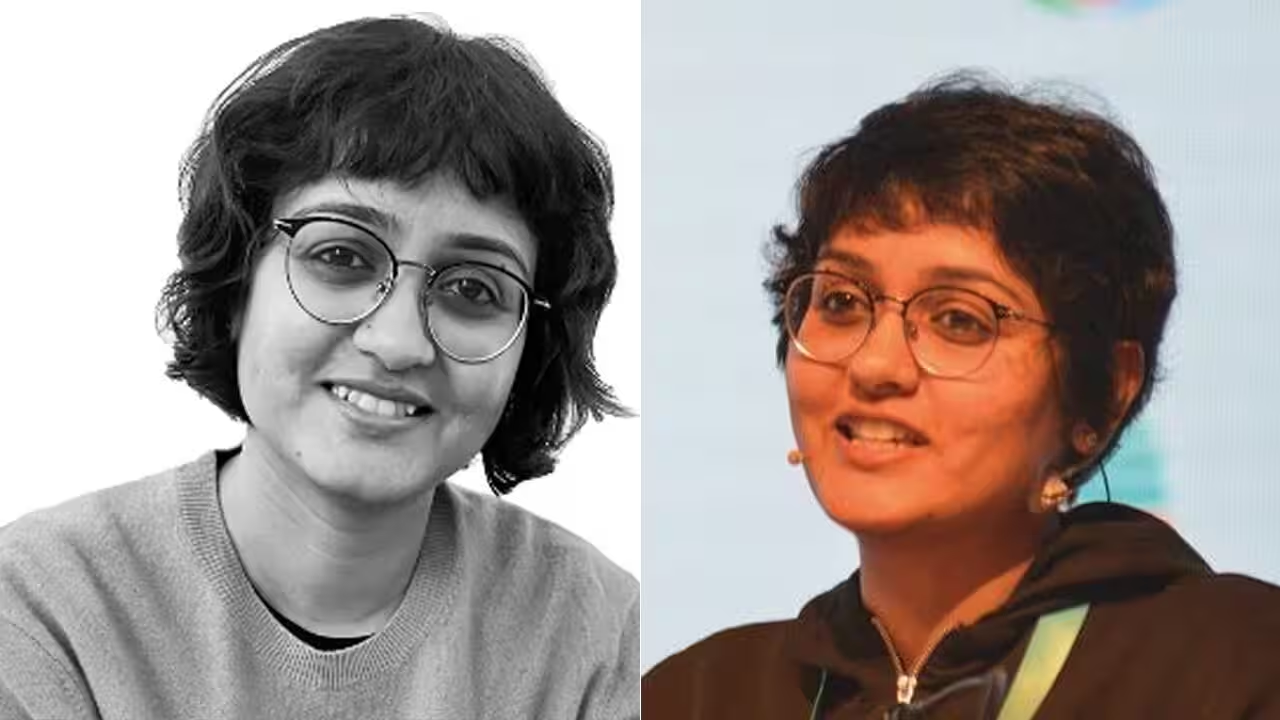
What if children were not simply taught how to use artificial intelligence, but were given the tools to create, experiment and learn with AI themselves?That is the idea behind the work of Shruti (Mohnot) Dhariwal, an Indian researcher and doctoral alumna of the Massachusetts Institute of Technology (MIT) Media Lab. Her academic and professional journey has moved from computer science engineering in India and educational game development to advanced research in creative learning and, now, co-creative AI tools for children and teenagers.Dhariwal has recently been working on CoCo, a collaborative computing and AI education platform designed to help young people learn and create together. Her work has also earned recognition from the MIT community and international education-technology circles.From computer science to an MBADhariwal began her academic journey with a B.Tech in Computer Science Engineering from Jaypee Institute of Information Technology, graduating in 2008.She subsequently pursued an MBA from Management Development Institute, Gurgaon, completing it in 2011.Her early professional experience included a stint as a Young Leader at Airtel. She later joined Bengaluru-based MadRat Games as Head of Product Development, where she moved closer to the intersection of technology, education and creativity.She helped build educational games in IndiaAt MadRat Games, Dhariwal led the design and development of educational and social games that reached more than 250,000 families across India, according to her professional profile.The company was also recognised among the Top 10 Indian Innovators by the Science & Technology Board, Government of India.This experience appears to have shaped the direction of her later academic work: instead of treating technology simply as software, she became interested in how digital tools could influence the way children learn, create and interact.Then came MIT Media LabDhariwal joined the MIT Media Lab in 2016, where she completed a master's degree between 2016 and 2018 and subsequently pursued a PhD from 2018 to 2025.During this period, she received the Learning Innovation Fellowship and later the prestigious LEGO Papert Fellowship for work at the intersection of learning, creativity and play.Her master's research also earned a Best Short Paper award at the 17th ACM Conference on Interaction Design and Children in Norway in 2018, for research involving new data-visualisation tools for children.She also co-authored and co-led MIT education initiatives, including projects focused on helping educators support creative coding experiences for children in India and globally.Her new focus: AI education for young peopleDhariwal's current work centres on CoCo, a co-creative computing and AI education platform aimed at young people.Her stated goal is not simply to make children consumers of AI-generated content. Instead, the project focuses on creating technologies and experiences that allow young people to remain creative, collaborative and actively involved in the learning process.CoCo won the 2023–24 Learning Engineering Tools Competition, an initiative supported by organisations including the Gates Foundation, OpenAI and Ballmer Group.Her research and work have also been featured by MIT News, MIT Technology Review and EdSurge.Why her journey matters for educationDhariwal's career brings together three areas that are becoming increasingly important in education: computer science, creative learning and artificial intelligence.Her journey from a computer science classroom in India to the MIT Media Lab, followed by work on educational games and AI-powered learning tools, reflects a broader shift in how technology is being used in education.The question is no longer only whether children should learn about AI. Increasingly, researchers such as Dhariwal are exploring a more ambitious possibility: what if children could use AI as a creative partner while learning to build, experiment and think for themselves?Disclaimer: This article is based on publicly available information and professional details shared by Shruti Dhariwal, along with information about her work published by MIT and other sources. TOI Education has not independently verified all claims, awards or project-related information mentioned above.Get the latest Education News and Live updates. Download the TOI app.
Topics in this story
Gathered from external sources. Rights to this text belong to whoever originally published it.