Navi Pillay, former UN human rights chief, wins Nobel Peace Prize
Pillay is recognised for her "efforts to promote peace and international law", the Norwegian Nobel Committee says.
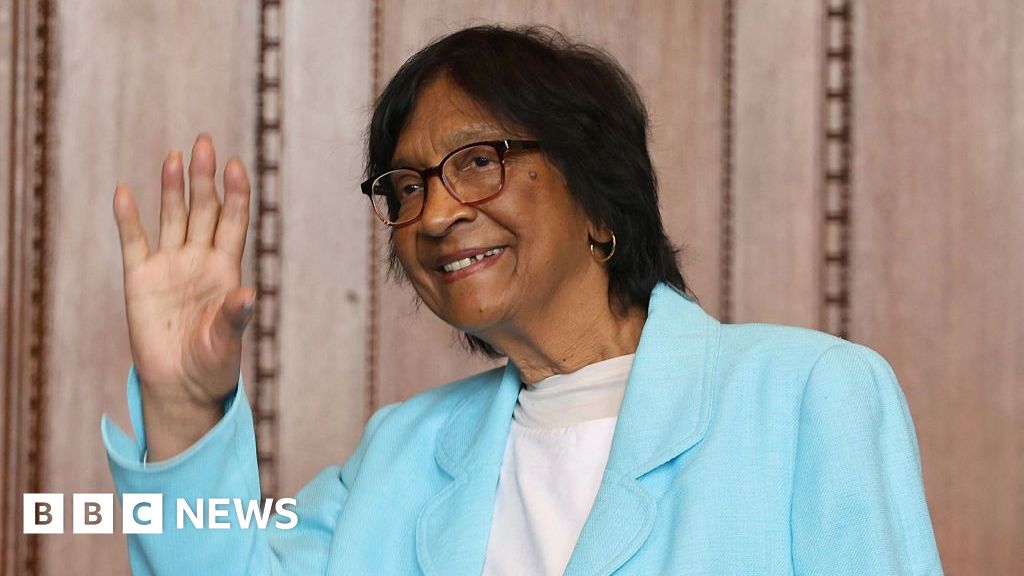
Former UN human rights chief and International Court of Justice judge Navi Pillay has been awarded the 2026 Nobel Peace Prize.
The South African judge was recognised "for her efforts to promote peace and international law", which paved the way for a "more comprehensive global legal order", the Nobel committee said.
Pillay, 85, has taken part in high-profile work considering allegations of human rights violations during a decades-long career, including in Rwanda, Myanmar and Gaza.
Her early work included defending anti-apartheid activists in South Africa, and on Friday she became the country's fifth Peace Prize winner - following in the footsteps of Nelson Mandela and Archbishop Desmond Tutu.
Pillay's work had been "instrumental in ensuring that war crimes, crimes against humanity, and genocide are prosecuted", said the chair of the Norwegian Nobel Committee Jørgen Watne Frydnes.
"Navi Pillay's commitment to universal legal principles and her firm moral compass are constants in a long career," he said.
"At a time of existential challenges - including more wars and conflicts than the world has seen in a long time - international law is no longer just a supplement to peace and security. It is an absolute necessity."
Frydnes said the committee had not been able to notify Pillay that she had won in advance, "so my message to her would be 'if you see a Norwegian number calling, please pick up'".
Shortly afterwards, Pillay reacted to the news from Nuremberg's Palace of Justice by saying "it must be a joke" and thanked those who had gathered to applaud her.
"If you clap a little bit more I may share this prize with Trump," she joked. Last year's winner, Venezuelan opposition leader María Corina Machado, gave her medal to the US president in January as "recognition for his unique commitment with our freedom" .
Pillay dedicated her award to "all the survivors of international crimes" and the practitioners of international justice "whose compassion and courage continue to ensure that impunity will not be allowed to reign".
Navanethem "Navi" Pillay grew up in South Africa during apartheid as a bus driver's daughter in a poor Indian section of Durban.
She went on to become the first woman to establish a law practice in Natal Province in 1967, and later the first non-white woman to be appointed to the country's high court.
Pillay served as a judge on the UN-backed International Criminal Tribunal for Rwanda - focused on the 1994 genocide in which 800,000 people were killed - including four years as its president. She was elected to the International Criminal Court in 2003.
From 2021-25, she chaired the UN Independent International Commission of Inquiry on the Occupied Palestinian Territory - a fact-finding body established by the UN Human Rights Council to investigate alleged violations of international law.
The commission concluded that Israel had committed genocidal acts in Gaza and that Israeli Prime Minister Benjamin Netanyahu, and his former defence minister Yoav Gallant, had "incited the commission of genocide" in their speeches and statements.
The three-member expert panel did not speak officially for the UN and had no legal authority. Israel rejected its findings and accused the three members of the commission of serving as "Hamas proxies".
The panel had previously concluded that Hamas and other Palestinian armed groups committed war crimes and other grave violations of international law on 7 October 2023, in which about 1,200 people were killed and another 251 taken hostage. The same report also accused Israel of war crimes.
Reacting to Pillay's award on Friday, Israel's Foreign Ministry said it represented a "grotesque weaponisation of an award to legitimise anti-Israel hatred and prejudice".
It said in a statement: "Her role in the relentless, politically motivated demonisation of Israel and promotion of the genoLIE speaks volumes."
Frydnes said the Nobel organisation was not taking a position on whether the Israeli offensive in Gaza amounted to genocide.
Pillay is currently a judge on the International Court of Justice (ICJ) in the case where Myanmar stands accused by The Gambia of genocide against the Rohingya people.
Myanmar has denied deliberately trying to destroy the minority Muslim population, with a government representative telling the court in January that the allegation was "unsubstantiated" .
UN human rights chief Volker Turk said Pillay's recognition was "a reaffirmation that human rights, the rule of law and justice, and accountability are fundamental to everything, to peace, to security, and prosperity".
Meanwhile, UN Secretary General António Guterres said she had been "a steadfast, independent voice of justice amidst some of the most historic international legal cases of our time".
South Africa's President Cyril Ramaphosa said she had been a "pioneering defence attorney for anti-apartheid activists" who had worked to "uphold human dignity and bring hope in South Africa and to peoples globally".
Amnesty International secretary general Agnès Callamard said she was with Pillay when she learned she had won - and called her an "inspired choice" for the award.
"At a time when both international law and justice are under attack, when too many states attempt to hollow them out, her Nobel Peace Prize could not come at a better time," she said.
Topics in this story
Gathered from external sources. Rights to this text belong to whoever originally published it.