Civics students say one of the biggest obstacles is sitting in the next seat
Among students who self-censored, 91 percent cited classmates as a concern.
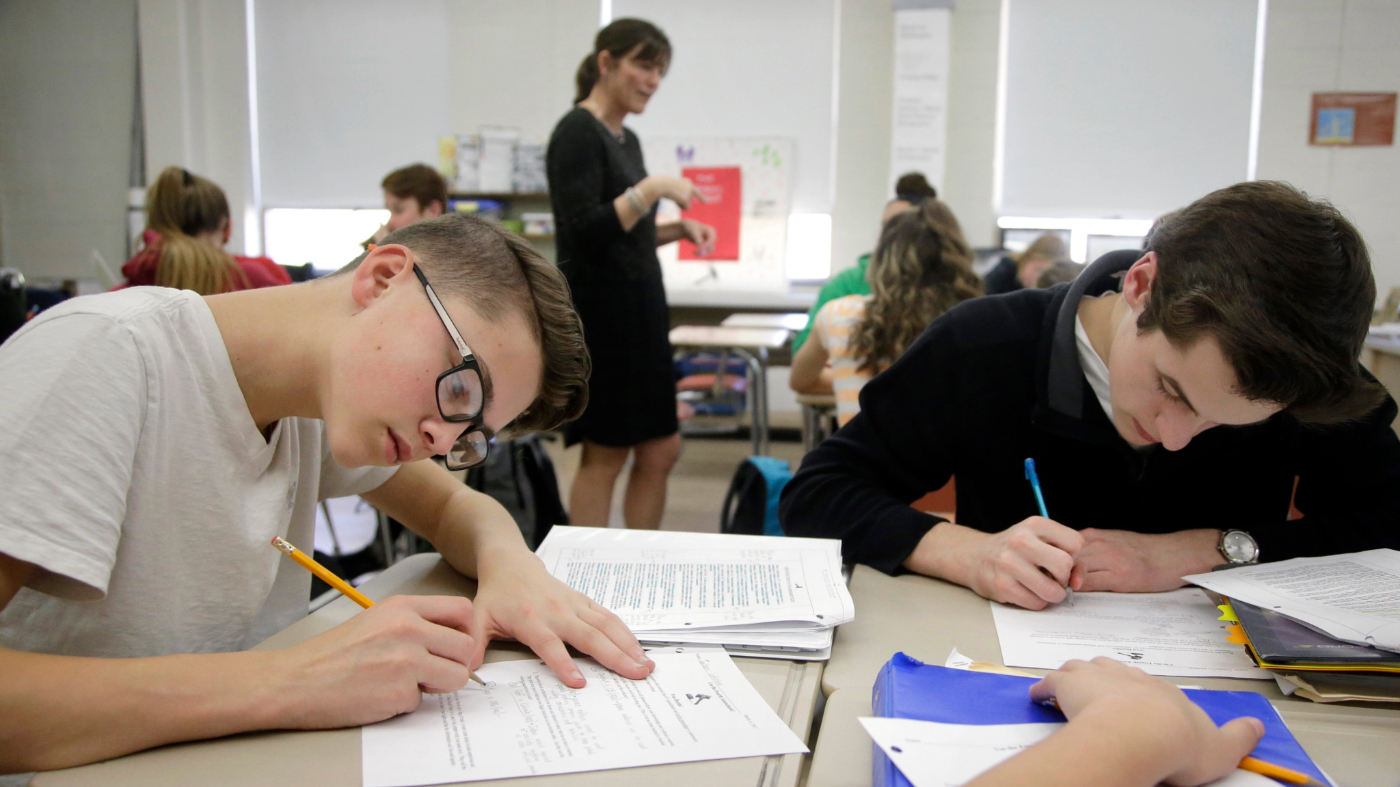
States across the country are adding civics requirements.
Iowa’s new law makes passing a test drawn from the naturalization exam a condition of graduation starting this fall. Kentucky’s 2024 law , now in effect, requires a civic literacy course or a 100-question civics test. Alaska wrote civics into the diploma in June . Mississippi passed a law in April that folds civics into required coursework starting in 2027.
The District of Columbia’s own requirement takes a different form. Its social studies standards, in effect since 2024, name “ engaging in civil discourse and taking informed action ” as a core practice, and its required government and civics course ends in an advocacy capstone: “Analyze the origins of a public policy issue, and present a proposal defending a position or invoking a call to action at the local, state or national level.”
These requirements strengthen civic knowledge and, in some cases, civic practice. A survey by my organization, the Sandra Day O’Connor Institute, points to a question that formal requirements cannot answer on their own: whether students will actually enter a disagreement.
This summer, we surveyed recent high school graduates who had attended school in 25 states and Washington, D.C., about how their civics classes handled disagreement. Fifty-eight percent said they had self-censored rather than say what they really thought about a political or civic topic because they were concerned about how others might react.
These were not, for the most part, students describing hostile classrooms. Seventy-three percent said they generally felt comfortable sharing honest views. Yet 51 percent of that comfortable group had still self-censored at least once, which suggests the silence was often situational. A room can be open in general and closed on a particular question.
One student who attended high school in Washington, D.C. described “the lack of the comfortable space to talk about those things” when contested topics came up and said that was “why people would want to refrain from saying anything.”
The most striking finding was about whom they were worried about. Among students who self-censored, 91 percent cited classmates as a concern. Forty-one percent cited the teacher. That reorders a familiar debate that often turns on adults: teachers, administrators, parents, legislators. The students were pointing at the desks around them.
A similar reluctance appears among young adults more broadly: in Harvard’s Fall 2025 Youth Poll , 47 percent of Americans ages 18 to 29 said they avoided political conversations because they worried about how others would react.
Why does self-censoring matter? Because civic education has two related tasks. Students need to know how the American government works, and they need to practice what citizenship asks of them: forming a view, explaining it, hearing an opposing argument and working through the disagreement.
But an opinion withheld because speaking seems socially costly never gets tested against evidence or against a classmate’s objection, and the student loses a chance to practice the part of citizenship that happens among other people.
Teachers remain central because they help shape the conditions in which peer pressure operates. Fifty-three percent of respondents in our survey had at least sometimes seen a teacher avoid, cut short or shut down a political or current-events discussion. In our 2025 survey of civics teachers , nearly 80 percent said they had self-censored or avoided certain topics because they feared pushback or controversy. These findings suggest caution on both sides of classroom discussion.
The research the report cites helps explain why classmates loom so large. One study of 10th grade social studies classes built around controversial issues found that students’ perceptions of their peers influenced participation more than the teacher’s behavior did. Other research finds that students can misread those peer norms. What they assume classmates think and what classmates actually think do not always match.
The report’s recommendations can be carried out inside any classroom, including Washington D.C.’s capstone course. Ask students, anonymously, whether a classmate who voices an unpopular opinion should still be treated with respect, and whether they think most classmates agree. Ask where students support the norm but assume their peers do not. Sharing the results may help correct the misperception. Let students argue an assigned position, or submit an opening response without a name attached, before they are asked to speak for themselves.
Because 26 percent of those who self-censored worried about being discussed or posted about on social media, make it an expectation that classmates’ remarks are not recorded, posted or circulated out of context. And train teachers in the peer dynamics of a discussion, not only its technique: when to protect a minority view, and when to step in.
A civics test can confirm that a graduate knows the three branches of government. It cannot confirm that she will defend an unpopular view to a classmate and still be on speaking terms afterward. Our survey suggests that willingness cannot be taken for granted.
Liam Julian is chief of programs and public policy at the Sandra Day O’Connor Institute, a nonpartisan nonprofit founded by Justice Sandra Day O’Connor. The Institute’s new report, “Why Are Students Self-Censoring in Civics Class?,” is available at oconnorinstitute.org/research2026 .
Topics in this story
Gathered from external sources. Rights to this text belong to whoever originally published it.